Moved by Community: East Side Evolution
Let’s go back a bit. In addition to making Buffalo a major grain port and industrial hub, the Erie Canal and railroads drew thousands of immigrants. Irish settlers arrived in the 1820s, followed by Germans in the 1830s, then Polish and Italian immigrants in the 1880s. African Americans were also moving northward, although their numbers wouldn’t really rise until after the Civil War. Together with a booming economy, these communities fueled Buffalo’s growth into the 20th century.
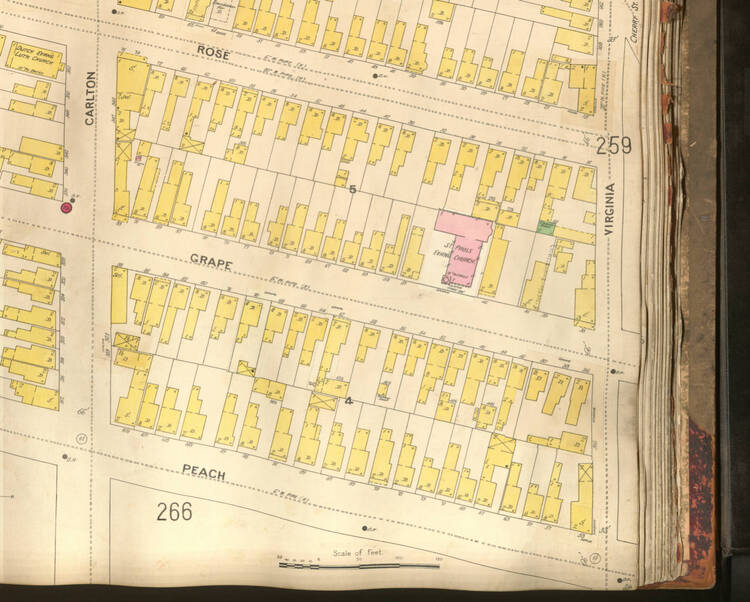
From the mid-1800s to early 1900s, the East Side was mostly German in character, with a few exceptions. The area closest to downtown became known as the Fruit Belt, which takes its name from the large number of orchards the first residents planted in the area. Lemon, Grape, Peach, Cherry and Orange streets remain as testimony to the early nature of the neighborhood. The German population included Lutherans who had traveled from southern Germany to escape religious persecution there. They would erect churches such as Trinity Old Lutheran Church, initially founded in 1839, and St. Andrews Evangelical Lutheran Church, built in 1885.
Two decades after the German neighborhoods were established, Black Americans began creating their own neighborhoods and community north of the Fruit Belt, including the historic Michigan Street Baptist Church. The now historic church would become the center of Buffalo’s abolitionist movement and, later, an icon in the Civil Rights era.
Further east, Polish immigrants began to lay down roots after the original St. Stanislaus Bishop & Martyr Church was constructed in 1874. They would make the area of Broadway and Fillmore Avenue their home, where they built the sixth-largest Polish American community in the nation. Community anchors like the Broadway Market, Adam Mickiewicz Library and Dramatic Circle, Polish Cooperative Savings and Loan Association, and Dom Polski (“Polish Home”) civic center served the neighborhood. Multiple Roman Catholic churches – Corpus Christi, Saint Adalbert Basilica, and Saint Stanislaus -- tended to their Polish American flocks. Local taverns were numerous. In years to come, places like Arty's Grill and R&L Lounge would provide traditional Polish dishes.
Over time, as the Black population grew and expanded beyond the Michigan and William Street area, the still rising numbers of German immigrants began moving along Genesee Street into Broadway-Fillmore and the greater East Side. By the end of World War I, the German character of the Broadway-Fillmore neighborhood had begun to vanish, while the community’s Polish immigrant roots remained and grew.
By the mid-1960s, Buffalo’s German and Polish populations had largely moved to the suburbs, replaced by growing numbers of Black Americans. Today in Broadway-Fillmore, African Americans are now the long-term residents, alongside new Americans including Bengali, Yemeni, and Burmese populations. After decades of disinvestment, initiatives such as the Regional Revitalization Partnership and East Side Avenues -- which focus on commercial, historic, and community development -- are providing the economic and planning resources to breathe new life Broadway-Fillmore and the East Side.
But in 1925, that population shift in Broadway-Fillmore hadn’t happened yet. The Polish American residents had spent decades building their community, and were happy living, worshiping, and working in the welcoming spaces they had created. And change was coming that would redefine Broadway-Fillmore and Buffalo forever.
Historic map courtesy of NYHeritage.org.
-
An Introduction to the Tour
-
Meet the Narrator: Drew Canfield
-
Welcome to Buffalo Central Terminal
-
Meet the Narrator: Dr. Ursuline Bankhead
-
The Rise of Buffalo's Railways
-
Meet the Narrator: Thea Hassan
-
Location, Location, Location
-
Meet the Narrator: Terry Alford
-
Moved by Community: East Side Evolution
-
The Big Build: 1926-1929
-
An Art Deco Icon
-
BONUS: The Grandest of Openings
-
BONUS: The Way Things Were
-
Meet the Narrator: Robby Takac
-
A Welcoming Sight: The Entry Plaza
-
Meet the Narrator: I'Jaz J'aciel
-
BONUS: Mafia Ties
-
What’s In a Name? The Connecting Streets
-
The Jewel: The Main Terminal Building
-
A Vision of Beauty: The Passenger Concourse
-
Waiting Never Felt So Good
-
A Passenger’s Point of View
-
Mail, Packages, and Baggage Galore
-
Neither Snow nor Rain nor Heat nor Gloom of Night…
-
The First Building: Railway Express Agency Terminal Building
-
Easy Access: The Train Concourse and Platforms
-
Open For Business: The First 25 Years (1929-1954)
-
BONUS: A Gateway For Black Americans
-
BONUS: The War Years
-
Harbingers of the Coming Collapse
-
Final Boarding Call: The Last 25 Years (1955-1979)
-
A Light at the End of the Tunnel
-
All Aboard for a New Journey