BONUS: The Way Things Were
The Central Terminal grounds that opened in 1929 were larger than the current footprint. It was a massive 70-acre complex. In addition to the Main Terminal Building, the Mail & Baggage Building, the Train Concourse and Platforms, and the Railway Express Building, there were multiple auxiliary buildings and support structures. There was a power plant, two signal stations and their adjacent repair shops, two utility buildings, a one-story structure sheltering the opening to the truck ramp, a service building for Pullman train cars, a coach shop with inspection pits and carpentry shops, an icehouse, and an 11-track coach yard. The Post Office wouldn’t be completed until 1930.
The three-story power plant was located approximately 300 feet east of the Main Terminal building. It provided heat, light, and power for every building on the site.
The signal stations were two-story buildings that housed the station’s complex safety controls. Immediately west of each signal station was a one-story repair shop. The utility buildings were small, one-story structures located at the east and west ends of the central train platforms. Each of the fourteen train platforms were 22 feet wide and sheltered by individual canopies rather than large train sheds. The canopies protected passengers from rain and snow while admitting ample light and air.
The new station tracks were spiked to wooden blocks set in concrete slabs troughed to the center to allow the tracks to be flushed.
Some of the infrastructure of the Central Terminal site was unique in world railroad station design.
The three-story power plant was a vital part of the Terminal, with three boilers, each standing 28 feet high.
It had the world’s largest Signal Plan for the new depot, with its two towers, Tower 48 and 49, directing 1,400 train movements daily.
Other unique designs in the Central Terminal includes the use of “Cementile” (a precast fireproof tile furnished by the American Cement and Tile Manufacturing Company of Pittsburgh) on the roof, the restaurant which could serve 250 people, and a direct connection to the nearby stock yards.
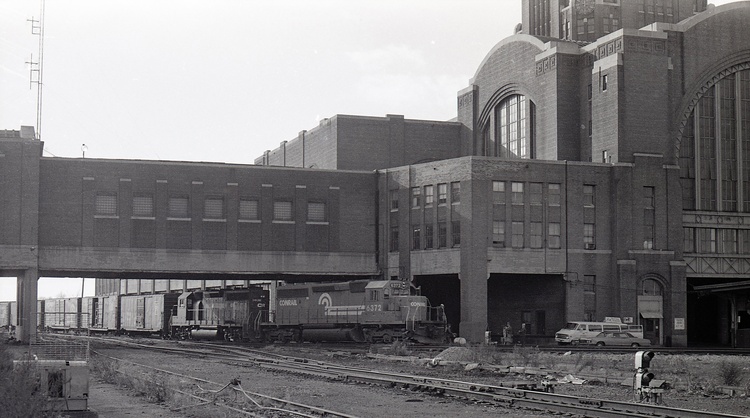
The Central Terminal’s Pullman Service Building, Coach Shop, Ice House, and Power House were demolished to reduce taxes and maintenance in 1966. In 1981, the bridge between the Main Terminal Building and the Train Concourse was removed, severing the connection so that the new higher freight cars could pass. Although these structures may have been lost to time, they all contributed to the efficiency of the Central Terminal. They may be gone, but they’re not forgotten.
Photo courtesy of Ken Kraemer.
-
An Introduction to the Tour
-
Meet the Narrator: Drew Canfield
-
Welcome to Buffalo Central Terminal
-
Meet the Narrator: Dr. Ursuline Bankhead
-
The Rise of Buffalo's Railways
-
Meet the Narrator: Thea Hassan
-
Location, Location, Location
-
Meet the Narrator: Terry Alford
-
Moved by Community: East Side Evolution
-
The Big Build: 1926-1929
-
An Art Deco Icon
-
BONUS: The Grandest of Openings
-
BONUS: The Way Things Were
-
Meet the Narrator: Robby Takac
-
A Welcoming Sight: The Entry Plaza
-
Meet the Narrator: I'Jaz J'aciel
-
BONUS: Mafia Ties
-
What’s In a Name? The Connecting Streets
-
The Jewel: The Main Terminal Building
-
A Vision of Beauty: The Passenger Concourse
-
Waiting Never Felt So Good
-
A Passenger’s Point of View
-
Mail, Packages, and Baggage Galore
-
Neither Snow nor Rain nor Heat nor Gloom of Night…
-
The First Building: Railway Express Agency Terminal Building
-
Easy Access: The Train Concourse and Platforms
-
Open For Business: The First 25 Years (1929-1954)
-
BONUS: A Gateway For Black Americans
-
BONUS: The War Years
-
Harbingers of the Coming Collapse
-
Final Boarding Call: The Last 25 Years (1955-1979)
-
A Light at the End of the Tunnel
-
All Aboard for a New Journey