An Art Deco Icon
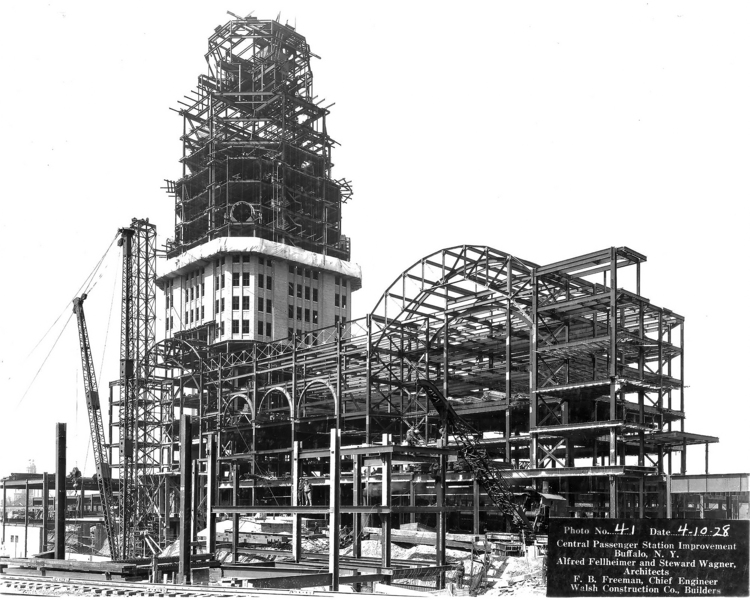
As construction moved forward, the beauty of the new transport hub quickly became clear as Fellheimer & Wagner brought their vision to life. Like New York’s Grand Central Terminal and Erie’s Union Station, Fellheimer & Wagner designed the Buffalo Central Terminal in the Art Deco style that was, as they said at the time, the bee’s knees. Art Deco is pretty easy to spot because of its bold, geometric forms and rich material palettes and often include a vertical element like our Tower. In terms of designs—think straight lines, zigzags, chevrons, and even stylized floral patterns. For the materials, think concrete, smooth stone, and metal, with pops of terra cotta and glass.
In the Passenger Concourse, other Art Deco elements stand out, including the use of bright, vivid colors; textured glass; and colored mirrors. As for the Tower, the architects elected to set the upper levels ablaze with light, making it visible up to 15 miles away. Lighted clocks on each of the Tower’s four faces ensured that passengers always knew what time it was.
Construction was completed in June of 1929, with the grand opening held on June 22. In the end, the Central Terminal cost $15 million -- which is roughly $275 million in today’s dollars -- and it was designed to handle over 200 trains and 10,000 passengers daily. The Central Terminal’s raised position allows it to overlook the downtown skyline – including Buffalo's other Art Deco masterpiece, City Hall, which began construction three months after the Central Terminal opened! The Central Terminal is perfectly placed in a way that the designers couldn’t have anticipated: our Buffalo Central Terminal is visible from all four major thruways in the area, all of which would be built decades later.
Photo courtesy of the Brian Angevine Collection.
-
An Introduction to the Tour
-
Meet the Narrator: Drew Canfield
-
Welcome to Buffalo Central Terminal
-
Meet the Narrator: Dr. Ursuline Bankhead
-
The Rise of Buffalo's Railways
-
Meet the Narrator: Thea Hassan
-
Location, Location, Location
-
Meet the Narrator: Terry Alford
-
Moved by Community: East Side Evolution
-
The Big Build: 1926-1929
-
An Art Deco Icon
-
BONUS: The Grandest of Openings
-
BONUS: The Way Things Were
-
Meet the Narrator: Robby Takac
-
A Welcoming Sight: The Entry Plaza
-
Meet the Narrator: I'Jaz J'aciel
-
BONUS: Mafia Ties
-
What’s In a Name? The Connecting Streets
-
The Jewel: The Main Terminal Building
-
A Vision of Beauty: The Passenger Concourse
-
Waiting Never Felt So Good
-
A Passenger’s Point of View
-
Mail, Packages, and Baggage Galore
-
Neither Snow nor Rain nor Heat nor Gloom of Night…
-
The First Building: Railway Express Agency Terminal Building
-
Easy Access: The Train Concourse and Platforms
-
Open For Business: The First 25 Years (1929-1954)
-
BONUS: A Gateway For Black Americans
-
BONUS: The War Years
-
Harbingers of the Coming Collapse
-
Final Boarding Call: The Last 25 Years (1955-1979)
-
A Light at the End of the Tunnel
-
All Aboard for a New Journey