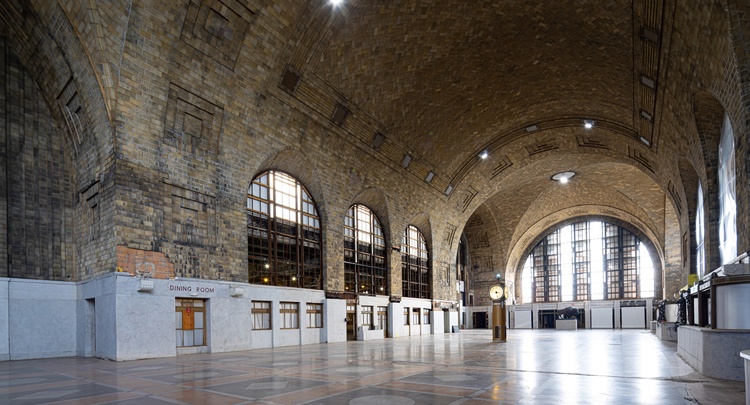
A Vision of Beauty: The Passenger Concourse
The Passenger Concourse, with its arched windows, was the heartbeat of the Central Terminal. Passengers arrived and departed, and families gathered to greet or say farewell to loved ones traveling near and far. The Concourse is known by architectural critics as “one of the greatest public spaces in Buffalo,” and it lived up to the name, with 24/7 activity. The Concourse is 66 feet wide and 225 feet long, the center of which is parallel to and directly over Curtiss Street. The Concourse’s arched ceilings rise 58.5 feet above the floor, while the vaulted sections are 63.5 feet tall.
A layer of sound-absorbing Akoustolith below the Guastavino tiles, as well as the cork-infused "vibration mats" in the floor, curbed acoustic problems caused by the vastness of the space and the movement of trains and people.
The Passenger Concourse had pretty much the feel of a modern airport: 24 hours of hustle and bustle. A combination restaurant, lunch counter, and coffee shop. A liquor store. Waiting Room. Women’s Lounge. Soda fountain. Barber shop. Ladies' hair salon. Drug store. Florist. Fruit shop. Post Office station. Shoe repair shop. Newsstands. A watchmaker. Lockers. A bank of telephones. A women's apparel shop. And a Traveler's Aid booth.
A central information booth housed a 14-foot-tall, four-sided clock reminiscent of the Golden Clock at New York City's Grand Central Terminal. The clock was one of the great meet-up locations, with patrons and visitors using it as an identifiable place to meet up amidst the bustle of activity. The clock features a glass globe that could be lit a radiant green that was a silent signal from the New York Central Railroad police. When the police knew of a criminal being transferred by train, they quietly notified shopkeepers by lighting the clock. The clock was sold off after the station closed and, after ending up in antique shops across America, was eventually located in Chicago. It was later purchased with the aid of supporters including WBEN Radio and M&T Bank. It was then returned to Buffalo, repaired, and once again graces the Passenger Concourse.
The Passenger Concourse’s 18 ticket windows featured beautiful bronze grillwork in geometric patterns. Metal finials in fleur-de-lis patterns sat atop pilasters flanking the windows. From there, the ticket sellers could make calls – yes, they had telephones back in 1929! – they could make calls to the people who would set up reservations in the Pullman train cars. Red-capped porters would take the luggage a short walk from the ticket windows to the baggage checkroom, which had a clever spiral-chute connection to the track-level baggage room below.
A famous resident of the Concourse was Stuffy, the plaster-and-metal statue with the preserved buffalo hide. Servicemembers deploying in World War II would rub his nose or take tufts of his hair for good luck. All of the physical attention Stuffy received left him looking a bit ragged, and he headed home to the Buffalo Science Museum in 1945. Plans for a perfect duplicate were thwarted by wartime material restrictions, so gold-painted plaster was used instead of metal. Stuffy’s successor stood guard over the Concourse for 30 years until he was destroyed by vandals. In the early 1990s, the University at Buffalo located the original artist’s mold, so now the Concourse has its third bison, which is painted bronze!
Photo courtesy of K.C. Kratt Photography.
-
An Introduction to the Tour
-
Meet the Narrator: Drew Canfield
-
Welcome to Buffalo Central Terminal
-
Meet the Narrator: Dr. Ursuline Bankhead
-
The Rise of Buffalo's Railways
-
Meet the Narrator: Thea Hassan
-
Location, Location, Location
-
Meet the Narrator: Terry Alford
-
Moved by Community: East Side Evolution
-
The Big Build: 1926-1929
-
An Art Deco Icon
-
BONUS: The Grandest of Openings
-
BONUS: The Way Things Were
-
Meet the Narrator: Robby Takac
-
A Welcoming Sight: The Entry Plaza
-
Meet the Narrator: I'Jaz J'aciel
-
BONUS: Mafia Ties
-
What’s In a Name? The Connecting Streets
-
The Jewel: The Main Terminal Building
-
A Vision of Beauty: The Passenger Concourse
-
Waiting Never Felt So Good
-
A Passenger’s Point of View
-
Mail, Packages, and Baggage Galore
-
Neither Snow nor Rain nor Heat nor Gloom of Night…
-
The First Building: Railway Express Agency Terminal Building
-
Easy Access: The Train Concourse and Platforms
-
Open For Business: The First 25 Years (1929-1954)
-
BONUS: A Gateway For Black Americans
-
BONUS: The War Years
-
Harbingers of the Coming Collapse
-
Final Boarding Call: The Last 25 Years (1955-1979)
-
A Light at the End of the Tunnel
-
All Aboard for a New Journey