The Big Build: 1926-1929
In 1925, New York Central Railroad and the City of Buffalo had found the perfect site for their new railway transportation hub: Close to existing rail lines, close to downtown, roughly halfway between New York City and Chicago -- and right on the edge of Buffalo’s Polish American community. While part of the site included existing New York Central Railroad property and an old West Shore Railroad embankment, it also covered residential streets, dozens of homes, and Polonia Park — a beloved recreational space. Over the next year, New York Central worked to acquire the land needed to build the new railway hub. Properties were transferred, purchased, and foreclosed upon. Despite protests from the Polish American community, many of whom did not speak English, the city acquired 150 residential lots, with 190 homes – each housing five to six families -- as well as Polonia Park.
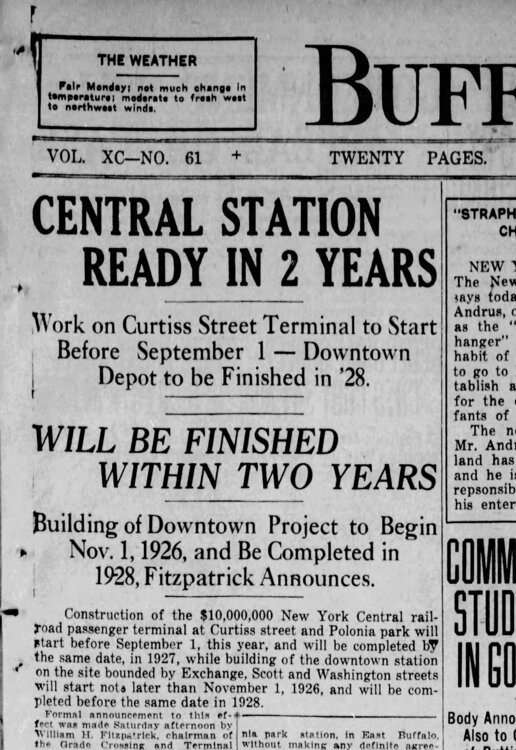
Groundbreaking took place on March 29, 1926, with Iowa-based Walsh Construction Company coming aboard as the contractor in April. Over the next 18 months, a flurry of site and track work took place: Workers cleared the area and leveled out the grounds. They also installed drainage systems, expanded a viaduct on William Street for more tracks, and reconstructed water mains and sewers. As part of a new street layout, Curtiss Street was moved 200 feet to the north; a new street, Lindbergh Drive, was built; and a new underpass south of the site would allow William Street (the most direct connection to downtown) to cross under New York Central’s main rail line. Oh, and they moved 30 miles of existing track, and built an additional 31 miles of new track!
While this was ongoing, a question remained: Who would design the new railroad hub? In 1927, New York Central Railroad chose the architectural firm of Fellheimer & Wagner. Alfred T. Fellheimer was already a big name—he’d been the lead architect on New York City’s Grand Central Terminal, and he and partner Steward Wagner had just finished Union Station in Erie, Pennsylvania. They would later design other major terminals like Union Terminal in Cincinnati and Union Station in Utica, New York.
The team was complete: Fellheimer & Wagner crafted the vision; New York Central’s engineers worked with Walsh Construction to bring it to reality. Construction on the buildings began on August 3, 1927. Steel was supplied by Bethlehem Steel, and ironwork was done by Premier Fireproofing, owned by Otto Klotz. The last rivet on the structural steel was driven in December 1928.
Fellheimer & Wagner designed the Main Terminal Building, Entry Plaza, Parking Structure, and the Mail & Baggage Building. Walsh Construction and New York Central’s engineers joined forces on the auxiliary buildings, which included signal towers, signal repair shops and small utility buildings. The Post Office Building wouldn’t be built until later, opening in 1930.
Photo courtesy of Newspapers.com.
-
An Introduction to the Tour
-
Meet the Narrator: Drew Canfield
-
Welcome to Buffalo Central Terminal
-
Meet the Narrator: Dr. Ursuline Bankhead
-
The Rise of Buffalo's Railways
-
Meet the Narrator: Thea Hassan
-
Location, Location, Location
-
Meet the Narrator: Terry Alford
-
Moved by Community: East Side Evolution
-
The Big Build: 1926-1929
-
An Art Deco Icon
-
BONUS: The Grandest of Openings
-
BONUS: The Way Things Were
-
Meet the Narrator: Robby Takac
-
A Welcoming Sight: The Entry Plaza
-
Meet the Narrator: I'Jaz J'aciel
-
BONUS: Mafia Ties
-
What’s In a Name? The Connecting Streets
-
The Jewel: The Main Terminal Building
-
A Vision of Beauty: The Passenger Concourse
-
Waiting Never Felt So Good
-
A Passenger’s Point of View
-
Mail, Packages, and Baggage Galore
-
Neither Snow nor Rain nor Heat nor Gloom of Night…
-
The First Building: Railway Express Agency Terminal Building
-
Easy Access: The Train Concourse and Platforms
-
Open For Business: The First 25 Years (1929-1954)
-
BONUS: A Gateway For Black Americans
-
BONUS: The War Years
-
Harbingers of the Coming Collapse
-
Final Boarding Call: The Last 25 Years (1955-1979)
-
A Light at the End of the Tunnel
-
All Aboard for a New Journey