BONUS: A Gateway For Black Americans
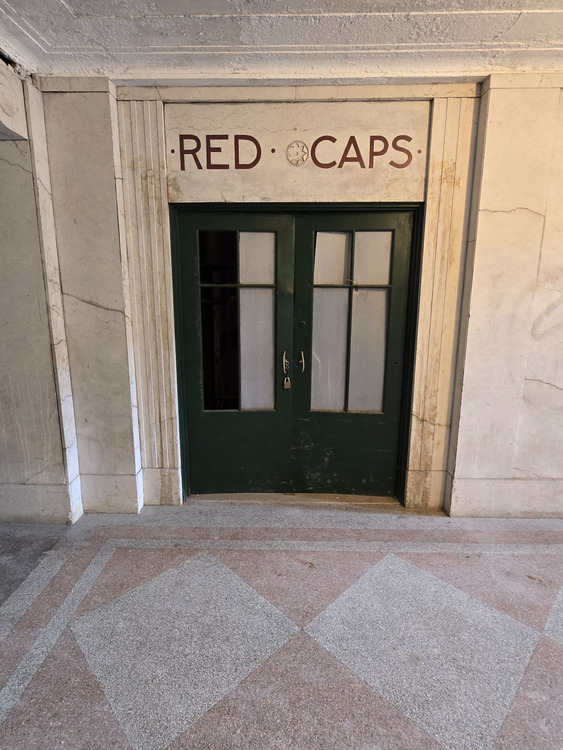
By the way, one of the most common sights in train stations were Red Caps, and the Central Terminal was no different. The mostly Black army of railroad employees was highly visible due to their red headgear, which allowed passengers to tell them apart from other railroad workers.
Many Red Caps were members of the Brotherhood of Sleeping Car Porters, the first successful African American-led labor union in the nation. In modern terms, they would be called baggage handlers, although they were much more than that. In addition to carrying passengers' baggage while leading them to their berth, porters also provided personal services, such as pressing clothes, shining shoes, and calling cabs. The pay from these positions helped elevate many Black families to the middle class.
The importance of the Central Terminal to local and national Black history can’t be overstated. Black musicians came through here to jam at the Colored Musicians Club. Many of them frequently traveled from here to New York City and back, helping fuel the Harlem Renaissance. Louis Armstrong. Count Basie. Billie Holiday. Duke Ellington. Nat King Cole. Ella Fitzgerald. Dizzy Gillespie. Earl Hines. Mary Lou Williams. The names go on and on.
Between the end of the Civil War and 1970, Black Americans fled the former Confederate states to escape violence and state-sponsored oppression. This Great Migration to northern cities, including Buffalo, caused a radical population shift.
During the Civil Rights movement of the 1960s, human rights activists came through here before heading to Michigan Street Baptist Church or the Nash House. Civil Rights leaders, like the Rev. Dr. Martin Luther King Jr., likely passed through.
Future Congressman John Lewis, a contemporary of King, likely also had a presence. Lewis, who was raised in the racially segregated South, visited Buffalo in 1951. The 11-year-old Lewis was shocked to see men of different races working side by side at the flour mills and the steel plants. He played with White children in what is now Martin Luther King Park. That experience, Lewis later wrote in his autobiography, inspired him to dedicate his life to desegregation. You can see a mural of Lewis across Memorial Circle.
-
An Introduction to the Tour
-
Meet the Narrator: Drew Canfield
-
Welcome to Buffalo Central Terminal
-
Meet the Narrator: Dr. Ursuline Bankhead
-
The Rise of Buffalo's Railways
-
Meet the Narrator: Thea Hassan
-
Location, Location, Location
-
Meet the Narrator: Terry Alford
-
Moved by Community: East Side Evolution
-
The Big Build: 1926-1929
-
An Art Deco Icon
-
BONUS: The Grandest of Openings
-
BONUS: The Way Things Were
-
Meet the Narrator: Robby Takac
-
A Welcoming Sight: The Entry Plaza
-
Meet the Narrator: I'Jaz J'aciel
-
BONUS: Mafia Ties
-
What’s In a Name? The Connecting Streets
-
The Jewel: The Main Terminal Building
-
A Vision of Beauty: The Passenger Concourse
-
Waiting Never Felt So Good
-
A Passenger’s Point of View
-
Mail, Packages, and Baggage Galore
-
Neither Snow nor Rain nor Heat nor Gloom of Night…
-
The First Building: Railway Express Agency Terminal Building
-
Easy Access: The Train Concourse and Platforms
-
Open For Business: The First 25 Years (1929-1954)
-
BONUS: A Gateway For Black Americans
-
BONUS: The War Years
-
Harbingers of the Coming Collapse
-
Final Boarding Call: The Last 25 Years (1955-1979)
-
A Light at the End of the Tunnel
-
All Aboard for a New Journey