Location, Location, Location
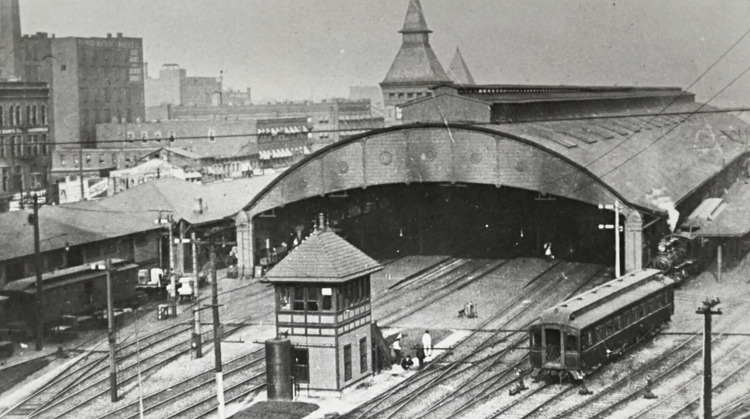
The calls for a new railway hub were nothing new. The debate on where a new train station would be located had been raging for decades. Some wanted to replace the Exchange Street station with an updated and expanded facility at a Hamburg Canal slip located south of and parallel to Exchange Street. Opponents argued that the location lacked enough space, and they had a point. By 1900, Buffalo was second only to Chicago as a top railroad terminus, with seven direct lines linking the city to six East Coast hubs.
Another option presented to the city in 1905 was a site at the base of Genesee Street near the harbor. Supporters said this location put the station in the most accessible part of the city’s business center and place it adjacent to factories and businesses bordering on the Erie Canal. Critics attacked the plan as too expensive and lacking space for future expansion.
In 1907, city and railroad officials suggested a New York Central property on Buffalo’s East Side. The 300-acre property was located under three miles from the Exchange Street station, along the edge of the city’s Polish neighborhood. Repeated attempts at a compromise plan that satisfied the City of Buffalo and the various railroad companies failed.
Amid all the arguments, the city’s railroads continued to grow. By the 1920s, Buffalo had five major railroad stations serving fourteen rail lines. Delays were common, causing delays and raising costs and headaches for passengers and shippers alike. By 1923, the effort for a union station had waned.
On June 21, 1925, Buffalo’s newspapers announced that the City of Buffalo and New York Central Railroad had finally resolved complex issues related to land use, track removals and connections, and grade crossings. They had reached an agreement to erect a new passenger station at Curtiss and Lovejoy streets on a portion of the railroad’s East Side site. The planned site had everything going for it. With Buffalo’s population of 525,000 expected to grow to over 1.5 million, and the city's continued expansion eastward from downtown, the railroad hub would become a central location.
It was close to existing rail lines, close to downtown, but far enough out to speed arrivals from and departures to cities like Niagara Falls, Detroit, New York City and Chicago without needing to transfer to another train. On top of that, it’s important to remember that this was about 20 years BEFORE highways in the United States. A direct route via rail from Detroit and Chicago through Buffalo and on to Niagara Falls and New York City would prove vital to American commerce.
The more centralized location would also have better lines of approach for a larger portion of the population than a downtown station, and trains wouldn’t need to attempt sharp turns at Lake Erie. And it was aligned with the Belt Line.
Also, on the New York Central Railroad system, the site would be roughly halfway between New York City and Chicago, and trains wouldn’t need to back up at a more hectic downtown location. Construction wouldn’t disrupt existing rail services downtown and would relieve street congestion within the central business district.
Lastly, it would be close to several assets already in place. New York Central had its vast freight and stock yards adjacent to the planned site, and the American Railway Express Agency, a national express delivery service, already had a depot on Curtiss Street. The structure, built in 1917, could be integrated into the workings of the new station. Remember: At the time, “express” items were loaded onto passenger, not freight, trains.
Yes, it was the perfect location, save for one issue: The southeast quadrant of the city’s Polish enclave pushed up against the site.
Photo courtesy of the Collection
of the Buffalo History Museum. NY Central Depot.
“Grouping of Public Buildings and Gardens,” 1905.
-
An Introduction to the Tour
-
Meet the Narrator: Drew Canfield
-
Welcome to Buffalo Central Terminal
-
Meet the Narrator: Dr. Ursuline Bankhead
-
The Rise of Buffalo's Railways
-
Meet the Narrator: Thea Hassan
-
Location, Location, Location
-
Meet the Narrator: Terry Alford
-
Moved by Community: East Side Evolution
-
The Big Build: 1926-1929
-
An Art Deco Icon
-
BONUS: The Grandest of Openings
-
BONUS: The Way Things Were
-
Meet the Narrator: Robby Takac
-
A Welcoming Sight: The Entry Plaza
-
Meet the Narrator: I'Jaz J'aciel
-
BONUS: Mafia Ties
-
What’s In a Name? The Connecting Streets
-
The Jewel: The Main Terminal Building
-
A Vision of Beauty: The Passenger Concourse
-
Waiting Never Felt So Good
-
A Passenger’s Point of View
-
Mail, Packages, and Baggage Galore
-
Neither Snow nor Rain nor Heat nor Gloom of Night…
-
The First Building: Railway Express Agency Terminal Building
-
Easy Access: The Train Concourse and Platforms
-
Open For Business: The First 25 Years (1929-1954)
-
BONUS: A Gateway For Black Americans
-
BONUS: The War Years
-
Harbingers of the Coming Collapse
-
Final Boarding Call: The Last 25 Years (1955-1979)
-
A Light at the End of the Tunnel
-
All Aboard for a New Journey