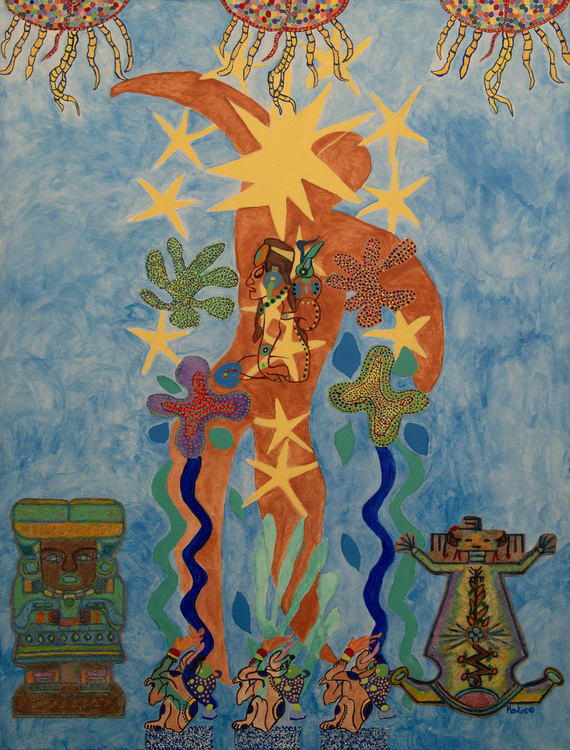
Sylvia Montero: Danza de La Nepantla
This text is by José Antonio Arellano this excerpt was edited and spoken by Cipriano Ortega
Art history’s an important part of Montero’s work. This piece, Danza de La Nepantla, references Matisse’s iconic cut-out Icarus. Matisse started to develop his “cut-out” technique while working on stage sets and costumes for Serge Di-ago-oh-lev ballet company Ballets ROOSS
His Icarus, like Montero’s Nepantla, appears to be dancing—not falling. Whereas “drawing with scissors—cutting directly into colored planes” allowed Matisse to resolve what he perceived as a “conflict between drawing and painting,” Montero instead maintains the “conflict” of media depicted as content.
Montero uses collage on a background of acrylic brushstrokes and depicts her figure with a Mezo-american glyph, on its chest instead of a red heart (as had Matisse). Montero’s glyph appears to name the powerful Mayan goddess Chak Chel.
The Aztec water goddess Chalchiuhtlicue (“she of the jade skirt”) also appears in Danza. Whereas Icarus is surrounded by yellow stars, Montero overlays yellow stars onto her figure as if to situate the source of celestial power within the dancer herself.
-
Anise Aiello: Mother of Waters
-
Monica Aiello: The Rincon
-
Quinn Aiello: Karver/Klassic Powder Surfers
-
Tyler Aiello: Dreissena Series
-
Barbara Baer: Four Rivers
-
Kevin Baer: Reflection Pool
-
Diane Cionni: June 11
-
Katie Elliott: Car Stories
-
Sally Elliott: Huevos de Emú/Huevos de Galinas
-
Gayle Gerson: Tapestree
-
Robert Gray: 20-13, 25-05, 25-04
-
Jamie Gray: Earth's Rays
-
Alysha Burney Haver & Nathan Havey
-
Cipriano Ortega: Oh Cocoa
-
Sylvia Montero: Danza de La Nepantla
-
Tony Ortega: Frida con una Corona de Elotes y Xolos
-
Eliel Saarinen
-
Loja Saarinen
-
Eero Saarinen
-
Lily Swann
-
Susan Saarinen
-
Eric Saarinen
-
The Sink Family
-
Bernice Strawn
-
Ben Strawn: Botticelli's Niece
-
Daniel Strawn: Beam In
-
Mel Strawn
-
Eriko Tsogo