Section 5: Tower Bios of Prominent Black Ranchers & Farmers
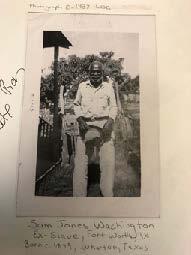
Sam Jones Washington (born 1849)
Us ride to side de leader and crowd him and force him to turn, and keep forcin’ him, and by and by dem critters am runnin’ in de circle. Dat keep dem from scatterment. Dat sho’ dangerous ridin’.
Sam Jones Washington as told to Sheldon F. Gauthier for the Federal Writers’ Project (1936-1938).
Sam Jones Washington learned to ride as “soon’s I cold sit de hoss” and enjoyed riding and roping cattle as well as the good clothes, horse, and saddle that came with working cattle. Washington would “stays out with de cattle mos’ de time.” He tended at least six horses and close to 100 head of cattle and learned to manage stampeding cattle before he was 20 years old.
Washington was born enslaved in Wharton County on a dual plantation that also produced cotton. After emancipation, he worked the same land for wages as a cowboy. Washington continued his work in agriculture as a farmer, then worked in packing plants and raised hogs.
Caption: Sam Jones Washington was photographed by the Works Progress Administration to accompany his interview by the Federal Writers’ Project. He was 88.
Creditline: Library of Congress, Prints and Photographs Division
Caption: A view of Fort Worth meat packing plants, where Washington worked later in life
Creditline: Fort Worth Star-Telegram Collection, University of Texas at Arlington Libraries.
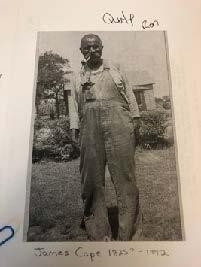
James Cape (1825 – 1942)
When I’s old ‘nough to set on de hoss, dey larned me to ride, tendin’ horses. ‘Cause I’s good hoss rider, dey uses me all de time gwine after hosses. I goes with dem to Mexico. We crosses de river lots of times.
James Cape as told to Sheldon F. Gauthier for the Federal Writers’ Project (1936-1938).
James Cape was recognized for his skill with horses and worked as a wrangler and a cowboy from childhood until late in life. Cape remembered the dangers of driving horses from Mexico in a bad hail storm. He led a group of five riders and 200 horses northward and had to keep the horses from scattering. If his own horse had stumbled, Cape knew that “right dere’s whar I’d still be!”
Cape was born into slavery in Gonzales County, Texas on a “dual plantation.” Cotton and crops were raised in the lowland and cattle were raised on the upland prairie. After the Civil War, Cape returned to Texas and continued to work in the Fort Worth Stockyards until 1928. He lived to be well over 100
years old.
Caption: James Cape was photographed by the Works Progress
Administration to accompany his interview by the Federal Writers’ Project. He was thought to be over 100 years old at the time of his interview.
Creditline: Library of Congress, Prints and Photographs Division
Caption: Stockyards, North Fort Worth, Texas, 1909
Creditline: Jenkins Garrett Texas Postcard Collection, University of Texas at Arlington Libraries
Johana “Chona” Phillips July Wilkes Lasley (1860-1942)
When dey was wild, wild, I would lead ‘em down to the river and get ‘im into the water where he couldn’t stan’ up and an I would swim up and get ‘im by the mane an’ ease up on him. He couldn’t
pitch, and when I did let ‘im out of that deep water he didn’t want to pitch. … but I was young and havin’ a good time. Johana July as told to Florence Angermiller for the Federal Writers’ Project (1936-1938).
Johana July was a horse-trainer and owned a business raising cattle, breaking horses and selling hides. July preferred to ride horses bareback with a simple, braided rope. She learned to calm wild horses by wading them into a river where she could control their movements and wash her clothes all at once.
July was a member of the Black Seminole community, born in October 1860 in Nacimiento de los Negros, Mexico. Her family had been forced to migrate to Oklahoma from Florida and ultimately escaped to Mexico in the 1830s as part of the Indian Removal program of the United States government. After the Civil War, her family returned to the United States near Eagle Pass, Texas, where her father trained horses for the U.S. Army and taught her to hunt, fish and care for animals.
July moved to Bracketville, Texas after 1910 where she raised her children and continued to work training horses. She died in 1942 and is buried in the Seminole Indian Scout Cemetery.
Caption: Johana July was never enslaved, but was photographed and interviewed for the Federal Writers’ Project as an “ex-slave” in Bracketville,Texas in 1937.
Creditline: Library of Congress, Prints and Photographs Division.
The Reverend Mack Williams, Sr. (1914-1998).
There were black cowboys ever since my grandfather got off the boat… you think that the slave owners would have a bunch of blacks there and not put them to work on horses?
Mack Williams, The Other Cowboy Forum, Institute of Texan Cultures, San Antonio, Texas (1997).
The Rev. Mack Williams was proud to have been “born a cowboy” in a pasture on the O’Connor Peach Mott Ranch on the Texas Coastal Bend. Williams descended from a long line of herders and cowboys going back before the Civil War. He worked as a tophand, an experienced and trusted leader who could
handle any job. Growing up in a large family that all worked on the ranches of South Texas, Williams spoke Spanish while working cattle and did not learn English until his late 20s.
After a career as a cowhand, Williams became a preacher and was active in many community organizations, including his Baptist church, the Red Cross, American Cancer Society and he served as
president of the Tivoli Lions Club.
Below are the captions related to the tower images:
Caption: Mack Williams was photographed on the sidewalk behind the Martin O’Connor ranch house in Refugio County, Texas between 1944 and 1945. He is wearing his first pair of boots.
Creditline: UTSA Special Collections.
[Image]
Caption: Williams (right) and friend wearing pistols as they stand in the street.
Creditline: UTSA Special Collections.
Caption: Williams standing next to his portrait, 1989
Creditline: UTSA Special Collections.
George McJunkin (1856-1922).
One of the most significant discoveries in archaeology was made by a black cowboy named George McJunkin. Julie Morrow, Arkansas Archaeological Survey
George McJunkin worked cattle and horses throughout his lifetime and later became known as the discoverer of one of the most important archaeological sites in the United States: the Folsom site in northeastern New Mexico.
McJunkin, born enslaved, worked his way up from breaking horses to foreman of the Crowfoot Ranch near Folsom, New Mexico. While riding the ranch, McJunkin saw bison bones protruding from the dirt. He wrote letters to several institutions to encourage them to examine the site. After McJunkin’s death and fourteen years after he found the bones, the Folsom site was dated to 10,800 years old and proclaimed one of the earliest bison kills in North America. McJunkin’s find demonstrated that people were in the Americas before the end of the Ice Age.
Below are the captions related to the tower images:
Caption: George McJunkin was fluent in English and Spanish. He learned to read by exchanging reading lessons for horse-breaking lessons.
Creditline: Denver Museum of Nature and Science.
Caption: Portrait of George McJunkin.
Creditline: Denver Museum of Nature and Science.
Caption: Flash flood exposure that revealed the bison kill site.
Creditline: Denver Museum of Nature and Science.
-
Black Cowboys: An American Story Entry Object & Panel Section 1
-
Section 2: Who Were Black Cowboys? Men & Women
-
Section 2: Who Were Black Cowboys? Children
-
Section 2: Who Were Black Cowboys? Enslaved
-
Section 2: Who Were Black Cowboys? Black Ranchers
-
Section 2: Who Were Black Cowboys? Recovering Black Cowboys Stories
-
Section 2: Who Were Black Cowboys? African Origins.
-
Section 3: Hector Bazy, Black Cowboy
-
Section 4: Black Cowboys Were Integral to the Texas Economy
-
Section 4: Tower Bios of Famous Black Cowboys
-
Section 4: Where did Black Cowboys Work? The Great Cattle Trails
-
Section 4: Essential Cowboy Skills Cooks & Other Jobs
-
Section 4: Wall Bio Hector Bazy
-
Section 4: Wall Bio Nat Love
-
Section 4: Impact of the Cattle Industry
-
Section 4: Monroe Brackins & Jim Perry Bios
-
Section 5: Black Cowboys - enslaved and free - used their skills to become Black Ranchers and shaped the legacies of Black ranching families
-
Section 5: Tower Bios of Prominent Black Ranchers & Farmers