Section 4: Wall Bio Hector Bazy
Hector “Heck” Bazy (1851-1924)
In telling of the cowboy scenes and incidents, I do so, with modesty. No one, and a man who has lived in the midst of the cowman’s life for years would have the right to do otherwise.
Hector Bazy, Introduction, 1910.
Hector Bazy recorded the story of his life in a 30-page manuscript in 1910. Bazy began working as a cowboy after Emancipation when he was fourteen years old. He describes breaking and training horses, working cattle on ranches, and driving thousands of heads of cattle to Kansas. His manuscript offers a
glimpse at the danger, excitement, and camaraderie of cowboy life.
Throughout his manuscript, Bazy states that white and Black cowboys “made no color distinction when out on the plains.” Yet, he highlights moments of isolation, discrimination and frustration. Bazy recalls attempting to sell horses to a potential buyer that did not believe the horses were his and thought them
stolen. The buyer had Bazy arrested. It was only due to Bazy’s honest reputation that prominent cattlemen convinced the buyer of the error.
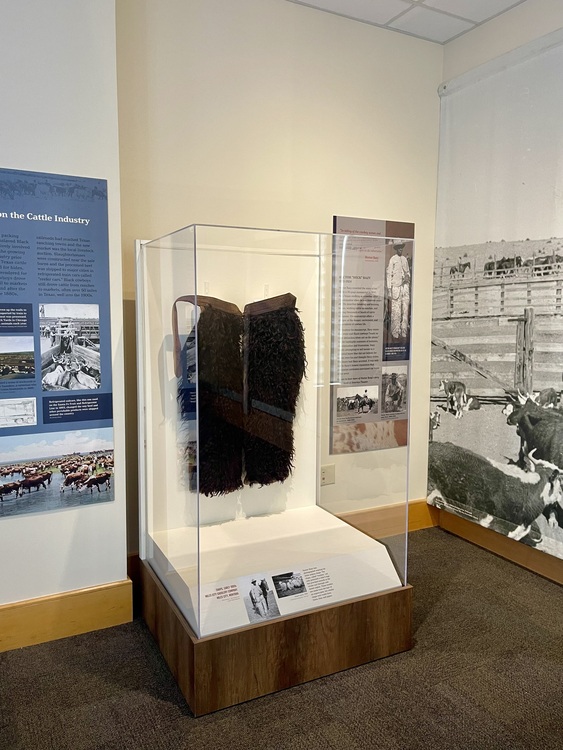
There is an exhibit case with artifact on display. The following is the exhibit label.
OBJECT LABEL: chaps
Chaps, early 1900s
Miles City Saddlery Company
Miles City, Montana
Hector Bazy was photographed wearing his white angora chaps. The chaps, called “woolies,” not only protected a rider’s legs but provided warmth in the winter and through cold desert nights. These woolies are made from the hair of an angora goat, but similar chaps were made from bison, bear, and jaguar.
Witte Museum, The Donald and Louise Yena Collection
Panel images captions follow:
Caption: Hector Bazy’s manuscript includes eleven images documenting his life as a cowboy, 1890-1910.
Creditline: Courtesy Anacostia Community Museum Archives,
Smithsonian Institution.
Caption: Hector Bazy cooking in camp over an open flame, 1890-1910.
Creditline: Courtesy Anacostia Community Museum Archives,
Smithsonian Institution.
Caption: Hector Bazy herds horses and foals on horseback, 1890-1910.
Creditline: Courtesy Anacostia Community Museum Archives,
Smithsonian Institution.
-
Black Cowboys: An American Story Entry Object & Panel Section 1
-
Section 2: Who Were Black Cowboys? Men & Women
-
Section 2: Who Were Black Cowboys? Children
-
Section 2: Who Were Black Cowboys? Enslaved
-
Section 2: Who Were Black Cowboys? Black Ranchers
-
Section 2: Who Were Black Cowboys? Recovering Black Cowboys Stories
-
Section 2: Who Were Black Cowboys? African Origins.
-
Section 3: Hector Bazy, Black Cowboy
-
Section 4: Black Cowboys Were Integral to the Texas Economy
-
Section 4: Tower Bios of Famous Black Cowboys
-
Section 4: Where did Black Cowboys Work? The Great Cattle Trails
-
Section 4: Essential Cowboy Skills Cooks & Other Jobs
-
Section 4: Wall Bio Hector Bazy
-
Section 4: Wall Bio Nat Love
-
Section 4: Impact of the Cattle Industry
-
Section 4: Monroe Brackins & Jim Perry Bios
-
Section 5: Black Cowboys - enslaved and free - used their skills to become Black Ranchers and shaped the legacies of Black ranching families
-
Section 5: Tower Bios of Prominent Black Ranchers & Farmers