Section 4: Impact of the Cattle Industry
From cowboys to rendering plant laborers, enslaved Black workers were actively involved in all aspects of the growing Texas cattle industry prior to the Civil War. Texas cattle were slaughtered for
hides, cut for beef and rendered for tallow. Black cowboys drove cattle up the trail to markets before, during and after the Civil War. By the 1880s, railroads had reached Texas ranching towns and the new market was the local livestock auction. Slaughterhouses were constructed near the sale barns and the processed beef was shipped to major cities in refrigerated train cars called “reefer cars.” Black cowboys still drove cattle from ranches to markets, often over 50 miles in Texas, well into the 1900s.
Panel images captions follow:
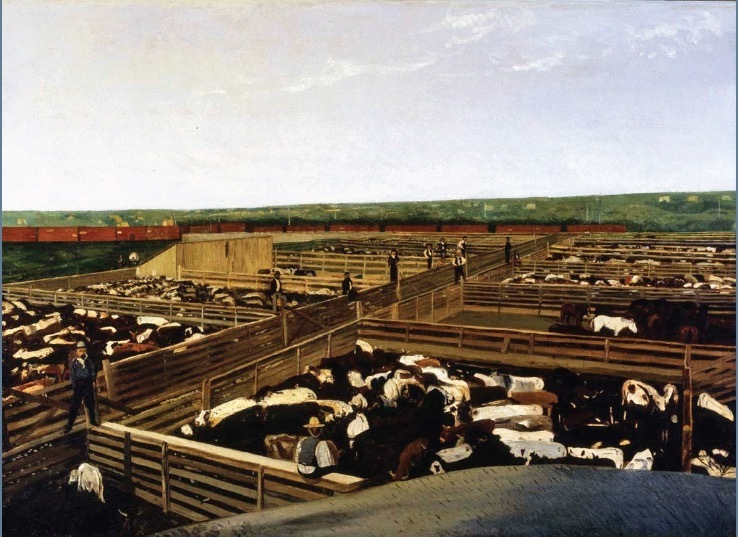
Caption: Soloman Saloman painted a scene of stockyards in San Antonio for George Saunders, a cattleman who helped to establish the Union Stockyards in 1889.
Creditline: Soloman Saloman, The Stockyards, n.d., Witte Museum
Collection.
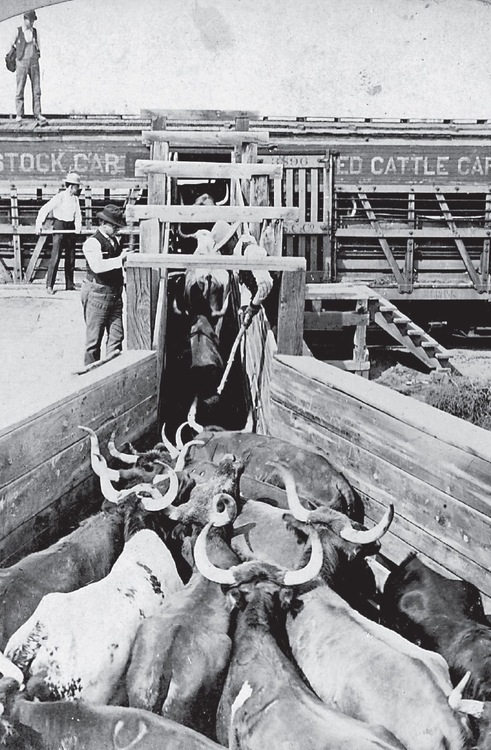
Caption: After cattle were driven up the trails to Kansas, they were
transported by train to Chicago, where their meat was processed. In 1870, the Union Stock Yards in Chicago processed two million animals each year.
Creditline: U.S. National Park Service, Gateway Arch National Park.
Caption: Refrigerated railcars, like this one used on the Santa Fe Fruit and Refrigerator Line in 1893, changed the way beef and other perishable products were shipped around the country.
Creditline: The British Library.
Caption: Image of cattle.
Creditline: The Miriam and Ira D. Wallach Division of Art, Prints and Photographs: Photography Collection, The New York Public Library.
-
Black Cowboys: An American Story Entry Object & Panel Section 1
-
Section 2: Who Were Black Cowboys? Men & Women
-
Section 2: Who Were Black Cowboys? Children
-
Section 2: Who Were Black Cowboys? Enslaved
-
Section 2: Who Were Black Cowboys? Black Ranchers
-
Section 2: Who Were Black Cowboys? Recovering Black Cowboys Stories
-
Section 2: Who Were Black Cowboys? African Origins.
-
Section 3: Hector Bazy, Black Cowboy
-
Section 4: Black Cowboys Were Integral to the Texas Economy
-
Section 4: Tower Bios of Famous Black Cowboys
-
Section 4: Where did Black Cowboys Work? The Great Cattle Trails
-
Section 4: Essential Cowboy Skills Cooks & Other Jobs
-
Section 4: Wall Bio Hector Bazy
-
Section 4: Wall Bio Nat Love
-
Section 4: Impact of the Cattle Industry
-
Section 4: Monroe Brackins & Jim Perry Bios
-
Section 5: Black Cowboys - enslaved and free - used their skills to become Black Ranchers and shaped the legacies of Black ranching families
-
Section 5: Tower Bios of Prominent Black Ranchers & Farmers