Section 4: Monroe Brackins & Jim Perry Bios
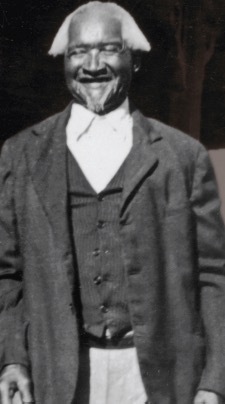
Monroe Brackins (1853 - 1942)
I used to rather ketch up a wild horse and break ‘im than to eat breakfast.
Monroe Brackins to the Federal Writers’ Project, 1936-1938.
Monroe Brackins was a ranch hand in Malone, Texas, where he practiced a technique to break horses. He would climb to the top of the tree and wait with his loop until a horse came by. Brackins would then jump down from the tree onto the horse’s back and continue to ride it until it was too tired to keep
running.
After breaking horses for around 20 years, Brackins bought his own farm in Medina County, where he grew corn, sugar cane and watermelons. He settled near the Tonkawa Creek and raised his children. Brackins was born enslaved in Monroe County, Mississippi and brought to Texas when he was two years old.
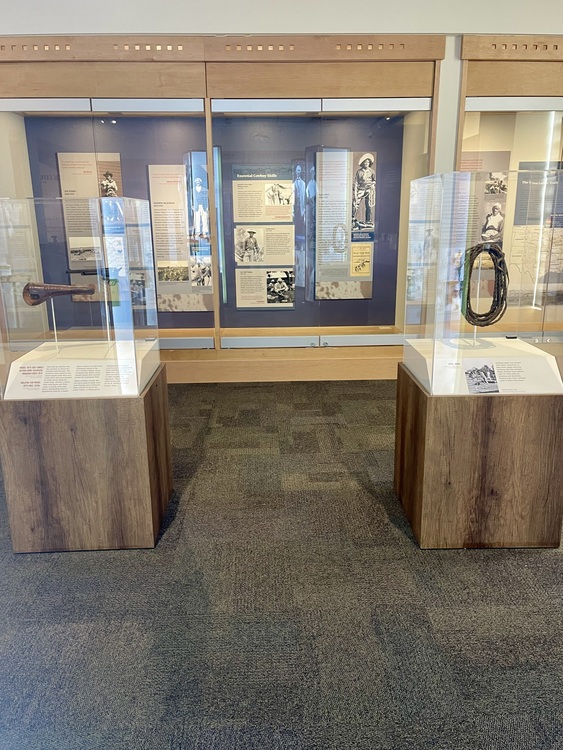
Below are the captions of the objects on display in this section.
[OBJECT LABEL: Rope]
Rope, 1800s
Rawhide ropes were treated with tallow, animal fat, to keep them supple and from breaking, like this example. Black cowboys used rawhide ropes to catch cattle for branding and doctoring. Making ropes from cowhides came to Texas from Spain.
Credit Line:
Witte Museum, The Donald and Louise Yena Collection
Caption: Monroe Brackins was photographed at 84 years old near his home in Hondo, Texas, 1937.
Creditline: Library of Congress, Prints and Photographs Division
Caption: Monroe Brackins was photographed by the Works Progress Administration to accompany his interview by the Federal Writers’ Project.
Creditline: Library of Congress, Prints and Photographs Division
Caption: Brackins grew watermelons on his farm in Medina County, like this one in Rusk County, Texas.
Creditline: Private Collection of T.B. Willis
Jim Perry (1858-1918)
If it wasn’t for my damned old black face I’d have been boss of one of these divisions long ago. Jim Perry on advancement on the XIT Ranch.
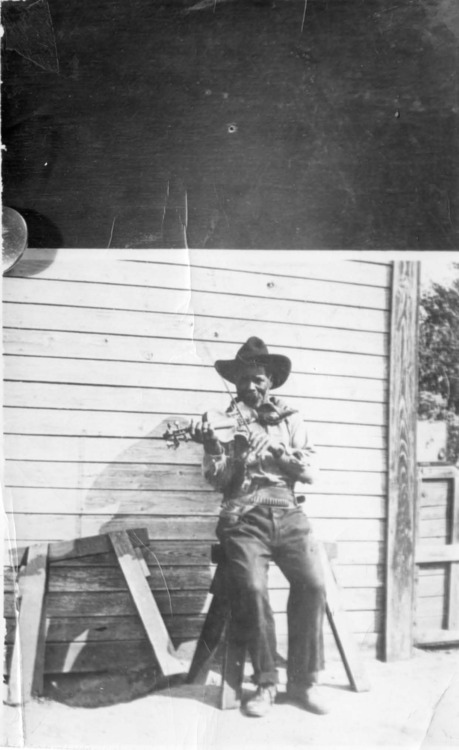
Jim Perry was a top hand, expert roper, renowned cook and fiddler on the three million-acre XIT Ranch near Dalhart, Texas for twenty years. Perry helped string over seven hundred miles of barbed wire fencing along the XIT Ranch property by 1887, making it the largest perimeter-fenced ranch in the world. Perry’s fellow ranch hands admired and respected him as one of the strongest and best riders. They confirmed that Perry would have been promoted to ranch foreman if he had been white.
Below are captions of the images on the panels:
Caption: Jim Perry from Austin, Texas, a cook, playing fiddle.
Creditline: Special Collections and Archives, Mary and Jeff Bell Library, Texas A&M University – Corpus Christi
Caption: The XIT Ranch stretched through ten counties in the Texas Panhandle.
Creditline: Ivan Cates, The XIT Ranch: A Texas Legacy, 2008
Caption: Cowboys on the XIT Ranch branding calves, 1904
Creditline: Library of Congress, Prints and Photographs Division
-
Black Cowboys: An American Story Entry Object & Panel Section 1
-
Section 2: Who Were Black Cowboys? Men & Women
-
Section 2: Who Were Black Cowboys? Children
-
Section 2: Who Were Black Cowboys? Enslaved
-
Section 2: Who Were Black Cowboys? Black Ranchers
-
Section 2: Who Were Black Cowboys? Recovering Black Cowboys Stories
-
Section 2: Who Were Black Cowboys? African Origins.
-
Section 3: Hector Bazy, Black Cowboy
-
Section 4: Black Cowboys Were Integral to the Texas Economy
-
Section 4: Tower Bios of Famous Black Cowboys
-
Section 4: Where did Black Cowboys Work? The Great Cattle Trails
-
Section 4: Essential Cowboy Skills Cooks & Other Jobs
-
Section 4: Wall Bio Hector Bazy
-
Section 4: Wall Bio Nat Love
-
Section 4: Impact of the Cattle Industry
-
Section 4: Monroe Brackins & Jim Perry Bios
-
Section 5: Black Cowboys - enslaved and free - used their skills to become Black Ranchers and shaped the legacies of Black ranching families
-
Section 5: Tower Bios of Prominent Black Ranchers & Farmers