Section 4: Tower Bios of Famous Black Cowboys
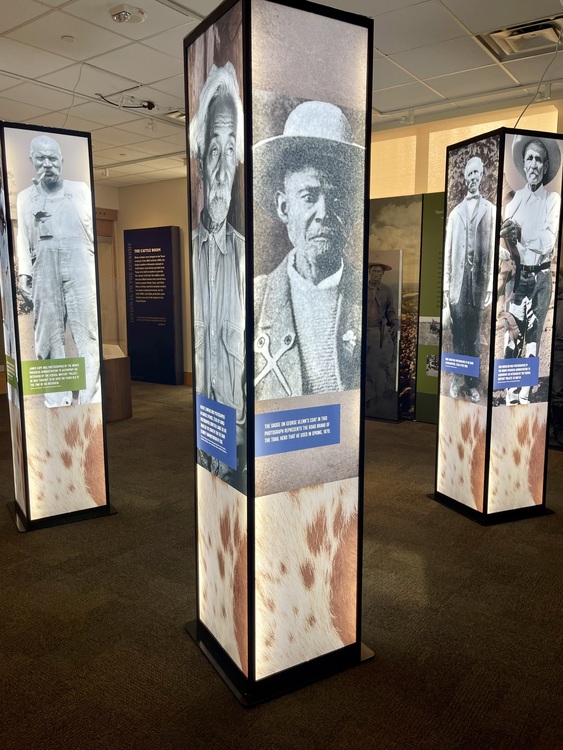
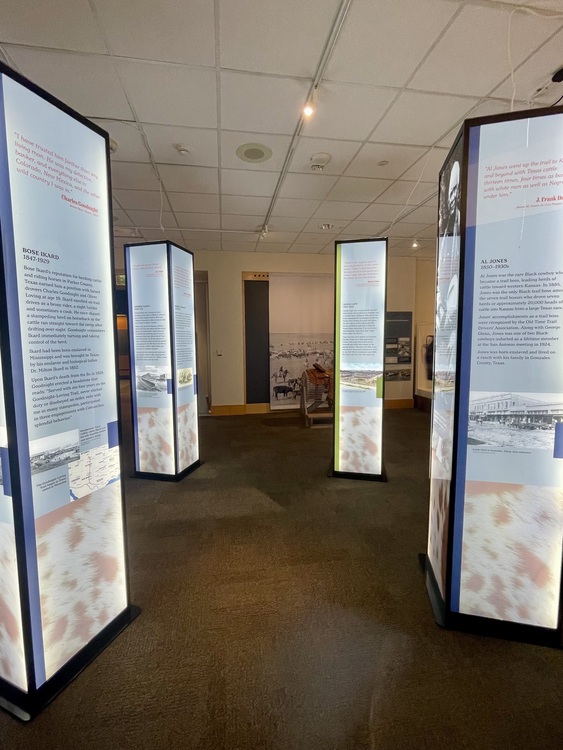
The exhibit includes multiple lighted towers that contain images and biographies of famous Black Cowboys. They follow below, each with the name of the Cowboy, their birth and death year as known.
Bose Ikard (1847-1929).
I have trusted him farther than any living man. He was my detective, banker, and everything else in Colorado, New Mexico, and the other wild country I was in. Charles Goodnight about Bose Ikard (1929).
Bose Ikard’s reputation for herding cattle and riding horses in Parker County, Texas, earned him a position with famed drovers Charles Goodnight and Oliver Loving at age 19. Ikard excelled as a bronco rider, a night herder, and sometimes a cook. He once chased a stampeding herd on horseback as the cattle ran straight toward the camp after drifting overnight. Goodnight remembers Ikard immediately turning and taking control of the herd.
Ikard had been born enslaved in Mississippi and was brought to Texas by his enslaver and biological father, Dr. Milton Ikard, in 1852.
Upon Ikard’s death from the flu in 1929, Goodnight erected a headstone that reads: “Served with me four years on the Goodnight-Loving Trail, never shirked duty or disobeyed an order, rode with me in many stampedes, participated in three engagements with Comanches, splendid behavior.”
Caption: Bose Ikard was photographed at his home in Weatherford, Texas, after 1900.
Creditline: Courtesy of Doss Heritage Museum
Caption: Weatherford, Texas (1884), where Ikard and his wife Angelina settled and raised a family
Creditline: University of Texas at Arlington Libraries, Special Collections
[Map] Caption: The Goodnight-Loving Trail began in Texas and ended in Wyoming
Ben Kinchlow (1846-1942).
I don’t care how rough a hoss is, if he can stand me, I sure can stand him. I can get my hoss saddled in the mornin’ an when I throw my leg over his back, I never move my legs, but ride all day like that, sittin’ straight.
Ben Kinchlow as told to Florence Angermiller for the Federal Writers’ Project (1936-1938).
Ben Kinchlow rode herds up the trail to Kansas and Nebraska six times. He was an experienced horse breaker, and said that the “one thing I was put in this world for was to judge a hoss.”
Kinchlow was one of the first Black men to work with the Texas Rangers. He spent 18 months as a guide for Texas Ranger Captain Leander McNelly. He then returned to cowboying, working for Sol
and Ike West, South Texas cattlewoman Amanda Burk, drovers John Blocker and Able “Shanghai” Pierce and other Black cowboys, Armstead Bankhead and Steve West.
Kinchlow grew up in Matamoros, Mexico, in exile with his half-white mother, Lizaar Moore, who had fled enslavement in Wharton County. After a robust cowboy career, he settled down in the Uvalde area in the 1880s, where he lived and ranched until his death.
Caption: Ben Kinchlow was photographed by the Works Progress Administration to accompany his interview by the Federal Writers’ Project. He was 91.
Creditline: Library of Congress, Prints and Photographs Division
Caption: Uvalde, Texas, 1880s-1890s.
Creditline: DeGolyer Library, Southern Methodist University
George Glenn (1850-1931).
Of such stuff were the old trail drivers, white and black, made of.
J.E. Folts on George Glenn to the Old Time Trail Drivers’ Association (1923).
George Glenn was a young cowhand working on the ranch of Robert B. Johnson in Colorado County, Texas, in 1870 when Johnson chose him to drive a herd of cattle up the trail to Abilene, Kansas.
When they arrived in Kansas, Johnson fell ill and died and Glenn had him buried there in a metal casket. Glenn returned to Abilene the following year to retrieve Johnson’s body and rebury him in
Texas with this family. Although Glenn never rode up the trail again, his 42-day sojourn to return Johnson’s body earned him special recognition by the Old Time Trail Drivers’ Association in 1924, where Glenn was honored as a lifetime member.
Glenn was born enslaved on Johnson’s ranch and continued to work for him after emancipation. He built a homestead near Glidden, Texas and lived there until his death.
Caption: The badge on George Glenn’s coat in this photograph represents the road brand of the trail herd that he used in spring, 1870.
Caption: Glenn drove cattle up the trail to Abilene, where the animals would be shipped east on the Union Pacific Railroad
Creditline: From Joseph G. McCoy’s Historic Sketches of the Cattle Trade of the West and Southwest, 1874
Robert Lemmons (c.1848 – 1947).
I worked alone and acted like I was a mustang. I made the mustangs think I was one of them. Maybe I was in them days. After I stayed with a bunch long enough they’d foller me instid of me having to foller them. Show them you’re the boss. That’s my secret.
Robert Lemmons, as quoted by J. Frank Dobie (1931).
Robert Lemmons was a “mustanger” who captured wild horses and trained them. He favored the “walk down” method for catching mustangs. He would lead them to walk for several days until the horses were so exhausted, they could be easily roped and corralled.
Lemmons worked alone catching and training horses until the wild mustang herds were gone from Texas. He taught himself to read and acquired more than a thousand acres with cattle, sheep, horses and goats. He registered the “4R+” cattle brand in Dimmit County.
Lemmons was born enslaved to John English in Caldwell County. When English’s son died tragically, he freed Lemmons in his grief. Lemmons began at 17 to “hunt me name” and adapted his name from Duncan Lammons, for whom he worked in Eagle Pass.
Caption: Robert Lemmons was photographed in Carrizo Springs, Texas, by famed photographer Dorothea Lange as she traveled the country for the Farm Security Administration in 1936.
Creditline: Library of Congress, Prints and Photographs Division, Farm Security Administration/Office of War Information Black-and-White Negatives.
Caption: Illustration of catching wild horses, from Gleason’s Pictorial Drawing-Room Companion, 1852.
Al Jones (1850 – 1930s).
Al Jones went up the trail to Kansas and beyond with Texas cattle thirteen times, four times as boss, with white men as well as Negroes under him.
J. Frank Dobie about Al Jones in Cow People (1964).
Al Jones was the rare Black cowboy who became a trail boss, leading herds of cattle toward western Kansas. In 1885, Jones was the only Black trail boss among the seven trail bosses who drove seven herds or approximately 20,000 heads of cattle into Kansas from a large Texas ranch.
Jones’ accomplishments as a trail boss were recognized by the Old Time Trail Drivers’ Association. Along with George Glenn, Jones was one of two Black cowboys inducted as a lifetime member at the San Antonio meeting in 1924.
Jones was born enslaved and lived on a ranch with his family in Gonzales County, Texas.
Caption: This photograph of Al Jones was taken at his induction into the Old Time Trail Drivers’ Association as a lifetime member in 1924.
Creditline: The Old Trail Drivers Association of Texas Collection, Witte Museum
Caption: Cattle herd in Gonzales, Texas, date unknown
Creditline: Gonzales County Historical Commission
-
Black Cowboys: An American Story Entry Object & Panel Section 1
-
Section 2: Who Were Black Cowboys? Men & Women
-
Section 2: Who Were Black Cowboys? Children
-
Section 2: Who Were Black Cowboys? Enslaved
-
Section 2: Who Were Black Cowboys? Black Ranchers
-
Section 2: Who Were Black Cowboys? Recovering Black Cowboys Stories
-
Section 2: Who Were Black Cowboys? African Origins.
-
Section 3: Hector Bazy, Black Cowboy
-
Section 4: Black Cowboys Were Integral to the Texas Economy
-
Section 4: Tower Bios of Famous Black Cowboys
-
Section 4: Where did Black Cowboys Work? The Great Cattle Trails
-
Section 4: Essential Cowboy Skills Cooks & Other Jobs
-
Section 4: Wall Bio Hector Bazy
-
Section 4: Wall Bio Nat Love
-
Section 4: Impact of the Cattle Industry
-
Section 4: Monroe Brackins & Jim Perry Bios
-
Section 5: Black Cowboys - enslaved and free - used their skills to become Black Ranchers and shaped the legacies of Black ranching families
-
Section 5: Tower Bios of Prominent Black Ranchers & Farmers