Section 2: Who Were Black Cowboys? Enslaved
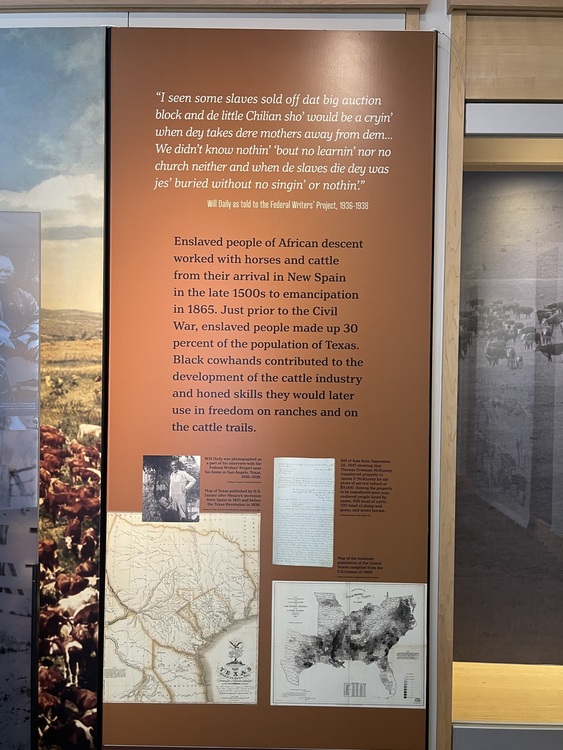
I seen some slaves sold off dat big auction block and de little Chilian sho’ would be cryin’ when dey takes dere mothers away from dem… We didn’t know nothin’ ‘bout no learnin’ nor no church neither and when de slaves die dey was jes’ buried without no singin’ or nothin’.
Will Daily as told to the Federal Writers’ Project, 1936-1938
Enslaved people of African descent worked with horses and cattle from their arrival in New Spain in the late 1500s to emancipation in 1865. Just prior to the Civil War, enslaved people made up 30 percent of the population of Texas. Black cowhands contributed to the development of the cattle industry and honed skills
they would later use in freedom as ranch hands and on the cattle trails.
The following are the captions for images in this section.
Caption (1): Will Daily was photographed as a part of his interview with the Federal Writers’ Project near his home in San Angelo, Texas, 1936-1938.
Creditline: Library of Congress, Manuscript Division
Caption (2): Map of the enslaved population of the United States compiled from the U.S. Census of 1860.
Creditline: Library of Congress, Geography and Map Division
Caption (3): Bill of Sale from September 28, 1847 showing that Thomas Freeman McKinney transferred property to James P. McKinney for six years of service valued at $9,000. Among the property to be transferred were nine enslaved people listed by name, 300 head of cattle, 700 head of sheep and goats, and seven horses.
Creditline: National Archives at Fort Worth, TX
Caption (4): Map of Texas published by H.S. Tanner after Mexico’s secession from Spain in 1821 and before the Texas Revolution in 1836.
Creditline: Courtesy of Frank and Carol Holcomb and the Texas General Land Office
-
Black Cowboys: An American Story Entry Object & Panel Section 1
-
Section 2: Who Were Black Cowboys? Men & Women
-
Section 2: Who Were Black Cowboys? Children
-
Section 2: Who Were Black Cowboys? Enslaved
-
Section 2: Who Were Black Cowboys? Black Ranchers
-
Section 2: Who Were Black Cowboys? Recovering Black Cowboys Stories
-
Section 2: Who Were Black Cowboys? African Origins.
-
Section 3: Hector Bazy, Black Cowboy
-
Section 4: Black Cowboys Were Integral to the Texas Economy
-
Section 4: Tower Bios of Famous Black Cowboys
-
Section 4: Where did Black Cowboys Work? The Great Cattle Trails
-
Section 4: Essential Cowboy Skills Cooks & Other Jobs
-
Section 4: Wall Bio Hector Bazy
-
Section 4: Wall Bio Nat Love
-
Section 4: Impact of the Cattle Industry
-
Section 4: Monroe Brackins & Jim Perry Bios
-
Section 5: Black Cowboys - enslaved and free - used their skills to become Black Ranchers and shaped the legacies of Black ranching families
-
Section 5: Tower Bios of Prominent Black Ranchers & Farmers