Section 4: Wall Bio Nat Love
Nat Love (1854-1921)
Imagine, my dear reader, riding your horse at the top of his speed through torrents of rain and hail, and darkness so black that we could not see our horse’s heads, chasing an immense herd of maddened cattle which we could hear but not see, except during the vivid flashes of lightning which furnished our only light.
Nat Love, The Life and Adventures of Nat Love Better Known in the Cattle Country as “Deadwood Dick” by Himself, 1907.
In 1869, Nat Love left Tennessee for Dodge City, Kansas for a new life after Emancipation. There he met a cattle crew from Texas. To test him, the Black cowboys made Love ride their worst horse. He
rode the horse to a stop and was hired on the spot, the trail boss purchasing a new saddle, bridle, spurs, chaps, blankets, and a .45 caliber Colt revolver for him.
Love continued to work in cattle ranches in Texas, Arizona and New Mexico, rounding up cattle and horses and driving them across cattle country from Mexico to South Dakota. He practiced “dare-devil” riding, shooting, roping, and other sports and competed in contests. In 1876, he beat other competitors
in a contest riding, roping and shooting in Deadwood, South Dakota and earned the nickname “Deadwood Dick” for his win. In 1890, he left the cattle business and joined the railroads as a Pullman porter, continuing his travels across the American West.
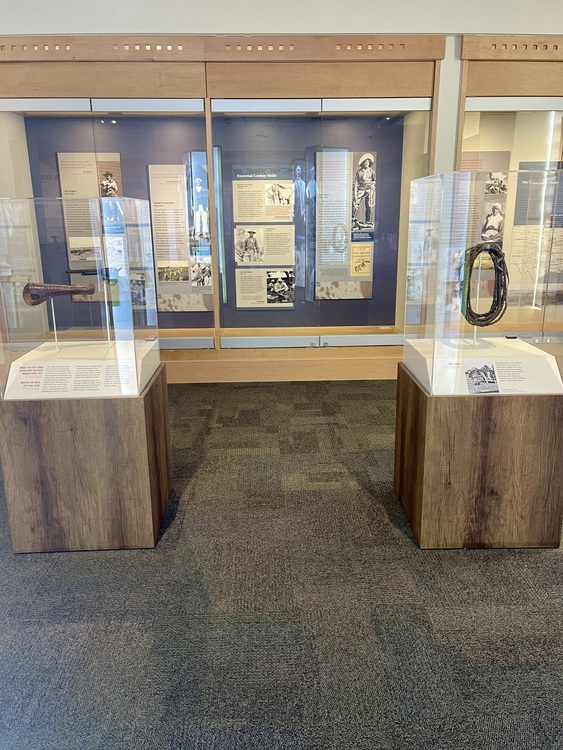
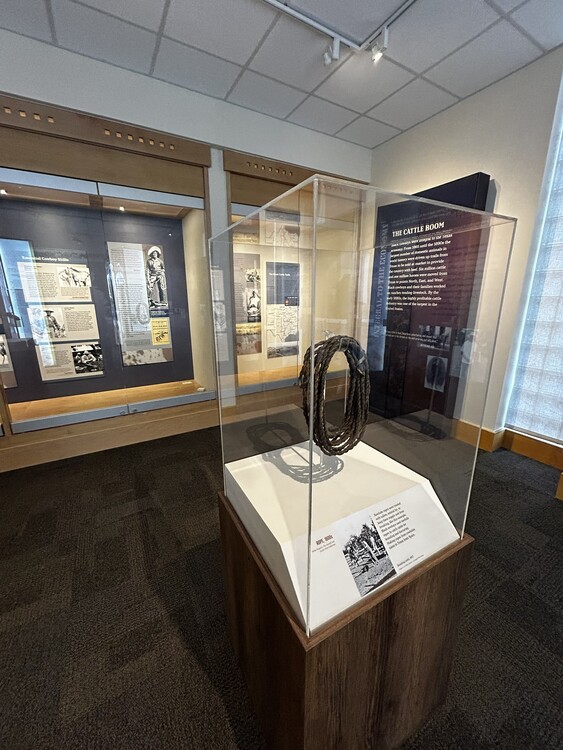
This section of the exhibit has two additional cases containing artifacts. Below are the captions for each case.
[OBJECT LABEL: Colt revolver and holster ]
Model 1873 Colt single-action Army revolver, manufactured 1874
This Colt six-shooter was the revolver of choice for cowboys and lawmen. The revolvers were stored in the chuck wagon most days on a cattle drive and were banned in many towns along the cattle trails.
During a storm, their loud boom and flash came in handy and could turn a stampeding herd of frightened cattle by a single Black cowboy on night duty. Originally issued to the U.S. Cavalry troops, many of whom were Black, these sturdy pistols were carried across the American West.
Witte Museum, The Donald and Louise Yena Collection
Holster for Model 1873 Colt, 1870s
Black cowboys usually did not carry guns in daily work and firearms were holstered when carried or left in the chuck wagon. A falling pistol dislodged from a holster could cause an uncontrolled shot, frighten the herd, or injure the cowboy. Firearms were carried when storms or other trouble was
expected. This holster was made during the trail drive era by H. Keller of Corpus Christi, Texas.
Witte Museum, The Donald and Louise Yena Collection
Caption: Photograph of Nat Love posing in his “fighting clothes,” possibly after the roping contest in Deadwood, South Dakota.
Creditline: Documenting the American South, University of North Carolina at Chapel Hill
Caption: Nat Love wrote The Life and Adventures of Nat Love Better Known in the Cattle Country as “Deadwood Dick” by Himself; a True History of Slavery Days, Life on the Great Cattle Ranges and on the Plains of the “Wild and Woolly” West, Based on Facts, and Personal Experiences of the Author.
Creditline: Documenting the American South, University of North Carolina at Chapel Hill
-
Black Cowboys: An American Story Entry Object & Panel Section 1
-
Section 2: Who Were Black Cowboys? Men & Women
-
Section 2: Who Were Black Cowboys? Children
-
Section 2: Who Were Black Cowboys? Enslaved
-
Section 2: Who Were Black Cowboys? Black Ranchers
-
Section 2: Who Were Black Cowboys? Recovering Black Cowboys Stories
-
Section 2: Who Were Black Cowboys? African Origins.
-
Section 3: Hector Bazy, Black Cowboy
-
Section 4: Black Cowboys Were Integral to the Texas Economy
-
Section 4: Tower Bios of Famous Black Cowboys
-
Section 4: Where did Black Cowboys Work? The Great Cattle Trails
-
Section 4: Essential Cowboy Skills Cooks & Other Jobs
-
Section 4: Wall Bio Hector Bazy
-
Section 4: Wall Bio Nat Love
-
Section 4: Impact of the Cattle Industry
-
Section 4: Monroe Brackins & Jim Perry Bios
-
Section 5: Black Cowboys - enslaved and free - used their skills to become Black Ranchers and shaped the legacies of Black ranching families
-
Section 5: Tower Bios of Prominent Black Ranchers & Farmers