Floor 2 (Main Plaza Level): Thousand Oaks and Camarillo Landmark Paintings
Now after viewing Simi Valley and Fillmore paintings, we will continue to the carpeted Thousand Oaks wall, behind the escalator on the Main Plaza level. This first group of paintings are of Stagecoach Inn, Historic Park.
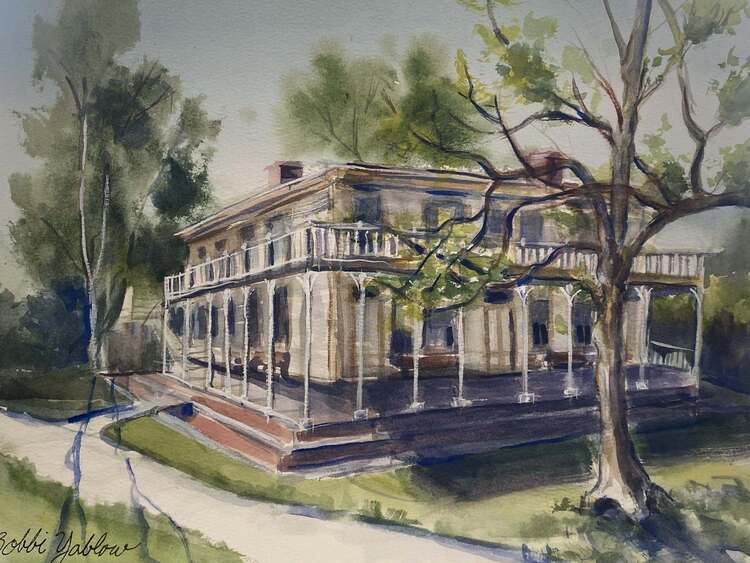
Stagecoach Inn, (also known as Grand Union Hotel).
A Ventura County Landmark. Also listed as a California State Historical Landmark and in the National Register.
This Monterey‑style inn, built of northern California redwood, features a wraparound porch and balcony. The original structure, completed in 1876, served many roles over the years, including a school, post office, steak house, church, gift shop, and movie set. The four‑acre property also has reconstructions of a carriage house, three‑room pioneer house, blacksmith shop, working windmill, original Timber School, Spanish adobe, outdoor beehive oven, and a Chumash bulrush hut. The inn was moved to its present location in 1965 to make way for the construction of Highway 101.
Sycamore Tree near Stagecoach Inn, with Chumash 'ap.
This unusually large and old California native tree was more than 150 years old when it was designated a landmark in June 1978. According to tradition, Chumash people bent its lower branches to mark the location of underground water.
Now continuing on the other side of the restroom hallway.
1924 Timber School House.
This is the second school building to occupy the site. The original Timber School, built around 1889, was condemned in 1921, and a 3/4 reconstructed model of the original wooden school is located at the Stagecoach Inn site. Distinguished architect Roy Wilson of Santa Paula was selected to design a new structure in the fall of 1924. A later classroom was added in 1955, and an auditorium in 1948. The current school is a simple one‑story Mission Revival structure, with a low gable roof topped by a small octagonal cupola, that also served as a working bell tower.
Hunt Olive Tree.
This tree is the sole survivor of an orchard planted by Conejo pioneer Richard Orville Hunt on the Salto Ranch, which he established in 1876. Hunt moved his family to the ranch in 1880; its Spanish name, meaning “a high bluff with a jumping‑off place,” referred to the nearby canyon now known as Hill Canyon. In 1891, the Hunt home became the Newbury Park Post Office, with Hunt appointed postmaster. The family orchard once included apricots, peaches, plums, apples, nuts, pomegranates, and olives. Richard Hunt died near the original location of this tree in 1918, after being thrown from his horse‑drawn buggy while supervising peach picking. The tree was moved to its present site in 1993.
Dos Vientos Ranch Buildings, (also known as Lewis or Clark Ranch).
Two large livestock barns were built in 1937 on the Dos Vientos Ranch, part of the 30000 acre Rancho Guadalasca Mexican land grant awarded to Isabel Yorba in 1836. Lima beans were farmed here, contributing to its reputation as the “lima bean capital of the world.” The barns were dismantled in 1996 during construction of the Dos Vientos residential subdivision. Some of the salvaged lumber was later repurposed to build a blacksmith shop at the nearby Stagecoach Inn Museum.
Oakbrook County Park Archaeological Area.
This 428‑acre park features a small interpretive museum, a reproduction Chumash village, and public hiking trails. Along the streambed of its narrow oak‑wooded canyon are eleven archaeological sites, clustered within just a few yards of one another, including bedrock mortars and rock shelters containing Chumash pictographs.
Artist Ryan Yablow won the award “Boldness in Watercolor,” for “Oakbrook Stillness” in Thousand Oaks. Ryan paints with our group, and also ventures out on his own to paint what inspires him, like this Chumash ‘ap in Oakbrook County Park.
Pederson House and Water Tower.
This typical turn‑of‑the‑century farmhouse and water tower, is a Sears Roebuck catalogue house, built in 1913 for Lars and Karn Pederson, members of the Norwegian Colony that settled the northern end of the Conejo Valley in 1890. In 1967, their son Richard donated the land for California Lutheran University, and the buildings were subsequently restored.
Crowley House, (also known as Goebel House).
Built in 1910 for newlyweds Frank and Mae Casey Crowley on the Newbury Ranch, this house earned the nickname, “Mother of Thousand Oaks,” because in the early 1920s, it served as the real estate office for the first housing development in the Conejo Valley. Prospective buyers were brought by car from downtown Los Angeles, shown lots among the valley’s large oak trees, and treated to dinner in the Crowley House dining room before returning home. The house was later owned by Louis and Kathleen Goebel, of Jungleland. This spacious two‑story, five‑bedroom home, still retains its hardwood floors, mahogany beams, and volcanic‑rock fireplace.
The next three paintings were painted at Joel McCrea Ranch.
Listed in the National Register of Historic Places.
The rustic McCrea Ranch, located at the base of the Norwegian Grade, was once owned by Hollywood stars of the Golden Age. Since the 1930s, famed actor and Western film hero Joel McCrea, and his wife of 57 years, actress Frances Dee, raised their three sons—Jody, David, and Peter—here, living simply as part of the local community, while farming the land and raising cattle. A longtime friendship between Joel McCrea and Tex Ward, General Manager Emeritus of the Conejo Recreation and Park District, helped pave the way for the McCrea family to donate the ranch and their home to the Park District.
We had a TIE for Thousand Oaks. Artist Divina Grover won an award for McCrea Ranch Bunkhouse in Thousand Oaks, as “Exquisite Atmosphere.” Divina is new to our group this past year, but she has attended nearly every paint out since, developing her skills in how to portray architecture, and a sense of place in a colorful way.
Now turn the corner for Camarillo, starting with the Don Adolfo Camarillo House.
A Ventura County landmark. Also listed as a California Point of Historical Interest, and in the National Register.
Built in 1893 for Don Adolfo Camarillo, known as “the last of the California Dons,” this two‑story Queen Anne, Victorian‑style residence includes seven bedrooms, three bathrooms, and two towers. Landings were added to the stairway in 1913, and a walk‑in electric refrigerator was installed in 1915. Don Adolfo, a prominent business, agricultural, and political leader, assumed responsibility for the 10000‑acre Rancho Calleguas at the age of 16 upon his father’s death; the property had been purchased in 1876 for $3000 in gold. Renowned for its hospitality, the ranch centered around this home, which was designed by local architects Herman Anlauf and Franklin Ward, who also designed other elaborate Victorian style houses in the county, including the Oxnard Petit House, and Santa Paula Faulkner house, that you will see later on the tour.
Camarillo Ranch East Garden Gazebo.
The copper cupola crowning the gazebo originally served as the domed roof of the bell tower of Saint Mary Magdalen Chapel, completed in 1913 in downtown Camarillo. Don and Katie Waunch acquired the cupola in the late 1990s, after its removal during seismic repair work, and later donated it to the Camarillo Ranch.
Beverly Lazor won the award “Elegant Beauty,” for her Camarillo Ranch House AND Gazebo paintings. Her paintings portray an aesthetic that is both stunning and highly refined, and have that amazing WOW factor.
Saint Mary Magdalen Church.
This Spanish Neo‑Classic style church, designed in 1913 by architect A C Martin as a chapel for the Camarillo family, is noted for its barrel vault, and fourteen stained‑glass windows commissioned from a factory in Munich, Germany. The Camarillo family crypt lies beneath the building, which became a parish church in 1940.
Eucalyptus Trees.
Along today’s 1 O 1 Freeway in Camarillo remains part of a historic grove of eucalyptus trees, that once lined both sides of the old two lane El Camino Real. In 1892, Adolfo Camarillo planted 650 of these trees, which extended from Pleasant Valley Road westward, and provided a shaded canopy for travelers. The grove soon became a recognizable landmark marking entry into Camarillo. While many of the original trees still stand, additional eucalyptus trees have since been planted. Eucalyptus was first introduced to Southern California from Australia in the mid 1800s, commonly used as a windbreak in agricultural areas.
Fulkerson Hardware Store.
This one‑story stucco building, constructed in 1925 to house a hardware business, spans three generations, and sits on the foundation of Jonathan Fulkerson’s original hardware store. Fulkerson, an early Somis resident, also operated a blacksmith shop, reflecting the community’s early commercial and agricultural roots.
The landmark painting tour continues on two more floors of the building. Take an elevator to Floor 3 to see Ojai, Malibu, and Anacapa Island paintings.
-
Welcome to the Atrium Gallery
-
Floor 2 (Main Plaza Level): Simi Valley and Fillmore Landmark Paintings
-
Floor 2 (Main Plaza Level): Thousand Oaks and Camarillo Landmark Paintings
-
Floor 3: Ojai, Malibu, Anacapa Island Landmark Paintings
-
Floor 4: Port Hueneme and Oxnard Landmark Paintings
-
Floor 4: Santa Paula Landmark Paintings
-
Floor 4: Ventura and Moorpark Landmark Painitngs