Floor 4: Ventura and Moorpark Landmark Painitngs
Round the bend from the Santa Paula paintings, we come to those picturing Ventura, and also Moorpark.
Sanchez Adobe, (also known as Lloyd-Butler Ranch),
Is located in Ventura’s Saticoy community. The house, which has twenty two inch thick walls, was built as a one-story with a tile roof in 1838. The tile roof was later taken off and a second story added around 1900. A veranda runs the width of the twelve-room house.
Saticoy Bean Warehouse is also Located in Ventura’s Saticoy community.
This 1917 warehouse served the area's important local lima bean industry. The bean warehouse and neighboring Saticoy Walnut Growers warehouse (not pictured here), stand today as important reminders of the agricultural history and the growth of the farming cooperative movement in California.
Linda Rinaldi won the award “Sublime Minimalism,” for her Saticoy Bean Warehouse painting. Linda is a plahn air painter that starts her paintings onsite to get inspired, painting slowly and thoughtfully, and finishes later in her studio, to achieve this sophisticated result.
The next three paintings feature the Gould House.
Thomas Gould Jr. House. Is on the National Register of Historic Places.
We plahn air painters loved our visit to the Thomas Gould residence, which had just turned 100-yrs-old. It was fun to imagine what it would be like to live in a house designed by renowned architect Henry Greene, who worked closely with Mabel Gould to create a more relaxed, farmhouse-interpretation of his iconic Arts and Crafts style—layered with subtle Japanese influences. The house is considered one of the best examples of Henry Greene's independent work; most of his other designs were created alongside his brother Charles as Greene and Greene. The house's interior decorations include ceiling moldings, a leaded glass china cabinet, and a carved mirror, the latter being a piece of furniture designed by Greene himself.
Now peek inside the County CEO office lobby, to see two more Ventura landmarks, and Moorpark paintings.
Former Ventura County Courthouse, (now San Buenaventura City Hall).
A Ventura County landmark, it is Also listed as a California State Historical Landmark, and in the National Register.
Designed by architect A C Martin, the courthouse was built in 1912 on a hill overlooking the city and the Pacific Ocean, against a backdrop of steeply rising hills. It was executed in Neo-Classical Revival style, also described as French Renaissance style. A deep granite staircase ascends to a decorated bronze gateway. Notable features are full Doric entablature, round arched first floor windows, with unusual friars' head keystones (attributed to the Gladding McBean Company). Interior features include stained glass domes, marble entrance lobby and sweeping staircase, mahogany and walnut paneling, and coffered ceilings.
Site of Junípero Serra's Cross.
In Grant Park, at end of Ferro Drive, City of Ventura. It is a California State Historical Landmark.
The first cross on the hill known as "La Loma de la Cruz," or the Hill of the Cross, was erected by Junípero Serra at the founding of the Mission San Buenaventura in 1782. This was the ninth and last mission founded by Father Serra in California.
Moorpark has 2 Ventura County Landmarks, which are the historic pepper trees, and the former Methodist Church, which is now a cherished mosque.
Pepper Trees along High Street.
These are the remaining California pepper trees planted by John Nubee and John Barrett in 1904. The original number of trees lining the street is unknown, though estimates suggest more than forty were planted. Several have been lost to disease over the years and replaced.
Mary Zangerle won the award “Meticulous Detail,” for Moorpark’s Historic “Pepper Trees in Springtime”. Her elaborate watercolors beautifully tell the story of a place. You can see actual peppers hanging from the trees!
Former Methodist Church.
A group of retired Methodist ministers established the colony of Epworth and in 1894 constructed a small church in what is now the Fairview District. The church was moved in 1907 to the corner of Charles and Walnut Streets in Moorpark, where it stood until 1930, when it was joined by the Methodist Church of Somis, built in 1892 on the site now occupied by Somis Elementary School. After a new Methodist church was constructed, the combined buildings became the Moorpark First Baptist Southern Church in 1950, and the congregation celebrated its 100th anniversary in 1992. The church served as the center of much of the town’s social life, hosting recitals, dramatizations, movies at a time when Moorpark had no theater, and other cultural events. The church bell also doubled as the town’s fire alarm, two ropes of unequal length were attached, with the long rope calling people to worship, and the short rope ringing the bell rapidly to alert residents to a fire, prompting the men of the town to hurry to the fire truck house in Tanner’s Garage.
Now, let us continue on with the Ventura landmark stories. This group of paintings were all painted at Olivas Adobe Historical Park.
Olivas Adobe is listed in the National Register of Historic Places, and is also listed as a California State Historical Landmark.
The original small adobe on this site was built by Don Raimundo Olivas and his son, Nicolas, in 1837, with Chumash laborers. The present structure was begun in 1847, with roof beams from the Santa Paula Canyon, and tiles made from native soil. Raimundo and his wife Teodora had 21 children. Don Raimundo lived here until his death in 1879. The last owner of this property was Major Max Fleischmann, who used the adobe as a hunting lodge, and had the large courtyard arch built in the mission style. In 1963, Two hundred and fifty acres were given to the City of Ventura by the Fleischmann Foundation for public use. Today, many weddings are held in the courtyard, with the beautiful arch as a backdrop.
Five Trees.
On a Hilltop above Ventura, visible from all angles of Ventura, and from the Pacific ocean.
In 1898, Joseph Sexton, a Ventura horticulturist noted for his work with walnuts, avocados, and pampas grass, hired his neighbor Owen Marron to plant a row of 13 blue gum eucalyptus trees on the hilltop to mark the western boundary of his ranch. In 1903, a brush fire destroyed all but five of the trees. Old mariner’s charts from this time show the five trees functioned as a navigational landmark. Vandals cut down three of the approximately 60-foot-tall trees on Halloween 1940, leaving only two standing. Reports vary as to whether the trees grew back from the stumps, or if local citizens replaced the lost trees. The remaining Two Trees narrowly avoided wildfire on several subsequent occasions. On Earth Day, 2017, the property owner, Rancho Ventura Conservation Trust, planted a sapling blue gum eucalyptus on the hilltop to continue the legacy of Ventura’s iconic Two Trees. One tree, while still standing, remains in poor condition; another new sapling was planted in early 2019 as replacement. For those looking to visit Two Trees in person, the Rancho Ventura Conservation Trust provides ongoing access to this local landmark via a guided hike.
Ortega Adobe.
Located on Main Street just west of Mission San Buenaventura, Ortega Adobe is listed as a California Point of Historical Interest.
This site is the original home of the Ortega Chili Company. In the late 1890s, the Ortega family began roasting chilis in the adobe's kitchen and built a wood shed adjacent to the adobe where the products were canned. Spanish and Mexican adobes once lined Ventura's downtown streets, but only the Ortega Adobe survives today due to its continuous occupation as a residence and business.
The next four paintings are included in the mission historic district.
Mission San Buenaventura.
Is listed in the National Register of Historic Places and as a California State Historical Landmark.
The Mission San Buenaventura Compound Site illustrates the historical development of San Buenaventura. Archeological investigation has produced artifacts associated with the Chumash Native Americans that date back several thousand years. Construction of the Mission, the 9th in the mission chain, and its compound began in 1782. After secularization, the mission lands were granted to Jose Arnaz in 1846. The district includes the existing mission buildings, fragments of the aqueduct, settling tank and holding reservoir, and the foundations of numerous mission-period outbuildings. The present Mission church, dedicated in 1809, is stark in decorative detail and bold in massing.
Peirano’s Market.
Constructed in 1877, this red‑brick commercial building is the city’s oldest surviving brick structure. Its distinctive ornamental relief brickwork reflects 19th century craftsmanship. For more than a century, it housed a general merchandise and later a grocery business operated by the Peirano family. In 1991, archaeological remains of the Mission Lavanderia were discovered beneath the structure, adding to its historical significance.
Turning the corner, we find Ventura Theatre.
It is listed in the National Register of Historic Places.
Located in downtown Ventura on Chestnut street, This lavishly decorated Mediterranean style theatre cost $400,000 to build, and created much excitement in the oil boom town of 11,000 people. Ventura joined the "movie palace era” of Hollywood with the grand opening of the Ventura Theatre on August 16, 1928. The first program included an organ solo, vaudeville acts, and screening of the film "Excess Baggage." Of particular interest is the interior decorative ceiling with original chandeliers.
First Baptist Church of Ventura.
Built in 1926 and renovated extensively into the Mayan Revival style in 1932, it is now home to the Ventura Center for Spiritual Living since 1952. According to its National Register nomination, it was deemed nationally significant "as a fine and essentially unaltered example of a scarce property designed in the Mayan Revival style by its most widely-recognized proponent, architect Robert B Stacy-Judd of Los Angeles. The Church exemplifies architectural exoticism, by representing a moment in American architectural history when the public's desire for the new and different, was at its peak. The property is the product of a rare convergence of national cultural events, and a unique force of personality."
Dudley House.
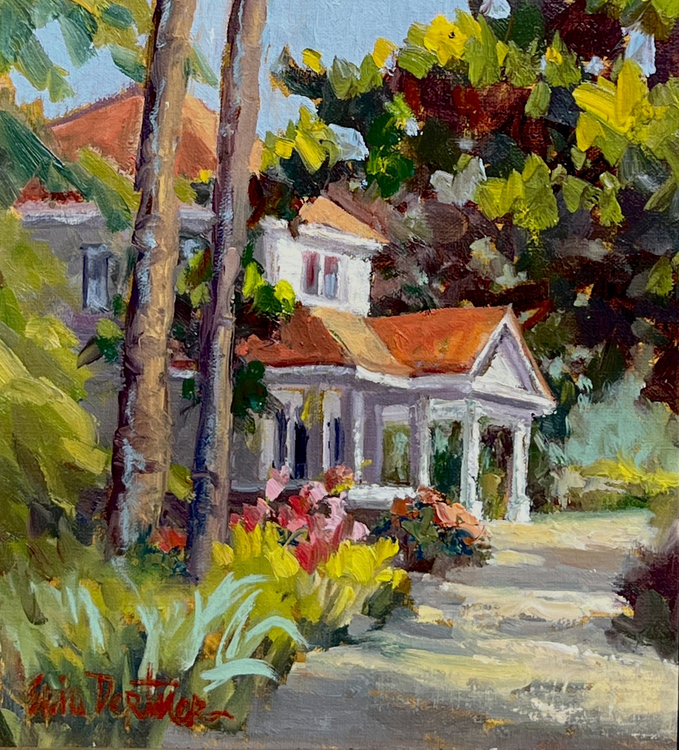
The Dudley House, was completed in 1892 by renowned local architect Selwyn Shaw, and is one of the last pioneer farmhouses within the city limits of Ventura, and typifies the agricultural heritage of Ventura County.
Keene House.
The Keene house, located on Ventura’s west end, was built in 1872, and may be the only remaining example of Second Empire Victorian style of architecture in Ventura. Second Empire style was popular from 1864 to 1885, and was a French way of enlarging living space, without violating the height limitations of Paris, achieved by a steep mansard roof from which gabled dormer windows projected.
Elizabeth Bard Memorial Hospital is listed in the National Register of Historic Places.
The Elizabeth Bard Memorial Hospital was built in 1902 by U.S. Senator Thomas Bard, for his brother Cephas Bard, the County's first doctor. Dr. Bard was the hospital's first patient and died there four months after the hospital opened. This Moorish-styled structure is picturesque on its hillside location, commanding a panoramic view of the City of Ventura.
Thank you for taking this audio walking tour to explore these amazing paintings by local artists. If you are interested in purchasing a painting, please email, Ventura County Arts Council at, gallery at vc arts council dot org.
The TREASURES OF VENTURA COUNTY art show will remain on display until July 7, 2026.
-
Welcome to the Atrium Gallery
-
Floor 2 (Main Plaza Level): Simi Valley and Fillmore Landmark Paintings
-
Floor 2 (Main Plaza Level): Thousand Oaks and Camarillo Landmark Paintings
-
Floor 3: Ojai, Malibu, Anacapa Island Landmark Paintings
-
Floor 4: Port Hueneme and Oxnard Landmark Paintings
-
Floor 4: Santa Paula Landmark Paintings
-
Floor 4: Ventura and Moorpark Landmark Painitngs