Floor 4: Port Hueneme and Oxnard Landmark Paintings
Stepping out of the elevators, our Floor 4 tour starts to the right, with Port Hueneme landmarks.
Architect Myron Hunt is famous for designing the Pasadena Rose Bowl and Los Angeles Ambassador Hotel, and he designed two landmarks right here in Port Hueneme, our Thomas Bard Mansion and the Hueneme Bank Building.
Thomas R Bard Mansion, (also known as Navy Officers Club).
The Bard Mansion is the largest historic house in Ventura County. Senator Thomas Bard died in 1915, only three years after the completion of the three‑story brick mansion, which was built in 1912 in the Italian Mediterranean style, designed by architect Myron Hunt. The home features twelve bedrooms, seven baths, and originally cost $110,000 to construct. Senator Bard’s widow lived in the mansion until her death in 1937. Leased by the U.S. Navy during World War II and purchased by the Navy in the early 1950s, the mansion now serves as the Officers’ Club at the naval base.
Gerberding and Moranda House.
One of the few remaining early homes in Port Hueneme, this house was built in 1890 as a single‑story, four‑room dwelling. An addition was completed in 1897, possibly when the attic was converted into a second floor. Its tall, narrow windows—described as “four high and two wide”—remain a distinguishing feature. Built for Frederick Gerberding, brother‑in‑law of civic leader Thomas Bard, the home was later occupied by the Lawrence Moranda family. Lawrence Moranda served as a Southern Pacific railroad station agent and later as justice of the peace; the nearby Moranda Park honors the family.
Wiltfong House.
Described as a “Modest Victorian,” this house is built entirely of redwood and has been exceptionally well preserved. Constructed in 1894, it features seven rooms plus bathrooms, twelve‑foot ceilings, an attic, and a basement—the only residential basement in Port Hueneme. Cleve Wiltfong and his wife, Marguerite, purchased the home in 1920.
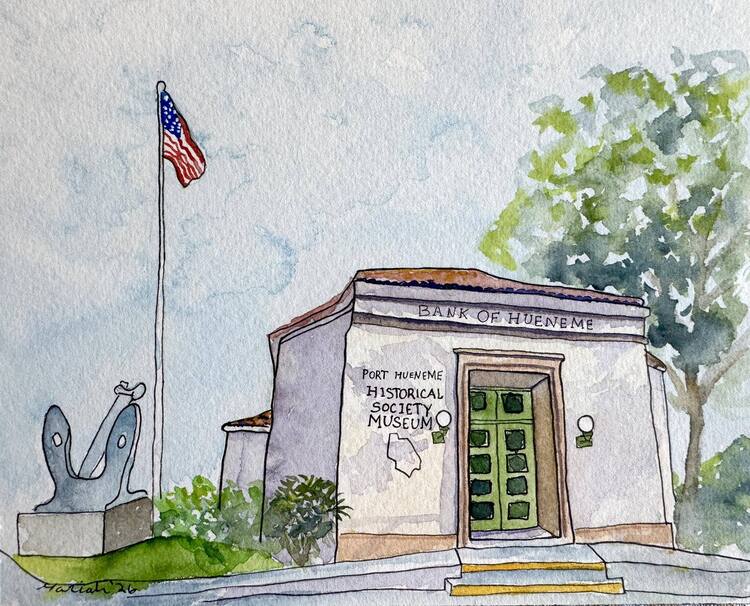
Hueneme Bank Building, (also known as Historical Museum).
The Bank of Hueneme was organized in 1889 with Thomas Bard as president and Achelle Levy as vice president, and E. P. Foster serving on the Board of Directors. The bank was initially housed in a brick building on Main Street at the entrance to the wharf area. In 1925, Myron Hunt designed the building at 220 North Market Street, in the Neoclassical architectural tradition—rectilinear in form with a stone‑like exterior—constructed at a cost of $18,000. From 1959 to 1973, the building served as Port Hueneme’s City Hall; it later housed the Chamber of Commerce and now functions as a historical museum.
Hueneme Sloo Site, (also known as Moranda Park).
The site of Moranda Park was originally a sloo, or tidal basin, that was replenished by the ocean at high tide. In 1938, the sloo was filled with material dredged during construction of the new Port Hueneme Harbor. In the years that followed, the site was landscaped as a park and named Moranda Park after a longtime Port Hueneme family.
Artist Anette Power won the award, “Painter of Light,” for Port Hueneme’s Moranda Sloo. Her passion for portraying just the essence of a scene, in an abstract way, is pure poetry.
Lightworks in the Hueneme Lighthouse.
Manufactured in 1897 in France, the lightworks consists of six handmade lens panels designed for an oil‑fired lantern, and operated by timing gears and weights. The system was electrified in 1925 with a single 1,000 watt bulb. In 1940, the lighthouse was relocated to the west side of the entrance channel to allow for harbor expansion. After the Navy took over the harbor, the Victorian style lighthouse was demolished in 1943, and the lightworks was moved to its current home in an Art Deco style Coast Guard building at the entrance to Port Hueneme. It continues to send out a beam every five seconds, marking the entrance to the port and the narrowest channel between the mainland and Anacapa Island.
Now please turn the corner, to begin the Oxnard portion of the Tour.
The focal point of downtown Oxnard is the Carnegie Museum and Plaza Park Pagoda.
Oxnard Carnegie Library, (also known as Carnegie Art Museum),
This building was one of nearly 1,700 free public libraries in the United States funded by Andrew Carnegie. The classical Greek architectural style was selected by Oxnard’s first mayor, who applied for the Carnegie funds. The building served as the city’s library until 1963, and its lower floor functioned as City Hall until 1949. In July 1971, the ornate structure became the first building in Ventura County to be listed on the National Register of Historic Places, and was also the first Carnegie Library in California to win that prestigious honor. The building was restored in 1977 with help from a federal grant, and reopened in 1980 as the Carnegie Cultural Arts Center, housing the Oxnard Historical Society Museum and the Art Club of Oxnard. It was closed in 2019 due to budget cuts.
Oxnard Plaza Park Pagoda.
This octagonal pagoda was built in 1910 to cover an artesian well and pump that supplied irrigation water for the surrounding park. In 1911, the roof was raised to accommodate a platform that was used for bands and public speakers for many years.
Weinman, Lehmann, and Miller House.
Elements of Colonial Revival and California Bungalow styles make this one of the most attractive houses on this historic Oxnard block of South D Street. Built in 1903 for the Simon Wineman family, who owned a clothing store on Fifth Street in Oxnard, the house later became home to Wineman’s daughter, Blanche, and her husband, Matthew Lehmann, one of the owners of Lehmann Brothers Department Store, also on Fifth Street. The Lehmanns lived in the house for forty years, followed by the Floyd Miller family, who also occupied it for forty years.
The next 8 paintings are of houses located in the Henry T Oxnard Historic District.
A Ventura County landmark, and Also listed in the National Register. The district is roughly bounded by Fifth Street and Magnolia Avenue in the City of Oxnard, and stretches from an alley between E and F Streets to the east and an alley between G and H Streets to the west. The first subdivision was created in 1911, and named after Henry T Oxnard, one of the four brothers who built the sugar beet factory from which the city developed. Several early 1900s homes remain in the subdivision. The area contains 137 homes ranging in size from 1,000 to 5,000 square feet, dating from 1911 to 1950, including late Victorian, 20th‑Century Revival, Prairie, large Craftsman bungalows, and a variety of smaller Revival‑style homes.
Henry C Downes House.
Built around 1921 for attorney Henry Downes, this bungalow features a side‑gabled roof and a pergola supported by tapered Classical columns framing the pedimented portico entry.
John Diedrich House.
Built in 1912 for rancher John Diedrich, this is one of the few cross‑gable, two‑story bungalow houses in Oxnard. Designed by Los Angeles architect A. C. Martin, it features exposed rafters under the eaves and a brick porch supported by brick columns. The front door contains three narrow windows that enhance the home’s Craftsman character. A cement hitching post remains in the parkway.
Daniel Barceia House.
Built in 1912 for Daniel Barceia, this one‑and‑a‑half‑story, front‑gable California bungalow is a notable example of early 20th‑century residential design in Oxnard. The Coral Tree, located on the property, is the official tree of the City of Oxnard.
Henry Levy House.
These two paintings show the front façade, and the backyard landscaping. This two‑story Craftsman house with English Tudor details was built in 1915. With eighteen rooms and spanning three lots, it is one of the largest residences in Oxnard. Henry Levy came to Hueneme from France in 1884 to join his brother‑in‑law, Achille Levy, in the brokerage business. The architectural integrity of the house has been well preserved.
Swift Residence and Lying-In Hospital.
This 1 point 1 acre site contains a residence built around 1926 for Dr. Floyd J. Swift, and a small office and hospital constructed in 1928, where Dr. Swift delivered some 5,000 babies. All buildings are linked by a series of interconnecting walls and brick patios that create interior courtyards.
J. A. Swartz Residence.
This 1300 square foot, one‑story residence, was designed and built by J. A. Swartz for himself in 1929, and features a T‑shaped plan. The house is clad in stucco siding with intersecting gables with pitched shed roofs of Mission tile. The central tower includes a small entry window with Spanish style grille work. Architecturally, the property is one of the finer examples of the Spanish Colonial Revival style within the early downtown core of Oxnard. Swartz was a significant builder who specialized in high‑end properties. The quality and longevity of his work identify him as an important contributor to Oxnard’s development, particularly during the onset of the Great Depression.
Palm Trees Along "C" Street.
These Mexican fan palm trees, (Washingtonia robusta), among the City of Oxnard’s earliest landmarks, were planted around 1904.
Bank of A. Levy.
In the 1880s, Achille Levy, a native of France, established a commission and forwarding business in Hueneme, buying grain and other products from local farmers, and chartering sailing schooners to ship the goods to San Francisco. Over time, he began lending money to farmers and cashing their checks. In 1905, the enterprise was incorporated as a banking institution, the Bank of A. Levy. Achille Levy regarded his bank as an essential part of the community, and during his lifetime there were no foreclosures—even throughout the Great Depression of the 1930s. In 1927, with Achille’s son Joe serving as president, the Bank of A. Levy moved into this Renaissance‑style building at the corner of A and Fifth Streets. The bank eventually opened numerous branches, but its headquarters remained at Fifth and A for many years. In 1995, the Bank of A. Levy Company was sold to First Interstate Bank.
Remember architect A. C. Martin, who designed the Thomas Bard Mansion? He also designed this next House, belonging to wealthy businessman Achille Levy.
Achille Levy House
This two‑story, shingle‑style house with Craftsman influences is one of the largest residences in Oxnard. Built in 1912 for Achille Levy, founder of the Bank of A. Levy, it marked his move from Hueneme, where he had worked as a commission and forwarding merchant in the 1880s and 1890s. Although he relocated his banking business to Oxnard when the city was established in 1898, he continued to live in Hueneme until moving into this home in 1912. The house is now divided into apartments.
Staire/Diener House
This two‑story house, which exhibits Craftsman influences, features 12 rooms, three fireplaces, beamed ceilings, and cherrywood‑stained redwood cabinets. It has remained largely unchanged since it was built in 1911, for Dr. Harry Staire and his wife, Jessie. Dr. Staire, one of the first dentists in Oxnard, began his practice there in 1908. The house was subsequently purchased by Paul Diener, and he and his wife raised their eight children there.
Gottfried Maulhardt/Albert Pfeiler Farm Site.
In 1872, Gottfried Maulhardt, along with his brother Jacob Maulhardt, and Johannes Borchard, purchased 1,230 acres in the Oxnard plain. On Gottfried’s share, Gottfried cultivated grapes used for the sacramental wine produced for the original Santa Clara Chapel. He stored them in a Brick structure he built himself, similar in style to the winery have been identified at the Maulhardt family home back in Germany, where Gottfried was born. In 1904, Louis Pfeiler purchased the 30‑acre ranch from Gottfried’s widow, Sophie Maulhardt, as a wedding gift for his son, Albert Pfeiler. The Pfeiler family lived on the farm site for the next 96 years.
The next 5 paintings are located in Oxnard’s Heritage Square.
The Justin Petit Ranch House,
a Queen Anne Victorian–style house, is one of fifteen turn‑of‑the‑century structures relocated to a city block in downtown Oxnard, known as Heritage Square. Originally built in 1896 on Wooley Road, the Justin Petit House was the first farm residence in Ventura County to be illuminated by electricity. Designed by the same architects as the Camarillo Ranch House, and the Santa Paula Faulkner House, architects Franklin Ward and Herman Anlauf designed this two story home to include eight porches, seven bedrooms, two parlors, two bathrooms, a kitchen, dining room, foyer, and a maid's room. The house is noted for its distinctive curved windows and its abundance of architectural detailing. Justin Petit, a native of France, became one of Ventura County’s most successful farmers of lima beans, sugar beets, and lemons.
Perkins/Claberg House.
The Perkins/Claberg House combines elements of Queen Anne and Stick architectural styles. Built in 1887 for David Tod Perkins, who came from Ohio and became a partner of Thomas Bard in farming and sheep raising, it was originally located at 464 Pleasant Valley Road in Oxnard. The house was constructed by master carpenter and builder Jens Rasmussen of Denmark and included a library, music room, drawing room, and four bedrooms. David Tod Perkins later served as a County Supervisor, a California Assemblyman, and president of the Union Oil Company. In 1920, the property was purchased by the Claberg family, who owned it until 1984. The house was moved to Heritage Square in 1989.
First Church of Christ Scientist.
This wooden church, built in 1902, is a rare surviving example of its type from that period. It features a high‑pitched gable roof, an offset front gable with a Gothic‑arched stained‑glass window, and a Mission Revival parapet on its north side. Originally located near C Street and Sixth Street, it was constructed for the Christian Church and moved in 1906 to its second location at the southeast corner of D and Second Streets. In 1915, it was purchased by the First Church of Christ Scientist. In 1989, the City of Oxnard purchased the building, and relocated it again to its current site at Heritage Square, for which it has been remodeled for use as a town hall.
Naumann Eucalyptus Rows.
The Naumann Eucalyptus Trees were originally part of the Hueneme Masonic Cemetery, established in 1898 by the Hueneme Masonic Cemetery Association to serve members of the Hueneme Masonic Lodge and the surrounding community. This row of blue gum eucalyptus trees (Eucalyptus globulus), approximately 1,300 feet long, was planted by Gustav Naumann, to act as a border and windbreak for the cemetery. Many founding figures of Oxnard and Port Hueneme are buried here.
Japanese Cemetery.
The Japanese Cemetery was given by the Masonic Lodge to the Japanese community around 1908, during a period when Japanese residents were not permitted to own land in California. The larger Masonic cemetery lies just east of the Japanese plot. The grave markers were originally wooden boards, later recreated in concrete, with inscriptions printed in Japanese. The last burials took place around 1960, and in later years the Japanese community began using non‑segregated burial sites.
Artist Kathryn Hansen won the award “Taking On a Difficult Subject and Finding Beauty” for Oxnard Japanese Cemetery. She also painted the Landmark “Oxnard Oil Derrick,” which nobody else was interested in painting, but we are pleased to display in our landmark exhibit.
Former Edgington Oxnard Refinery
The Former Edgington Oxnard Refinery is the site of one of the first wells on the Oxnard Plain and is the last remaining refinery in the Oxnard area. During its period of significance (1952–1968), Ventura County’s petroleum and related industries were among the primary sources of employment in the region, second only to agriculture in their importance to Oxnard’s economic development. In the 2020s, the property owner, California Natural Resources Group, pursued demolition of the tanks, structures, equipment, and other accessory features while retaining the derrick.
McColm Manor Apartments
This 12‑unit apartment complex, known as McColm Manor, was completed in 1950 for Ralph and Sofia McColm, who invested heavily in real estate and development throughout Ventura County. The property is an example of the “U‑parti” form of courtyard apartment complexes. One of the most common courtyard types built in Southern California, the U‑parti is characterized by building masses that enclose a courtyard on three sides with an opening facing the street. Parked on the street out front, a 1950 Ford Custom was added by artist Laura Jespersen to enhance the mid-century modern feel.
A Ventura County landmark, and also listed in the National Register,
The Scarlett/McGrath Ranch House.
is the subject of the last 3 paintings, for Oxnard landmarks. While relatively close to portions of the Oxnard Plain that were suburbanized during the World War II period, the property is bound on all sides by large agricultural parcels, such that its setting remains rural. The barn was constructed between 1929 and 1934.
This a 2‑1/2‑story Queen Anne/Eastlake residence was built in 1889 for John Scarlett, one of the first settlers and prominent ranchers of the Oxnard Plain. The house was constructed on a portion of the Mexican land grant “El Rio de Santa Clara o la Colonia,” awarded in 1837 to eight soldiers from the Santa Barbara Presidio. In 1932, the ranch was purchased from the Scarlett heirs by the Dominick McGrath Estate.
Next stop is Santa Paula.
-
Welcome to the Atrium Gallery
-
Floor 2 (Main Plaza Level): Simi Valley and Fillmore Landmark Paintings
-
Floor 2 (Main Plaza Level): Thousand Oaks and Camarillo Landmark Paintings
-
Floor 3: Ojai, Malibu, Anacapa Island Landmark Paintings
-
Floor 4: Port Hueneme and Oxnard Landmark Paintings
-
Floor 4: Santa Paula Landmark Paintings
-
Floor 4: Ventura and Moorpark Landmark Painitngs