Floor 2 (Main Plaza Level): Simi Valley and Fillmore Landmark Paintings
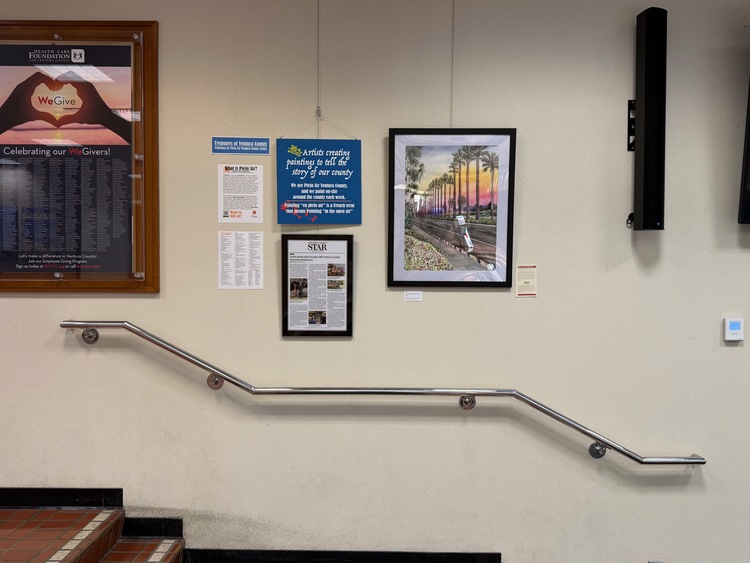
START in sunken area of Main Plaza Floor 2, looking toward Board of Supervisors’ wall.... These are the paintings of Simi Valley.
Palm Trees along Alamo Street.
One hundred forty‑four Washingtonia filifera palm trees were planted in 1913 to form the southern boundary of the Tapo District subdivision, a project of the Patterson Ranch Company. The trees remain in good condition today. Their typical lifespan is 70 to 100 years.
Now going up the ramp: These 6 paintings are from a visit to Strathearn Park in Simi Valley. Mary Zangerle painted the old adobe in watercolor, while Erin Dertner created a diptych showing the adobe’s Victorian farmhouse added on by the Strathearn family, with the blue and yellow Colony Houses on the left side, and the Wood Ranch Barns on the right.
Simi Adobe/Strathearn House (also known as de la Guerra Adobe).
Built by Santiago Pico, original grantee of El Rancho Simi, this adobe served as the rancho headquarters beginning in the early 1800s and formed an important link between the San Fernando and Ventura missions. When Robert Strathearn acquired roughly 15,000 acres from the Simi Land and Water Company around 1890, only two usable rooms of the original 1810 adobe remained. In 1892 a nine‑room Victorian farmhouse was added, with the adobe rooms continuing to serve as the family’s dining room and kitchen. The Strathearn family lived in the house continuously until 1968.
The blue Haigh Talley Colony House.
This is one of twelve pre‑cut, partially assembled two‑story houses shipped by rail and built in 1889 by a group of Chicago physicians who founded the townsite of Simiopolis. It was moved from its original location at Second and Ashland Streets to the historical park in 1970.
Wood Ranch Barns.
A main barn and a feed barn were built around 1945 for cattle ranching by Adrian and Emma Grubb Wood on their five thousand acre property known as Taylor Ranch. The barns were moved to the historical park when development began on the Wood Ranch subdivision.
Simi Library Building, Original.
This small, square, one‑room building was the first purpose‑built branch library in the Ventura County library system, funded after local residents raised money for the land in 1930. It served the community until the early 1960s, when a new library opened on Church Street in the Community Center. Originally located on Third Street near Los Angeles Avenue, it was moved to Strathearn Historical Park in 1971.
Saint Rose of Lima Catholic Church.
This small frame building was constructed in 1902 as a Presbyterian church. When the community could no longer support two Protestant congregations, the Presbyterian members merged with the Methodists and began worshipping in the Methodist church. Around 1910, the former Presbyterian building became a mission church of Santa Clara in Oxnard, remaining the only Catholic church in Simi Valley until the new Saint Rose of Lima Church was completed in 1965.
THe Next 4 paintings are of Grandma Prisbrey's Bottle Village.
This is an example of a landmark not custom-designed by an architect.
From 1955 to 1965, Grandma Tressa Prisbrey created a whimsical folk‑art village made up of 14 structures with walls and ceilings formed from cement embedded with recycled items, multicolored bottles, and discarded objects such as car headlights and TV tubes, to house her pencil and doll collections. The site was badly damaged in the January 1994 Northridge earthquake.
Elephant Rock.
This natural sandstone formation served as a Chumash habitation site and later became a favorite picnicking spot for Simi Valley’s pioneer families. Viewed from the northwest, a portion of the rock resembles the head of an elephant, complete with ear and trunk.
Southern Pacific Railroad Depot, Santa Susana.
One of the few surviving structures from the original Santa Susana townsite, this depot was built in 1903 and first stood on Los Angeles Avenue. It was moved to Santa Susana Park in 1975. The building was constructed using Southern Pacific’s Standard Number 22 station plans.
Corriganville Movie Ranch Site (also known as Hopetown).
Corriganville was a 1,500 acre property in Simi Valley purchased in 1937 by western film star Ray “Crash” Corrigan. For nearly three decades it operated as a working movie ranch and served as the filming location for numerous movies and television series, including Fort Apache, The Lone Ranger, and The Adventures of Rin Tin Tin. In 1949, Corrigan opened the ranch to the public as “Corriganville,” a western‑themed amusement park. Bob Hope purchased the property in 1965, giving rise to its alternate name, Hopetown. Today, the site—now Corriganville Park—offers trails, scenic views, and historic photo displays.
and the last two paintings of Simi Valley, are
Brandeis-Bardin Institute's House of the Book.
This brutalist, thin-shell concrete building, known as “House of the book,” is located on the remote campus of the American Jewish University in Simi Valley. Planned as a religious retreat and library, it has also appeared in several movies, including Star Trek. Designed in 1973 by architect Sidney Eisenshtat, the cylindrical facade features a raised map of ancient Jerusalem.
Artist Erin Dertner won the award “Painting with Grace,” (which means creating art with fluidity, and, often conveying spiritual depth, inner peace, and compassion), for Simi Valley’s House Of the Book, an example of Erin’s ability to translate a scene of great detail onto canvas in just a few hours. Here she portrayed the intricate Hebrew lettering of the massive concrete entry monument for amazing effect.
The tour continues with Fillmore, left, down the hallway.
Start in the Fillmore hallway, with the two FILLMORE sign paintings.
Fillmore Sign.
Located on the Northeast corner of Highway 126, (or Ventura Street), and Central Avenue.
Designed in the Streamline Moderne style, this lozenge‑shaped sign features a slim vertical form, rounded at the top and bottom. The name “Fillmore” appears in 12‑inch white neon letters arranged vertically, with a neon arrow near the base that seems to pass through the sign as it points toward downtown. Installed in 1940, after the highway was shifted one block south from Santa Clara Street to Ventura Street, the sign served to guide passing motorists into Fillmore’s business district.
Southern Pacific Railroad Depot, Fillmore.
This prefabricated railroad building stands near its original location. When the Southern Pacific Railroad completed its line between Ventura and Los Angeles in 1887, Fillmore, named for Southern Pacific’s West Coast superintendent, Jerome Fillmore, was established as the only train stop in the sparsely settled eastern Santa Clara Valley. The town itself followed in 1888. The stop played a vital role in supporting the region’s citrus and oil industries between 1910 and 1920. Today, the building houses the Fillmore Historical Museum.
Number 570 Santa Fe Caboose at Fillmore Depot.
The caboose served as a home away from home for train crews, equipped with bunks, a table, stove, ice chest, toilet facilities, and a desk where the freight conductor completed paperwork. The cupola provided the brakeman with an elevated view of the train ahead. Santa Fe contracted American Car and Foundry to rebuild older boxcars into cabooses, and Number 570 was completed in 1927, and rebuilt in 1970, and 1978.
Fillmore State Bank.
This two‑story Mediterranean and Italian Renaissance building, constructed of brick and terra cotta in 1917, was designed by Albert C. Martin, a prominent Los Angeles Beaux‑Arts architect. The Second Avenue entrance is distinguished by classically inspired voussoirs—wedge‑shaped elements used in arch construction—and cable and bullet molding archivolts, with decorative cartouches flanking the signage above. The cornice line is accented with small medallions, and the roof is finished with Mission tile. The structure served as the second home of the city’s first bank, and housed the city library on the upper floor for roughly a decade.
Farmers and Merchants Bank.
This one‑story plastered concrete structure was designed in the Classical style in 1914, featuring square engaged Doric columns along both street façades and a pedimented entrance.
Lois Freeman-Fox won the award “Lyrical Style,” for Fillmore’s Farmers and Merchants Bank. She has a knack for portraying personality and movement in her portraits of buildings.
Arts and Science Buildings - Fillmore High School.
Artists Katie Well painted the Arts Building, and Mary Zangerle painted the Science wing.
These two buildings, the earliest structures on the campus, are single‑story Mediterranean‑style designs dating from 1937. Rectangular and stucco‑clad, they feature low‑pitched gable tile roofs, elaborate Moorish arched entrances, with extensive Churrigueresque relief. Recessed arched windows flank the primary doorways. The Arts Building originally served as the junior high school.
Sespe School.
(also known as Fillmore Unified School District Offices).
Eight classrooms, a kitchen, and an auditorium were constructed on the nine‑acre site in 1922. Classes were held in the building until the 1960s, when it no longer met earthquake safety standards. The school’s auditorium continues to serve the community for public events.
Artists' Barn,
(also known as Hinckley's Artists' Barn).
For many years, the Hinckley’s Artists' Barn, originally a circa 1910 barn converted into a residence and studio in 1936, served as an important art center for Ventura County. It was even featured in a 1936 Life magazine article. The barn regularly functioned as a Lyceum of the arts, hosting cultural and creative gatherings. The nearby pepper tree dates back to the late 1880s.
Trinity Episcopal Church.
This redwood church, designed in an English gingerbread and Craftsman style, features one of the few remaining lych‑gates in the United States, which is a roofed gateway traditionally used as the gathering point for mourners before a funeral procession. The name “lych gate” is derived from the Old English word for “corpse.” Built in Hueneme in 1901, the church was commissioned by Senator Thomas Bard for his wife Molly. In 1933, Mrs. Bard gifted the church to the Fillmore Episcopalian community; and then it was carefully dismantled, each piece numbered, transported to Fillmore, and reconstructed. For decades, locals have affectionately referred to it as “The Little Chocolate Church.”
Sanitary Dairy/Clifford Hardison House.
Located on Old Telegraph Road, Fillmore,
A 40‑foot‑tall silo, prefabricated and purchased from Sears, along with the milk barn, was built around 1916, for a family‑run dairy that supplied milk to homes, schools, and stores in Fillmore, until it closed in 1976. The silo was damaged in a windstorm in 2021 and was subsequently demolished.
The next two paintings are of Bardsdale Methodist Church.
A Ventura County Landmark, and Also listed in the National Register.
This one‑story clapboard church, the oldest church and congregation in the Fillmore area, was first organized in 1892 and built in 1898 in the Gothic‑influenced Carpenter Gothic style, featuring a high‑pitched tower roof. The lots were donated by Thomas M Bard, who also contributed the north art‑glass window, and matched by a west art‑glass window donated by the community. You can see the west art glass window in Artist Valerie Williams's painting. Much of the construction labor was provided by church members. A rebuilt 1905 Robert Morton theater‑style pipe organ, installed in 1936 and later enhanced with chimes, has since been replaced by a Schoenstein pipe organ believed to be of the same vintage as the building.
Church of Christ Scientist. (also known as Lutheran and Community Churches).
This English Tudor‑style stucco church features a winding flagstone and brick path leading to its entrance. Designed in 1929 by architect H Roy Kelley, the building received an Honor Award from the American Institute of Architects, Southern California Chapter.
Now step across the hallway, find Newhall Mansion painting at the end of the nearby row.
Newhall Mansion, (also known as Cook, Piru, and Warring Mansion).
The original Cook Mansion, was built in 1887. This residence, considered the epitome of the Queen Anne style, was completely reconstructed after a 1981 fire, while incorporating updated plumbing and other changes. The two‑and‑a‑half‑story, multi‑gabled house features exceptionally large rooms and a remarkable array of architectural elements, including a three‑story Sespe stone tower, balanced by another, three‑story pointed wooden tower capped with a Phoenix finial; moon windows; recessed arched balconies; extensive exterior woodwork in varied shingle patterns; and a wraparound porch, accented with a wrought‑iron seahorse‑motif railing. The home also contains two impressive brick and Sespe stone fireplaces, numerous stained‑glass windows, unusual tile floors, and even a round outhouse with a conical roof.
First Church in Piru/Sullivan House.
Built in 1887, this is one of the few remaining houses from this period in Piru that has retained its original architectural character. The porch provides entrances on both the south (front) and east sides. The house was reportedly constructed as the town’s first church and originally stood on Main Street near the mouth of the canyon; after serving as a church, it later functioned as a schoolhouse before being used as a residence.
Piru Train Bridge.
This steel through‑truss, two‑span railroad bridge, built around the turn of the century, is approximately 300 feet long with a concrete center pier. It formed part of the rail route from Castaic to Ventura, which opened in 1886. The bridge has since been featured as a filming location in several movies.
Piru Hotel, (aka Mountain View Hotel/Round Rock Hotel).
Built in 1888 for Piru’s founder, David Cook, this two‑story building became the only hotel between Santa Paula and Castaic Junction. Over the years, it has attracted film productions, often serving as a stand‑in for buildings set in New England or the Old South.
Piru Methodist Church.
This Gothic clapboard church was built between 1887 and 1890 by David Cook, founder of Piru, shortly before he completed the Cook Mansion. It houses a rare 1865 pipe organ, purchased by Hugh Warring and built directly into the church walls. The organ was shipped around Cape Horn, survived the 1906 San Francisco earthquake and fire, and was finally installed in this church in 1935.
The next 7 paintings are of the historic “crown jewel” of Heritage Valley,
Rancho Camulos.
A Ventura County Landmark. Also listed as a California State Historical Landmark, and in the National Register.
Rancho Camulos was part of the 48 thousand acre Rancho San Francisco, granted in 1839 by the Mexican government to Antonio del Valle in recognition of his military service. After his death in 1841, the property was divided among his descendants, and in 1853, his son Ignacio acquired the western portion and established Rancho Camulos. The main adobe and veranda were built in several phases, beginning in 1853 and reaching essentially its present plan by 1880. The ranch gained literary fame when Helen Hunt Jackson used it as the setting for the opening of her 1884 novel Ramona. In 1924, the del Valle family sold the property to the August Rubel family. Today, approximately 600 of the ranch’s 1,800 acres remain under cultivation, and the historic landmark consists of fifteen structures, including a 1910 gas and oil house, 1867 winery, 1930 Schoolhouse, 1853 fountain, and a cemetery.
Now continue to the carpeted Thousand Oaks wall, behind the escalator. The first group of paintings are of Stagecoach Inn Historic Park.
-
Welcome to the Atrium Gallery
-
Floor 2 (Main Plaza Level): Simi Valley and Fillmore Landmark Paintings
-
Floor 2 (Main Plaza Level): Thousand Oaks and Camarillo Landmark Paintings
-
Floor 3: Ojai, Malibu, Anacapa Island Landmark Paintings
-
Floor 4: Port Hueneme and Oxnard Landmark Paintings
-
Floor 4: Santa Paula Landmark Paintings
-
Floor 4: Ventura and Moorpark Landmark Painitngs