Floor 4: Santa Paula Landmark Paintings
After finishing the Oxnard landmark paintings, we continue around the balcony corner to Santa Paula....
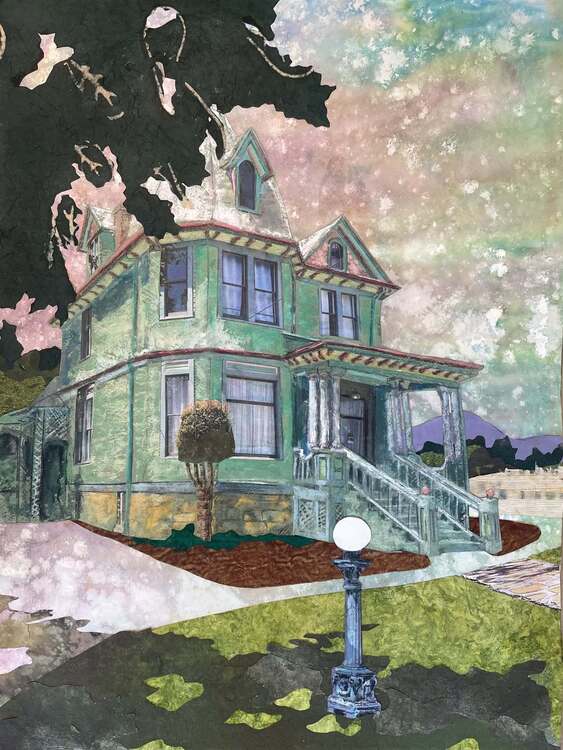
Baker House.
This house was built in 1890 for Andrew Baker, City Marshall and Constable. It features an irregular shaped gabled roofline, offset by a French Mansard tower, which is angled to form a large bay window. It has a prominent front porch with slender classical columns grouped in threes.
Two paintings show Teague Mansion, the north side with driveway entry gate, and south side.
This 9,600 square foot, two story building was designed in 1923 by Roy Wilson, in the Classic English Tudor Revival style, for Charles Collins Teague. Its unique features include an elevator, indoor barbecue, cedar doors and woodwork from Italy, ten furnaces, seven bathrooms, four fireplaces, three chimneys, a game room in the basement, outdoor swimming pool, four car garage, and five bedroom suites with baths. A cistern in the basement gathers rainwater for houseplants.
Charles Collins Teague House.
This 2 and a half story Colonial Revival house features a slightly flared high-pitched truncated hip roof and a bell-cast dormer with a Palladian window flanked by stone columns. The house was designed by architects Greene and Greene in 1900 for Charles Collins Teague, rancher and President of the First National Bank and C.C. Teague Lemon Company. The front door and window panels are of oak with leaded glass. The porch and balcony wrap around the west side of the house and are supported by split Sespe stone and wood columns.
Charles L and Nellie Sheldon House.
This house, built in 1900, has been authentically restored as a Neo Classic Row House. It was built for Charles Sheldon, Secretary Manager of the Santa Paula Citrus Association., and his wife. An L shaped 1 and a half story house with narrow clapboard siding, it rests on a stone foundation. Outbuildings, twin water tanks, and a summer kitchen are also preserved.
Underwood House.
This elaborate Queen Anne style house, built in the mid 1890s, has an irregular roofline, gabled dormers, slanted bay windows, and decorative fish scale and shield shingles under its unusual rounded front gable, and on its large curved front porch. Other significant details include a sunburst design in the porch gable, two leaded glass front windows, and a stained glass window in the kitchen. The house was converted to a rooming house, but has been restored to its original style.
W L Hardison Stable.
An adjacent Italianate two story house was constructed on a portion of Rancho Santa Paula e Saticoy, in 1884 for W L Hardison, co-founder of Union Oil Company and Limoneira Ranch. The stable was built in 1885 by a Pennsylvania craftsman. The first floor housed horses, carriages, wagons, tack and other equipment; the second floor was a large open hay loft with grain feed bins. The exterior is rustic shiplap siding with double-hung windows, paneled sliding doors, and ventilated cupola. Wife Clara Hardison remained in the family home until 1923, when she purchased the home of Charles C Teague on Santa Paula Street in Santa Paula. The Hardisons and their direct descendants continued to live on the property until 2011. In 2013, the Hardison farm was purchased by a real estate developer, who preserved the property within a heritage park easement in the new development.
McKevett School, (aka North Grammar School).
Property for the school was donated by Alice Stowell McKevett, Santa Paula pioneer, who also gifted a building and grounds to the Ebell Club. The school building was built in 1910 and awarded first prize by the National Building Committee in Washington, D C as the best planned school building in the U S for that year. It is built in Mission Revival style and U shaped, with each room opening onto a wide veranda and center courtyard.
Balcom House.
This Italianate style house, with a two story slanted bay window, was built in 1885 by William Elder Balcom, in a location remote from town commerce at the time. William and his wife Margaret raised eight children. When their first three sons were old enough to take over the duties on the family ranch, (near the canyon that still bears the Balcom name), the rest of the family moved to this house to be closer to Santa Paula schools.
Turn the corner, to continue the painting tour. Remember the Architects Franklin Ward and Herman Anlauf? They also designed the Faulkner House.
Ventura County Landmark Number 1. Also listed in the National Register
This house, on a modern working farm, is one of the finest examples of pure Queen Anne style in southern California. It has a three story octagonal tower, irregular roof line, projecting gables, gracefully curved porch, and ornate stained-glass windows. The front door contains more than 500 pieces of beveled, etched glass set in copper, and the upstairs library is crowned by a domed ceiling with a stained-glass skylight. The house was wired for electricity and piped for plumbing when it was built in 1894, years before those services were generally available. Other modern features were a dumbwaiter from the basement to kitchen, for delivery of firewood, a roll top desk built into the living room wall, and a built in speaking tube system, complete with bells.
Santa Clara Schoolhouse, (also known as Little Red Schoolhouse).
This is the only one room schoolhouse in the county still in use. It is of wood construction, with a stone foundation, built in the high tower Colonial Revival style in 1896. It was painted red in the early 1960s. The original blackboards were literally blackened boards. The children used slates for all writing purposes. The teacher had a small table and kitchen chair. The children, who sat on benches, faced the wall while studying, and the center of the room when reciting.
People’s Lumber Company Building.
Designed by architect Roy Wilson, The 1890 People's Lumber Company Building, is a Neoclassical style masonry building with a rectangular plan and one story height with a flat roof.
It features a cast stone (concrete) cornice across the front of the building, inscribed with the name “People’s Lumber Company,” and flanked by fleur-de-lis designs. Other features are leaded glass windows, and colorful brick, which intersperses common red and purple brick, laid out in a Flemish bond pattern.
Union Oil Company Building, (also known as The Oil Museum).
This office building was the first headquarters of Union Oil Company. Built in 1890, it is primarily Queen Anne style with Italianate influences. Unocal opened a small museum in the building in 1950. In 1990 the company, in observance of its centennial anniversary, spent 2 and a half million dollars to restore the building and enlarge the museum. The building has ten fireplaces, no two alike, and three walk-in vaults.
Odd Fellows’ Town Clock.
The four faced Seth Thomas clock above the lodge's hall, originally weight-driven, was installed in 1905 and still tolls the hours with its cast bronze bell. Above each face is the Odd Fellows' insignia, (which is three links symbolizing friendship, truth, and love), carved in wood. The clock’s original lead weights were set with a hand winch, which was woaund every Monday morning. In 1952, the cable which held the weights was found to be seriously frayed, so the clock was electrified.
Anna M Logan House.
This 1 and half story house represents the best example of the Eastlake style in Santa Paula, designed in 1888 by architects Franklin Ward and Herman Anlauf, (the same architects as the Faulkner House). The irregular roofline is composed of steep pitched intersecting gable and hip roofs. The dormer is distinguished by a dropped stickwork pendant and cutout detail, with a radiating sunburst arched window. The chimney is corbelled, and the porch and front bay have a profusion of applied stickwork and cutout detail.
Glen Tavern Hotel.
A Ventura County Landmark. Also listed in the National Register
This combination Craftsman and English Tudor style hotel, built circa 1910, was designed by notable architects Hunt and Burns. It has two large offset gables and multiple gabled dormers. The interior features original dark wood paneling, some original light fixtures, a stone fireplace, and Craftsman columns.
Santa Paula Ebell Club, (also known as Theater Center).
A Ventura County Landmark. Also listed in the National Register
The Ebell Club is an outstanding example of the shingled Craftsman style, designed in 1917 by the noted Los Angeles architectural firm of Hunt and Burns, who also designed the Landmark Glen Tavern Hotel. The building and grounds were a gift to the Ebell Club from Alice Stowell McKevett, in memory of her husband, Charles McKevett. Mrs. McKevett was instrumental in organizing the Santa Paula Ebell Club in 1913, the ninth chapter in California. Previously, the property was the site of an early motion picture studio. The garden’s bridge, fish pond, and gazebo were removed in the late 1940s.
Universalist Unitarian Church Building.
This is the oldest standing church in Santa Paula, and one of the first Universalist churches on the west coast. Designed by Architects Seymour Locke and Frederick Roehrig, it was constructed of local brick and river rock in 1892. The stained-glass windows were shipped from Chicago by rail.
Southern Pacific Railroad Depot.
Built in 1887, this first train depot in Ventura County was also among its first prefabricated structures. The second floor of the building served as living quarters for the station agent and family. Few events in the county’s history transformed as many lives as the coming of the railroad. Passenger service at the depot ended in 1934, and freighting ended in 1975. The depot has been a filming site for many movies and commercials.
Artist Hellah Urban won the award “Confident Mastery,“ for Santa Paula Depot, showing incredible skill for telling the story of a place, and incorporating people in her painting. Here she shows us the historic Depot, and Morton Bay Fig Tree, but also includes today’s modern opportunity of visitors riding the rail cars!
Morton Bay Fig Tree.
This tree was planted on July 4, 1879, by the Reverend Mr. Eben H Orne, to honor the birth of his daughter, Cecilia.
The Mill.
In 1887, the Southern Mill and Warehouse Company built eight produce storage facilities along the rail line between Santa Barbara and Newhall; this was the smallest one. Farmers brought wagonloads of produce here to be weighed, stored, and shipped out by rail. In 1894, the Southern Pacific Milling Company bought the building, enlarged it, and began to sell livestock feed, grain, and seed as well as storing beans, cleaning grain, and shipping apricots and other produce. From 1954 to 2004, the Hengehold family of Santa Paula ran Santa Paula Feed and Supply in the building, but by 1960 renamed it, The Mill. In 2006, the Ventura County Transportation Commission, received a federal grant to renovate the building. The Ventura County Agriculture Museum is the current tenant, showcasing exhibits to tell the story of Ventura County’s farming and ranching tradition.
The tour continues around the corner, with Ventura landmark paintings.
-
Welcome to the Atrium Gallery
-
Floor 2 (Main Plaza Level): Simi Valley and Fillmore Landmark Paintings
-
Floor 2 (Main Plaza Level): Thousand Oaks and Camarillo Landmark Paintings
-
Floor 3: Ojai, Malibu, Anacapa Island Landmark Paintings
-
Floor 4: Port Hueneme and Oxnard Landmark Paintings
-
Floor 4: Santa Paula Landmark Paintings
-
Floor 4: Ventura and Moorpark Landmark Painitngs