

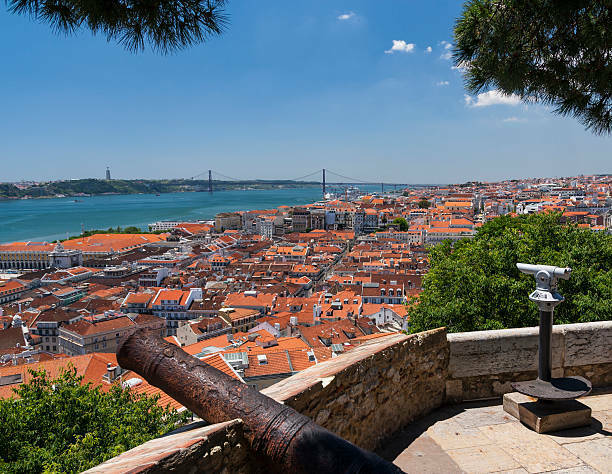
Without a doubt, this is the most spectacular viewpoint over Lisbon.
Further away, to the southwest, which diagonally to your left, you will see the 25 de Abril Bridge, which connects Lisbon to the south bank of the Tagus river and the city of Almada.
Have you noticed that this is very similar to the Golden Gate Bridge in San Francisco? In fact both were built by the same construction consortium.
If you look slightly to the left, you will see at the foot of the Castle’s hill, close to the Tagus, the imposing Praça do Comércio, formerly known as Terreiro do Paço, with the equestrian statue of King Joseph the first, standing in its middle. On each side of the square stands the former Royal Palace.
This was for centuries the city’s main square, as well as the center of Portugal’s political power, which ruled an Empire that stretched from Brazil to the very Far East.
It was remodeled to its actual shape after the great earthquake that shook Lisbon on the 1st of November, 1755, which has destroyed nearly the entire city, killing thousands of people.
To the right of the Praça do Comércio is the quarter of Baixa: Lisbon’s downtown. This was totally built over the shattered ruins of the old medieval center after the earthquake of 1755, under the rule of the Marquis of Pombal. Its grid shaped streets, and large boulevards became icons of the Age of Enlightenment which spread through Europe in the 18th century.
The uniform five floor buildings that form this quarter were designed to resist strong earthquakes.
Further to the right, you will see, pointing from the middle of Baixa, the Santa Justa Lift Behind the iron elevator, on the hill of Sheeaado, opposite to the Castle, you will find the ruins of the gothic Convent of Carmo.
This was erected in the 14th century, and it was also the victim of the earthquake of 1755.
Its ruins were preserved to this day in memory of that dreadful event.
At the foot of the Convent of Carmo you will distinguish three large squares standing next to each other: the Praça do Rossio, the Praça da Figueira, and the Praça dos Restauradores, with the obelisk in the middle.
It is believed that the tsunami that followed the earthquake of 1755 reached this area, devastating everything in its way.
Today these wide, luminous squares are at the very center of Lisbon’s busy life.
Once you’re done admiring the view over Lisbon, please walk along the paved pathway that goes along the panorama, to the right, until you reach more cannons lined up.