

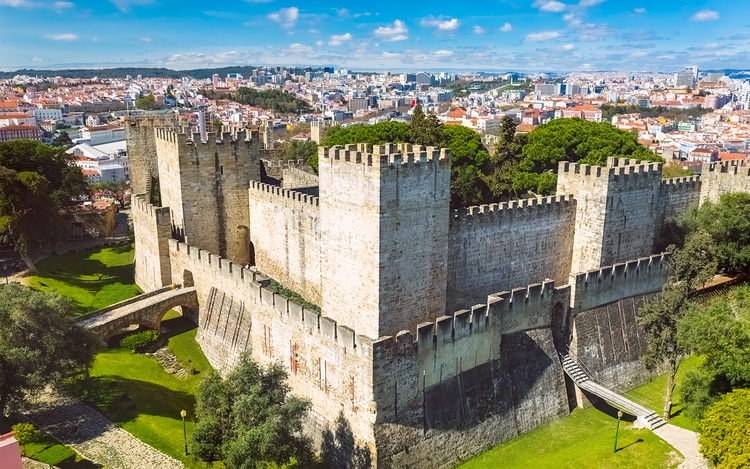
St George Castle, perched atop Lisbon's highest hill, has stood as a symbol of the city's resilience and history for over a millennium. Originally built by the Moors in the 11th century, it was strategically positioned to defend the city from invaders and served as a royal residence for centuries. The castle you see today is the restored version of the Moorish construction, which was Later named after Saint George, the patron saint of England, following the Anglo-Portuguese Treaty in 1373.
In 1147, during the Reconquista, Christian forces led by Afonso I of Portugal seized the castle from the Moors after a fierce battle. It became a royal palace until the 16th century when a devastating earthquake caused significant damage.
Throughout the centuries, St George Castle underwent various renovations and expansions, reflecting the architectural styles of each era, from Moorish to Romanesque to Gothic. It witnessed the reigns of numerous monarchs and played a crucial role in Portugal's maritime discoveries during the Age of Exploration.
By the 20th century, the castle underwent extensive restoration, transforming it into a major tourist attraction. Today, visitors can explore its ramparts, towers, and archaeological sites while enjoying panoramic views of Lisbon and the Tagus River. St George Castle stands not only as a testament to Lisbon's storied past but also as a beacon of cultural heritage and pride for Portugal.