Stop 7 - Migration, the Clearances and the Cleopatra.
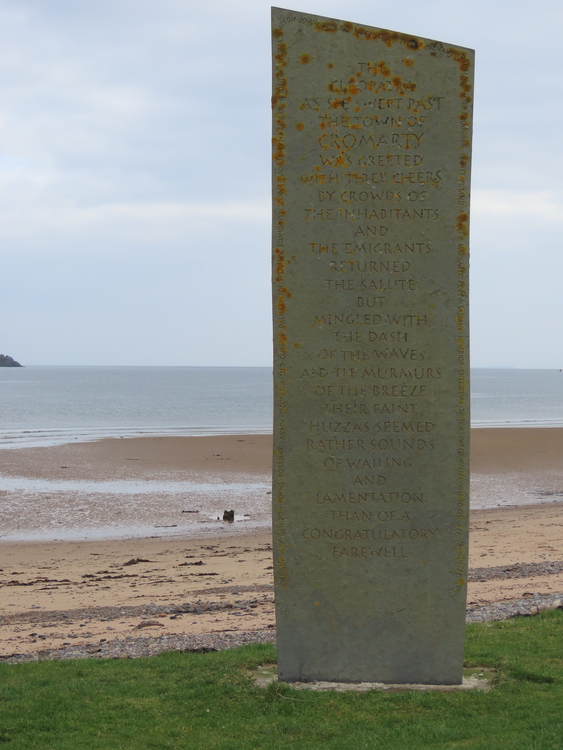
The stone you see before you was erected in 2002 as one of a series of events to mark the bicentenary of the town’s most famous son – Hugh Miller. The words carved in the stone were from a report written by Miller as he witnessed the Cleopatra, an emigrant ship leaving the town to travel to Quebec in 1831. In that year alone 62 ships sailed from the Cromarty Firth with passengers looking to carve new lives for themselves across the Empire.
Migration from the Highlands had been ongoing for a long time. The decline of the clan system from as early as the 1700s had seen many of the middle class families move away as they grew concerned about the future. Clan Chiefs were increasingly viewing their estates as assets for their personal wealth rather than lands they held in trust for all their extended family, so many who could leave did so for purely economic reasons. But the pace of migration accelerated through the 1800s and peaked in the middle of the century at around the time Hugh Miller watched the Cleopatra sail from Cromarty. Many of the later migrants were forced from small farms by their landlords who increased rents and looked to replace subsistence farming with more lucrative agricultural ventures like sheep farming. This period became known as the Highland clearances. The displaced families often moved to the developing industrial heartlands on the Clyde but some, if they could raise the price of passages, left Scotland entirely.
As a result, there is hardly a town or village in Canada, the United States, Australia or New Zealand that does not have a street or significant building named after a Scottish Highland migrant.
Walk across the grassed area (the links) towards the low-lying white buildings. These are two prefabricated homes typical of thousands built after WW2 to house families whose homes were destroyed during the blitz. They were only ever meant as a temporary measure but proved incredibly popular. Nowadays there are only a few examples left.
Keep walking over the links but keep the sea in view. You will eventually come to Shore Street where you should listen to stop 8.