Stop 6 – Cromarty: The Harbour and the Factory Mileometer at 27 miles.
We will now take you on a walk around Cromarty. This is one of our favourite small towns in the Highlands and, in many ways, you can tell much about the history of Scotland from a stroll through its streets.
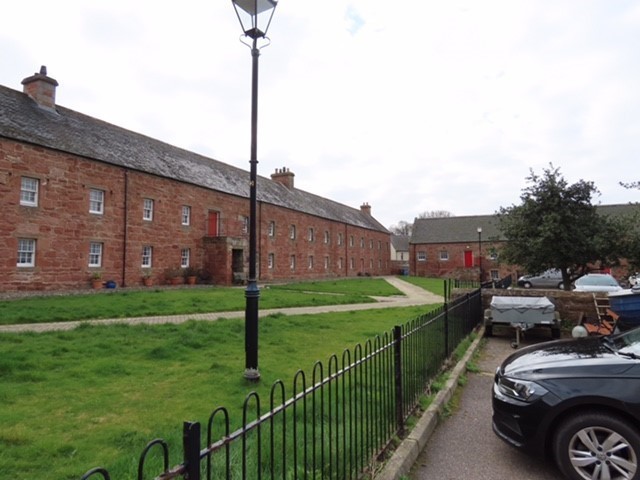
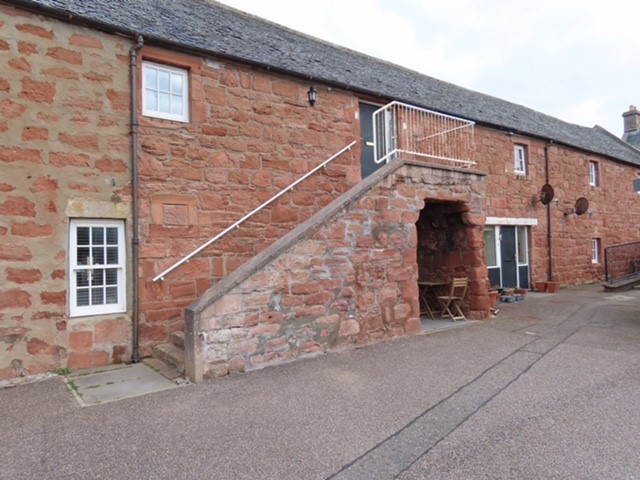
If you face the town with your back to the sea you should see the Royal Hotel. To its right there is a building set back off the road and forming 3 sides around a courtyard. These are now used as housing but if you visited in the late 1700s this was a thriving scene of industry. The buildings were constructed as a “manufactuary” or as we would say today, a factory. They served various purposes including a rope works but were principally used for making hemp sacks. The hemp itself was imported from the Baltic states then woven into cloth by outworkers, using hand looms in their own homes. It was then finished here as sacks for export across the world. Many of the sacks ended up in the Carolinas in the Southern USA or in the Caribbean so we can guess they were used for parcelling tobacco or cotton grown using slave labour. This will not be the only sign of the importance of the slave trade as we walk around Cromarty but that makes it no different from practically every town in the country who either directly or indirectly benefitted from that odious trade in some way.
The factory was built by George Ross who is without doubt the most important single figure in Cromarty’s history and you will hear much more of him as we progress.
Turn now and walk towards the harbour. Again, Ross was responsible for many of the improvements to the harbour although Cromarty’s importance as a sea port goes back to medieval times. A ferry ran from here across the firth and formed part of the pilgrim trail for those visiting the tomb of St. Duthac in Tain. There is still a wonderful small ferry that runs from Cromarty to Nigg on the far shore, but only at limited times. It only takes 2 cars and has a turntable on its deck so they can drive on and off without reversing. We’ve made the journey before, accompanied by Moray Firth Dolphins and while I can’t promise you’ll be that lucky, a crossing here is always a memorable experience.
It’s said Cromarty prospers when Britain is at war and struggles when it isn’t. This is mainly due to its importance as a sheltered and easily defended deep water port. The British Navy used Cromarty for its North Sea fleet for many years. During World War I vessels sailed from here to take part in the battle of Jutland, the biggest naval battle of the war. It resulted in a bit of a stalemate. But the German Fleet never again tried to break out of their North Sea ports and were effectively neutralised as a threat.
There are interpretation boards close to the harbour well worth reading that tell you more about the importance of the port.
As you walk past the harbour imagine how busy it would have been when this was an active fishing port. There would have been nets to repair, fish to gut ready for salting, barrels to be filled and all manner of activity.
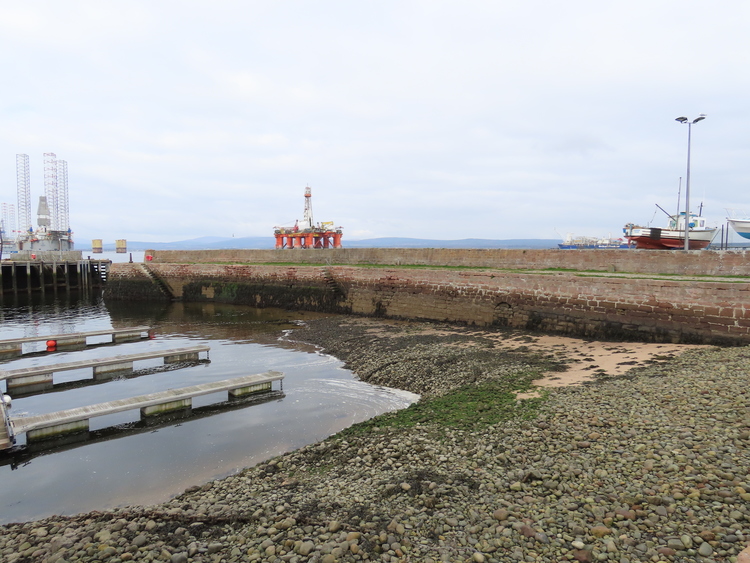
Those days are gone, but you can’t visit Cromarty and not notice a more modern industry that now dominates. Oil. Since the 1970s the Cromarty Firth has been an important base for the construction and servicing of oil exploration and production. The major activity for this sector is at Nigg and Invergordon but the giant fabrication yard and the riggs and exploration vessels that lie sheltered in the firth are a constant reminder of how important this industry has been to the Highlands and Scotland as a whole.
Nowadays the naval ships have gone and the fishing fleet reduced to a couple of boats. Even the oil industry employs a small fraction of the workforce it once did. A few pleasure craft bob in the sea, but the days of Cromarty as an important harbour are long behind it.
Continue to walk past the harbour and walk across the grassy area to the standing stone on the shore edge and listen to stop 7.