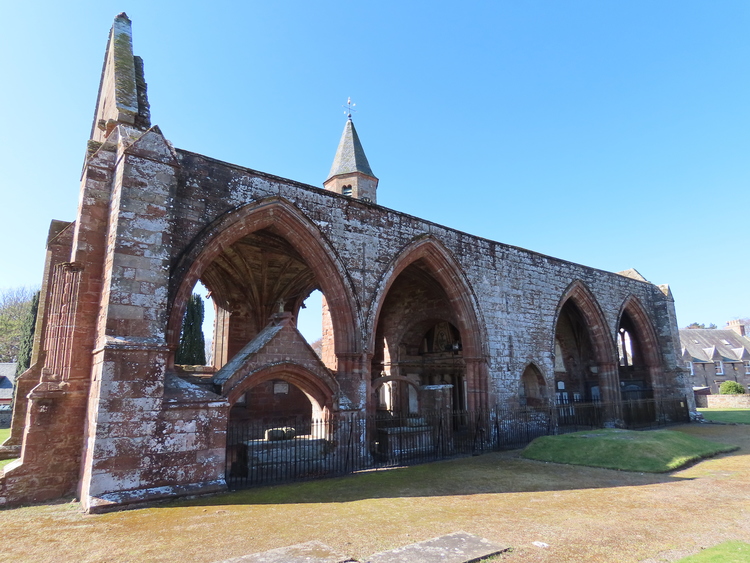
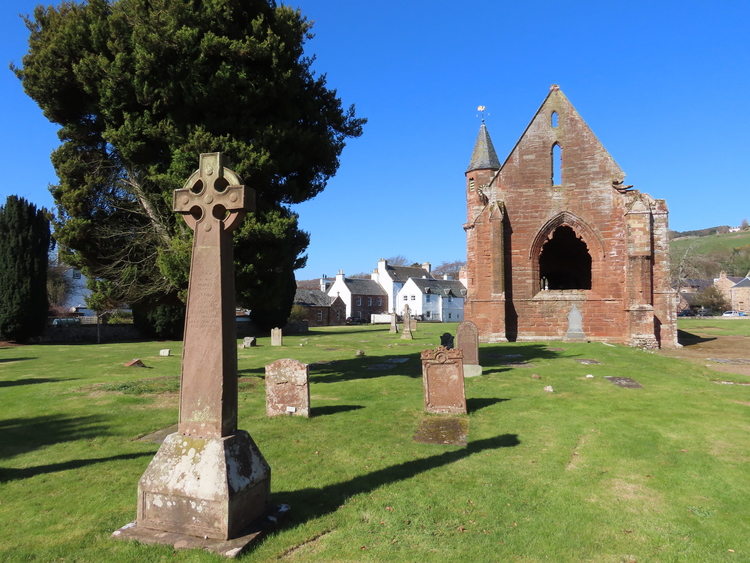
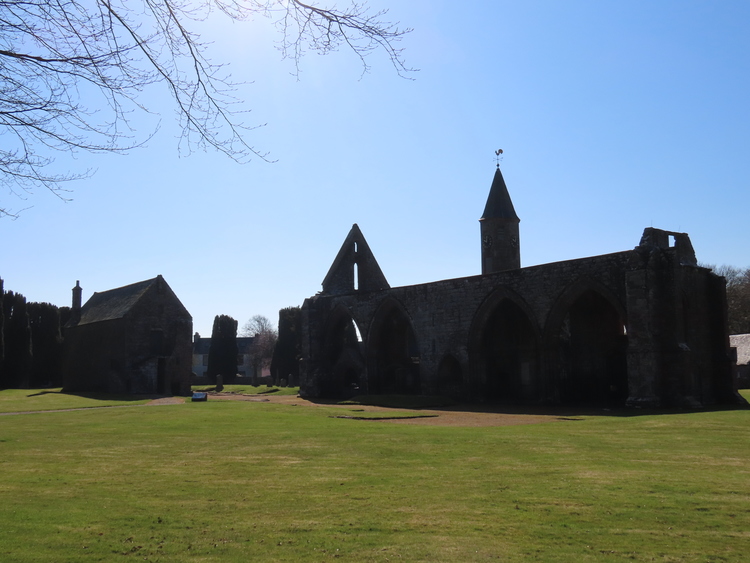
Stop 4. Fortrose Cathedral. Mileometer is around 16 miles.
Fortrose is a more substantial place with many grand sandstone villas you would have passed as you came into town. These are testament to the considerable wealth here at one time. Some of these were used as holiday homes for the wealthy and other as hotels and bed and breakfasts for tourists. While tourism may never have reached the peaks the builders of the Black Isle railway hoped for, it has always been important as a source of income to the area and is still a favourite holiday destination for many today.
But Fortrose is much more than a Victorian and Edwardian seaside town. It has a rich history and was, in the medieval period, an important settlement. Fortrose Cathedral, the ruins of which are before you in the Square, was the seat of the Bishops of Ross and is believe to date back to around the year 700. The oldest parts of the ruins you see at Fortrose now are much younger than that, dating to the 1300s. Little is still standing but anyone looking at the ruins today could appreciate this was an important building in its day.
The Cathedral continued to be used as a church after the reformation in the 1500s but was noted to be falling into disrepair by the 1600s. Parts were still used up to the 1800s, after which it was only the grounds that were used as a graveyard.
Fortrose is a nice wee town and well worth a wander around but I would suggest you continue to the next stop before having a longer walk.
One other thing to note about Fortrose is the long promontory that sticks out into the Moray Firth at the far end of the village. Fortrose Golf course sits either side of the road that runs down to the point. This is Chanonry Point - reputed to be the finest place to view the famous Moray Firth Dolphins, the most northernly school of these wonderful mammals in the world. I can’t guarantee you will see them but this is where to come if you want a go at dolphin spotting. We aren’t stopping here on this tour, but you might want to return in the future, although it can get very busy.
Continue through Cathedral Square and turn left at Union Street, then right to rejoin the main road. At around 17 miles you will come to Rosemarkie. At the far end of the High Street, there is a carpark on the right hand side just before the Plough inn. It’s signposted for the Groam Museum. If it is full keep going down the slope to the beach front where you can usually find a space. Park here and listen to stop 5. There is a public toilet next to the car park.