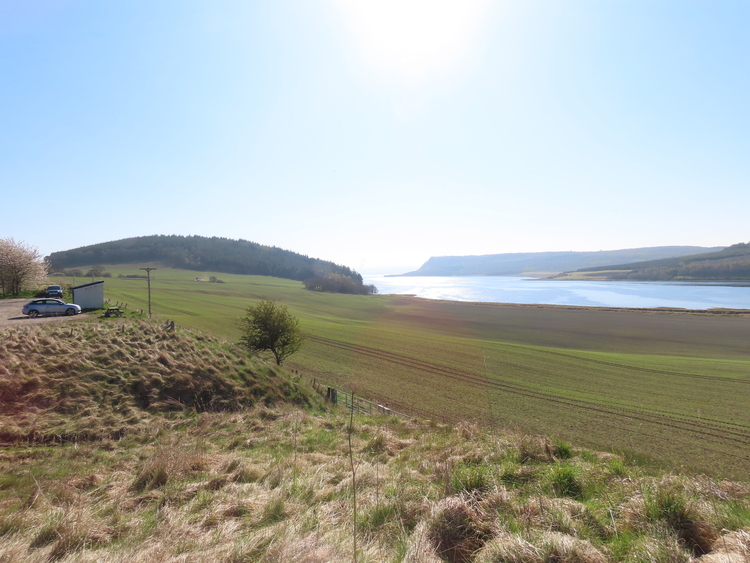
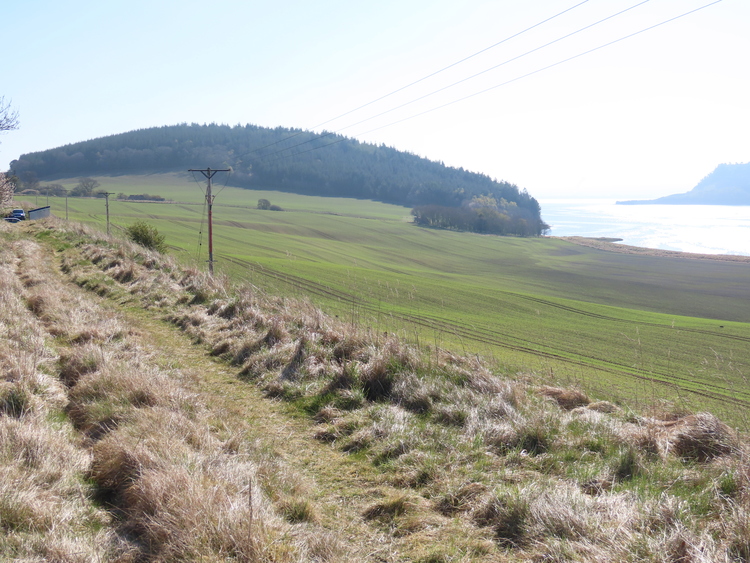
Stop 3 - Munlochy Bay. Mileometer will be at around 12 miles.
This is just a brief stop – no walking. Munlochy Bay is a nature reserve and is visited by many sea birds and wildfowl. It is an incredible natural bay and quite a sensible place to hide away if you’re in a small boat up to no good, a smuggler perhaps. There are also stories of boats hiding here during the Jacobite rebellions. There was a mill at the mouth of the bay for a while, powered, not by a running stream, but by the tide. This was not unique but much rarer than either windmills or those mills located beside rivers.
You are now firmly on the Black Isle which as you can see is neither Black nor an Island. But it is a peninsula and for hundreds of years people travelling North or South would have crossed it by ferry across the Moray Firth on one side and the Cromarty Firth on the other. This would have made it feel very like an island. And why Black? There are numerous theories – one is that it was heavily wooded and that made it appear black; but really? Trees are green – so why not the Green Isle? The other theories are that it appears black in winter because it experiences very little snowfall. Most of the heavy snow falls on Ben Wyvis to the West, sparing this area which has its own little micro climate as a result. And the last theory I have heard is that the soil is rich and dark and when the fields are ploughed for sowing in the spring it looks like a black island. Pay your money and take your pick – or make up your own theory.
If you look to your left or right you will see an embankment running parallel to the road. This is the route of the old Black Isle Railway that ran from Muir of Ord (just outside Beauly) to Fortrose. When built there was great hope it would boost the economy of the Black Isle with visions of transporting goods to Inverness and beyond, as well as welcoming hundreds of tourists to this great holiday destination. Sadly neither materialised in any significant way and the line never made any money. Opened in 1894 it was closed first for passengers in 1951 and for freight in 1960. One point of interest is that it had a private station on its route at Rosehaugh – a very grand country estate. You will pass its gates and see some of the wonderful parkland on the left hand side on your next leg. But like the Black Isle Railway itself, Rosehaugh Estate is no more, or at least its grand house isn’t. But it is still a popular spot for walkers and has some interesting buildings dating back to its halcyon days.
Our next stop will be Fortrose but it would be wrong if I didn’t say a little bit about Avoch, the next village you pass through. Avoch is one of those places named to confuse travellers. Forget how it is spelt and just accept it is pronounced Och. There is no surer way to single you out as a stranger than getting this one wrong. Avoch is typical of many Scottish coastal towns that look with one eye to the sea and fishing and with the other to the land and farming. There are records of commercial fishing here going back to the late 1500s. The original harbour was built in 1814, designed by Thomas Telford the great engineer who was responsible for many of the harbours and roads throughout the Highlands as well as the Caledonian Canal. Nowadays it is mainly used for pleasure craft.
From Munlochy Bay car park continue on the main road through Avoch. As you come into Fortrose, at around 17 miles, you will see Academy Street on your right which leads to Cathedral Square on the left. Park here and listen to stop 4.