Eton's Museum of Antiquities is housed in the Jafar Gallery and is part of the Bekynton Field Development, named after Thomas Bekynton (1390-1465). He was Bishop of Bath and Wells and secretary to Henry VI.
It was designed by John Simpson, who also designed the Queen’s Gallery at Buckingham Palace in 2002.
It contains Egyptian artefacts and other items given to the school over many centuries.
Amongst the collection is the bequest of William Joseph Myers (1858 - 1899), an Old Etonian, who saw service in the Zulu War and was later stationed in Cairo. He became interested in ancient Egypt in 1885, collecting until 1897. On returning to Eton, as Adjutant of the Cadet Corps, he kept his collection in his College house. Following his death, everything was bequeathed to the College.
These included a Sistrum fragment of Senwosret I, a cosmetic tube of Amemhotep II, a pectoral ornament, a wire ring with Scarab, and a collar terminal of Tutankhamun.
The gallery was opened by HRH, The Prince of Wales in June 2015.
Nearby, there is a new garden, with a dedication to Mrs Winifred Hay; it commemorates her long service to the people of Eton.
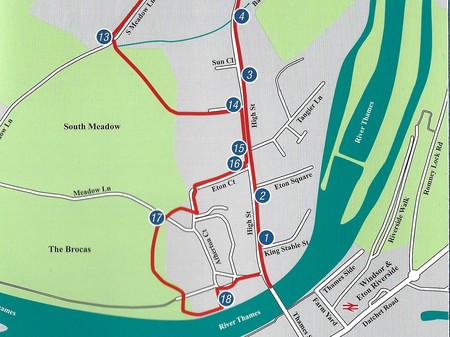
After the Gallery, a short distance further along South Meadow Lane, there is a public footpath marked on the left, at a gap in the hedge.
Turn left and follow the track at about your ten o'clock, across South Meadow towards the back of St John’s Church, around 170m away.
There is an alleyway connecting the Meadow, past the doctors’ surgery and Church entrance, which then runs through the churchyard before joining Eton High Street once more.