The Herschel Observatory is named after Sir William Herschel (1738 - 1822).
Herschel was King George III’s Astronomer (the first such appointment) and he is probably the most famous astronomer of the 18th century.
He fled to Britain with nothing but his life - having survived the defeat of the Hanoverians by the French in 1757 where he had been a drummer in the Hanoverian army.
He quickly developed his musical ability and won an organ competition using a novel technique of placing weights on the keyboard to make it seem like he had more fingers.
Through his fame he then secured a job as organist at the Octagon Chapel in Bath.
Whilst living in Bath, he met Sir William Watson who was observing the sky through his seven foot telescope in the street.
Herschel started manufacturing his own telescopes by hand, adapting Sir Isaac Newton’s reflecting mirror telescope to improve the amount of light that could reach the telescope’s mirror and the observer’s eye.
This endeavour took William Herschel from being a musician earning £200 a year to selling telescopes for £5,000 to the King of Spain in 1791.
On March 13th 1781, Herschel discovered Uranus. The remarkable feat was achieved through mapping the sky at night with his sister Caroline at the garden of his house in Bath, which is now the William Herschel Museum.
He would call out his observations to his sister who would sit nearby with a torch and make notes of the observations so that he could see the stars without his vision being impaired by the torchlight.
He was given a royal appointment as astronomer with an income of £200 for his discovery and so moved to Herschel House in Slough, to be closer to court in London.
He was to make Slough a place of scientific pilgrimage.
In addition to discovering the planet Uranus, he also observed and catalogued over 800 double stars and 2,500 nebulae.
He was the first astronomer to correctly describe the spiral structure of our Milky Way and once stated, ‘A knowledge of the construction of the heavens has always been the ultimate object of my observations.’
He continued his work of mapping the sky with his sister Caroline and discovered infrared in 1800.
He was acknowledged for the discovery, by being invited to reproduce it experimentally for the Royal Society of London.
His son, John Herschel, attended Eton College, but only briefly.
The Herschel Astronomical Society still meets in the observatory.
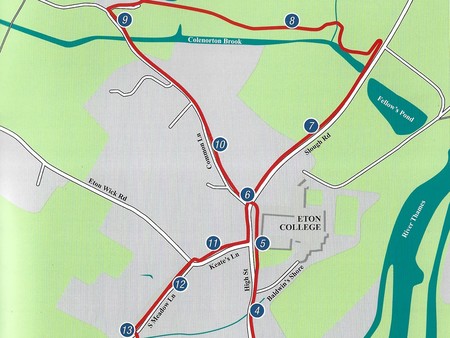
Continue about 300m back towards the College along Common Lane.
As you go, look up on the right hand side, to see the Gormley Statue looking down over Common Lane.