The Wall Game is a unique game, involving many scrums against the Wall, in College Field. A soiled and soggy ball is placed along the eponymous Wall, a 278-year-old structure 11 feet high and roughly 355 feet long. A small boy sits, hen like, on top of the soccer style ball. About 15 of the game’s other 19 players called seconds, walls and longs pile on top of the small boy, forming a rugby-like scrum known with killing aptness as the bully. Then, after a signal from the umpire (usually a teacher in mufti), the boys push, shove and tackle one another, while the bully shakes around in a many legged frenzy that, as one appreciative former house master put it, resembles the “death throes of some monstrous crab." After 30 minutes of this fun the players change ends and blearily set about knocking heads for another 30 minutes. There are metal steps on the road-side of the 1717 wall enabling boys to climb onto the wall to witness the melee beneath.
The game has been played in the Michaelmas (autumn) term since the 1830s. The first written rules date from 1841, but there is evidence of playing from the 1750s. On St Andrew’s Day each year there is a special match between the Kings Scholars (those students provided for by the original foundation of Henry VI and who live in College) and Oppidans (students who pay and stay in boarding houses in the town), watched by parents and boys alike. M.R. James, one-time Provost of Eton, enjoyed playing the Wall Game as a boy, though damaged his knee and suffered a crumpled ear from friction against the Wall. Years later he wrote: ‘I sigh to think how little I remember of the inwardness of the Rules: they cannot, indeed, be kept in the mind unless you are constantly playing or umpiring in the game.’ It attracts casualties; Ian Fleming broke his nose and Lord Hailsham was bitten on the leg.
Nearby is the boy’s house, Timbralls, so called because it was built in Eton’s timber yard (‘timber halls’). Among its famous one-time residents was Ian Fleming, creator of the secret service character James Bond. Coincidentally, the lamp post outside is numbered 007.
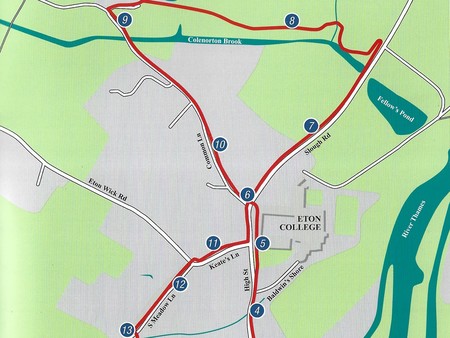
Continue to follow the main road (B3022) for about another 150m taking the gate to the left after the bridge and onto the public footpath which navigates around the school playing fields along side Colenorton Brook. Skinner’s Bridge over the Brook can be found close to the College buildings 150m into the college grounds.