Stop 7: James K. Polk’s Presidency
During Polk’s presidency, the U.S. Post Office issued the country's first postage stamp, creating a system we still use today. Polk’s administration also oversaw the opening of the Naval Academy, and on August 10, 1846, he signed the act establishing the Smithsonian Institute, today the world's largest museum complex. March 3, 1849, the day before Polk’s last day in office, Congress authorized the minting of the first federal gold dollar and double eagle. The gold coin on display is a federal gold dollar produced from 1849 to 1954. The obverse side (the side on display) shows an open wreath surrounding the denomination “1 DOLLAR 1853.” On the reverse side is the Liberty Head surrounded by thirteen stars.
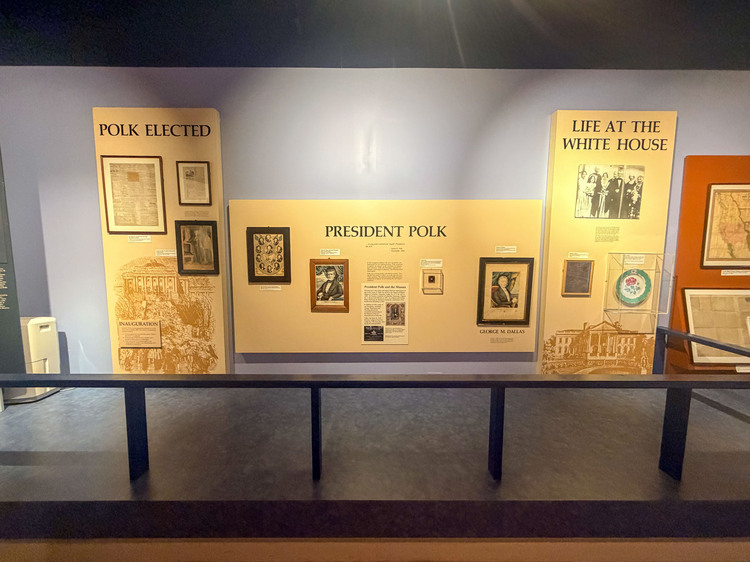
Polk’s inauguration in 1845 was the first to be covered by telegraph, with the broadcast originating in Washington, D.C., and reaching Baltimore, Maryland. He was also the second president to have “Hail to the Chief” played at his inauguration upon his entrance to the ceremony.
Social Gatherings and First Lady Sarah Polk
A little to your right, you will find a panel labeled “Life at the White House.”
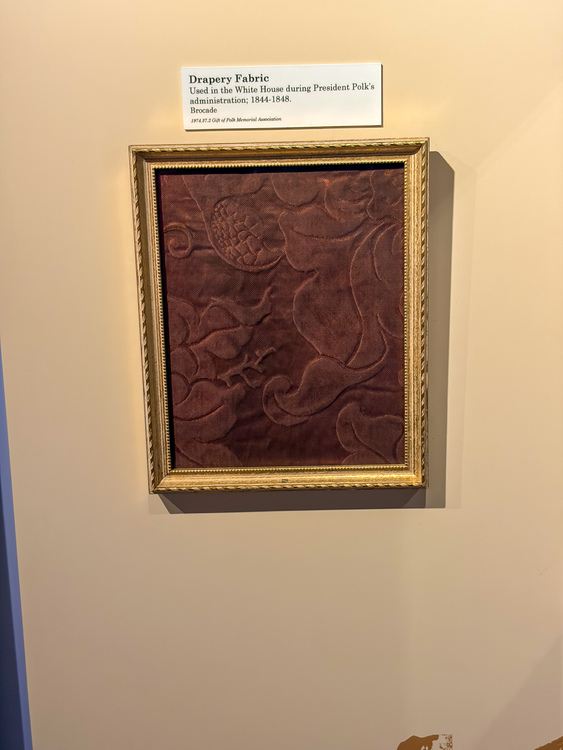
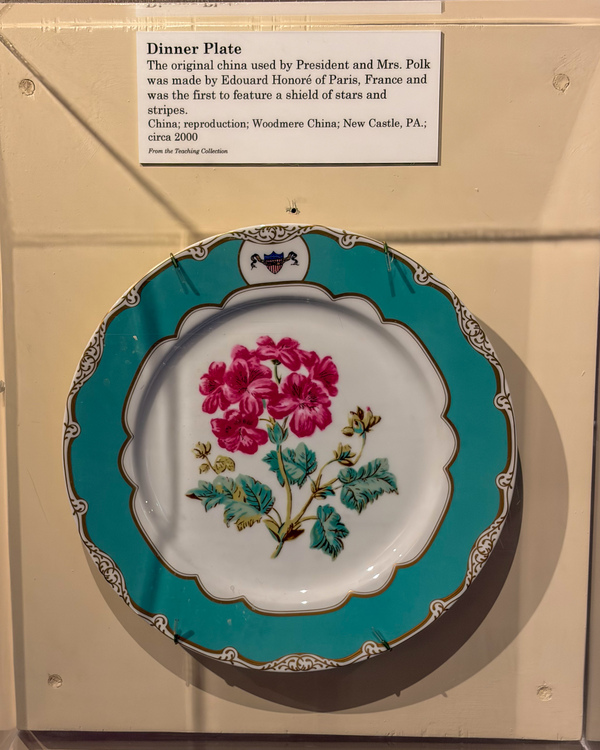
Throughout his presidency, Polk’s peers noted his relentless work ethic. He rarely left his office in Washington, D.C., and even when he did, Polk is known for being the President who took the least amount of vacation days. This left First Lady, Sarah Polk, in charge of hosting social events at the White House. In contrast to her husband’s awkward social skills, Sarah was the epitome of an ideal hostess. From foreign dignitaries to former First Lady Dolley Madison, Mrs. Polk entertained guests and hosted events at the White House weekly and sometimes daily. Sarah attended all state dinners, even those her husband did not attend. The dark red drapery fragment, in the gold frame, would have graced the windows in the White House, and the china pattern, located next to the fragment, would have adorned the tables. White House affairs were lavish, dignified, and hospitable, but with a complete prohibition on dancing. Mrs. Polk believed dancing to be inappropriate, both to her Christian faith and to her husband’s astute position. It would not do to engage in frivolity in one room while affairs of state took place in the other.
The next stop will be the red, square sign labeled #8, in front of the maps and the display panel that says, “War with Mexico.” Scan the QR code, or press next on your device.
-
Introduction
-
Stop 1: American Indian and Catawba Nation
-
Stop 2: Life on the Polk Farm
-
Stop 3: Childbirth
-
Stop 4: Southern Cotton
-
Stop 5: The Spirited Age: 1820-1850
-
Stop 6: The Whig Party and the Election of 1844
-
Stop 7: James K. Polk’s Presidency
-
Stop 8: War with Mexico
-
Stop 9: Santa Anna versus the new state of Texas