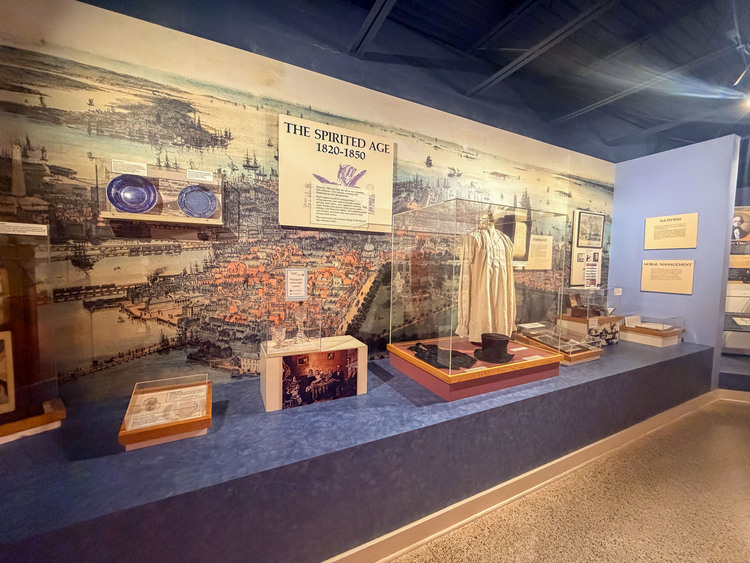
Stop 5: The Spirited Age: 1820-1850
The Spirited Age was a movement of social thought and cultural reforms that followed the Industrial Revolution.
Temperance –
First Lady Sarah Polk publicly embraced temperance, but she did allow for the consumption of wine at White House festivities, although not hard liquor like whiskey or rum. Wine, after all, helped guests to socialize with each other.35
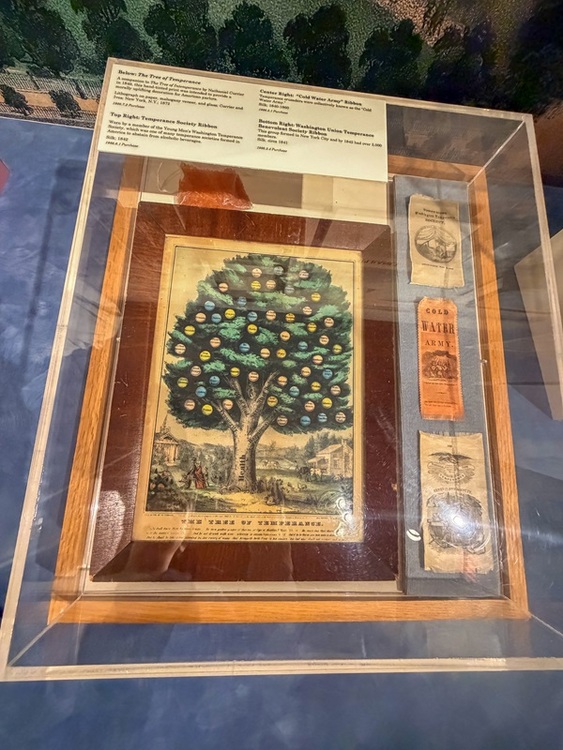
The temperance movement in the United States was a movement led mostly by women to severely limit and prohibit alcohol consumption in social life. Alcohol abuse affected women negatively, as they were more vulnerable to domestic abuse from their husbands, who drank excessively. Additionally, religious and health concerns helped garner support for the temperance movement. In the case beneath the temperance panel, there is a lithograph print showing the tree of temperance with fruits of discernment, piety, and love for God, written on them. Next to the lithograph print are several temperance ribbons that equate abstinence from alcohol with other positive qualities, such as benevolence and religious piety.
Abolitionist Movement
Slavery was a contentious issue during Polk’s presidency. His policies of Manifest Destiny, or expanding the land mass of the United States to the West Coast, caused abolitionists to fear that a culture of slavery would spread throughout the continent. During his inaugural address in 1845, Polk stated, “it is confidently believed that our system may be safely extended to the utmost bounds of our territorial limits...”
Frederick Douglass, editor of the abolitionist newspaper the North Star, was one of President Polk’s most vocal critics during his administration. Douglass was vehemently outspoken against President Polk and his wartime policies, believing that westward expansion would lead to the death of Indigenous people as well as the inevitable spread of the institution of slavery.
Nativism
QUOTE “In the management of our foreign relations it will be my aim to observe a careful respect for the rights of other nations, while our own will be the subject of constant watchfulness.” END QUOTE - President James K. Polk’s 1847 Annual
Message
During Polk’s presidency, the potato famine in Ireland led to a substantial increase in the number of Irish and Dutch people immigrating to the US. In Germany, the failed political and economic revolutions of 1848 sparked the immigration of Germans to the United States. In the 1840s-50s, this sudden influx of newcomers, mostly to the Northern territories of the US, created an anti-immigrant movement called Nativism, which critiqued the Democratic Party for allowing new immigrants to run for and hold public office.
While not a major focus during Polk’s presidency, Nativists insisted that the interests of native-born Americans, meaning those born in the United States, be considered primary over those of immigrants. It also excluded Black people, especially the enslaved, Indigenous people, as well as other non-voting members of the public, such as women, who were not granted the right to vote until 1920.
Moral Management: During Polk’s time, public healthcare was not an issue addressed by the President, as most families handled healthcare privately at home. However, a rising interest in public, government-funded healthcare programs gained interest in the 1840s and 50s. Phillipe Pinel, a French Physician practicing in the late 1700s, advocated for humane treatment, based on compassion and morality, toward those living with mental illnesses. The approach became known as moral management,” a health care movement focused on therapy and rehabilitation of those living with mental illnesses. Newer treatments, such as electrotherapy, harnessed the power of mild electrical currents to treat a variety of ailments, from arthritic pain to cancer. The magneto-electric machine, marked with a red dot, is an example of this type of 19th-century technology.
Dorothea Dix, born in New England in 1802, was an advocate for mental health in America. Prior to Dorothea’s impact on mental health care, those living with mental illnesses were incarcerated in asylums, which functioned more like prisons. There was little to no medical care and poor living conditions. The Dorothea Dix Hospital in Raleigh operated from 1856 to 2012. The hospital existed on a 308-acre campus with parks and outdoor spaces. At its height, the hospital housed over 3000 patients. Today, visitors can explore the green space and learn about the history of the hospital and mental health care.
The next stop will be in front of the red, square sign labeled #6. We will begin at the Henry Clay exhibit. Scan the QR code, or press next on your device.
-
Introduction
-
Stop 1: American Indian and Catawba Nation
-
Stop 2: Life on the Polk Farm
-
Stop 3: Childbirth
-
Stop 4: Southern Cotton
-
Stop 5: The Spirited Age: 1820-1850
-
Stop 6: The Whig Party and the Election of 1844
-
Stop 7: James K. Polk’s Presidency
-
Stop 8: War with Mexico
-
Stop 9: Santa Anna versus the new state of Texas