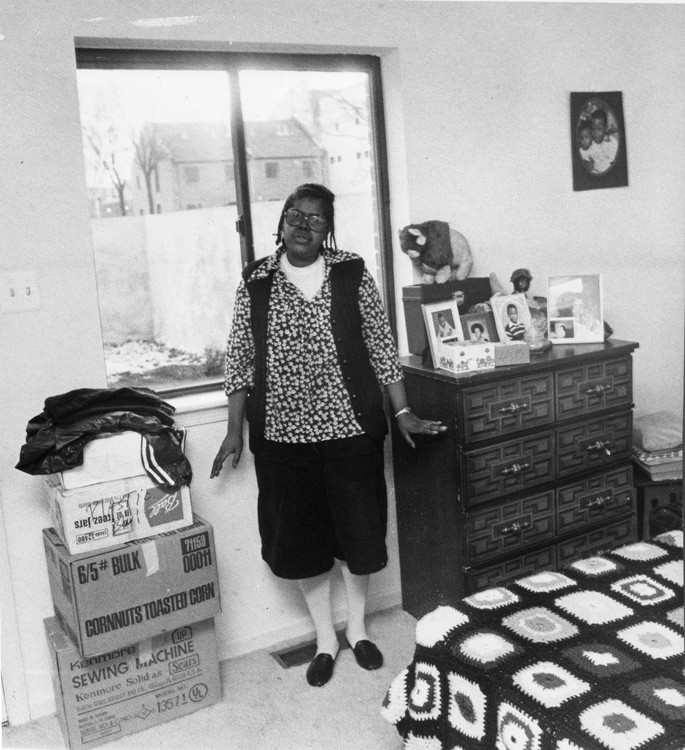
6th and Lombard Sts (Affordable Housing)
Not everyone who resisted displacement was unsuccessful. In the early 20th century, the Octavia Hill Association, a Philadelphia settlement house, purchased twelve row houses along the north side of the 600 block of Lombard Street and began renting them out as low-income housing. These properties abutted the eastern end of W. E. B. Du Bois’s survey of the 7th Ward, the historically African American neighborhood that stretched across Center City between Spruce and Streets Streets, from S 7th Street to the Schuylkill River. At the northeast corner of this intersection stands Mother Bethel African Methodist Episcopal (AME) Church, dedicated on this site in 1874 by former slave Richard Allen. Mother Bethel served as mother church to the growing numbers of AME congregations—in Philadelphia and beyond--and was also a site on the Underground Railroad.
By 1940, the 600 block of Lombard Street was occupied by a mix of black and white working-class residents. The Washington Square East urban renewal plan marked the Octavia Hill properties for acquisition and rehabilitation. Octavia Hill soon determined that it would be unable to complete the required upgrades while continuing to offer affordable rents, so it announced plans to relocate the existing residents. Seven of these households—six black, one white—would not go without a fight. An African American woman named Dorothy Miller became the public face of the Octavia Hill Seven, as these households became known. Miller had lived in this neighborhood since her birth in 1930 and moved to 615 Lombard Street after she got married. She would go on to work for 27 years as a school crossing guard at the intersection of S 7th and Pine Streets. You can hear her commenting on her feelings on her potential displacement in the included audio clip.
In the early 1970s, Miller joined forces with several of the newer residents of Society Hill (including Philip Price, Jr., whom you heard speaking at the 321 Spruce St tour stop) to propose the government-subsidized construction of new replacement housing for these residents on several already-cleared nearby sites. What followed was a contentious, nearly decade-long battle between groups of Society Hill residents who either supported or opposed this plan. Some residents feared this new low-income housing would diminish property values, while others advocated for the inclusion of housing that served multiple economic classes—including, in particular, these long-time neighbors. After years in court, and with the support of Community Legal Services, the Octavia Hill Seven won. Although Miller and her neighbors had to temporarily relocate out of Society Hill, by 1981, they were able to come back—thanks to the construction of three small cluster of new row houses. These new buildings include the ones before you at the NW corner of S 6th and Lombard Sts, as well as the clusters at S 6th and Addison Streets and S 6th and Pine Streets. Miller moved into the unit at 540 Pine Street, inside of which she is depicted in this 1982 photograph. You will pass all of these developments on your way to the next tour stop.
What has historically been the relationship between renewal and displacement? What mechanisms exist today to facilitate the revitalization of communities to the benefit of existing residents as well?
Image Source: Photograph by Prentiss Cole, Philadelphia Inquirer, 1982. Philadelphia Inquirer Photograph Collection, Temple University Libraries.
Audio Source: Dorothy Miller Interview, Project Philadelphia 19106, Temple University Libraries and Preserving Society Hill.
-
Le hall d'entrée
-
L'escalier d'honneur
-
Le hall des bureaux des attachés militaires
-
Le hall de tapisseries
-
La salle de musique
-
La salle des estampes
-
La grande galerie centrale
-
La salle à manger
-
Le boudoir
-
Le petit salon
-
Le grand salon
-
Le bâtiment des anciennes écuries