Old Pine Community Center and St. Peter's School (Institutions and Displacement)
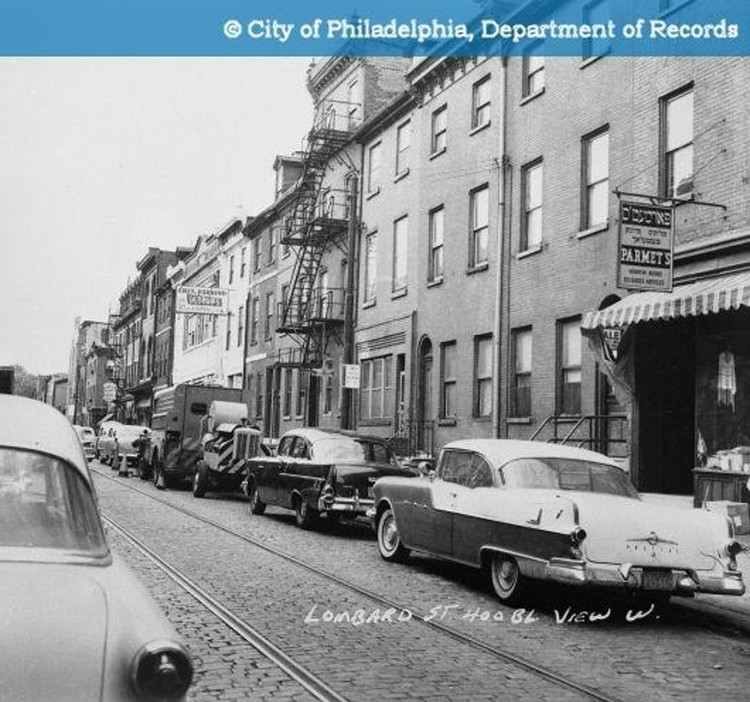
Before urban renewal, as suggested by the accompanying image of the north side of the 400 block of Lombard Street, these two corners were filled with buildings: both mixed-use and purely residential. But the city hoped that existing institutions – including schools, hospitals, synagogues, and churches – would serve as anchors around which redevelopment would flourish. They used urban renewal to offer these organizations the opportunity to acquire additional property at an affordable price in order to expand their footprints. Such was the case at St. Peter’s Episcopal Church, to the east—which extended its school building and grounds—and Old Pine Presbyterian Church to the west—which built a Community Center and the Presbyterian Historical Society in the 1960s and ‘70s.
The city tore down many buildings and displaced many residents in order to free up this space for new construction. Charles Peterson and others protested these plans due to the historic fabric that would be lost. Residents also protested the loss of their homes. But they ultimately proved unsuccessful. Today, these institutions are vital parts of the neighborhood. For example, city residents play sports, attend camps, and visit the food pantry at Old Pine Community Center. St. Peter's Cemetery serves as a neighborhood park, and musical performances take place there in warmer months. But urban renewal investment in these community institutions came at a price of lost buildings and residents.
The audio clip here includes one resident testifying at a public hearing in the hope of stopping the destruction of her home for the Old Pine expansion. In total, official records count 580 families as being displaced by the urban renewal of Society Hill. This likely undercounts the total, however, as it misses those who left in anticipation of displacement, those who initially attempted to stay on but ultimately could not afford the requisite restoration work, and any residents of the boarding houses who did not “count” as households in official recordkeeping. Urban renewal legislation required that each of these 580 families be offered relocation assistance and modest support for their move. In urban renewal projects around the country, displacements like these typically landed residents in housing of physically improved quality. But, as sociologists have shown, the accompanying psycho-social impacts of displacement and the destruction of community bonds were great. Mindy Fullilove has termed these post-traumatic stresses "root shock."
In what ways have private and non-profit institutions figured into the history of urban renewal and development (in Philadelphia and elsewhere)?
Image Source: PhillyHistory.org
Audio Source: Big City 1980 with Garry Moore (CBS Television Network, 1961), From the Vault of MIT, available via YouTube.
-
Le hall d'entrée
-
L'escalier d'honneur
-
Le hall des bureaux des attachés militaires
-
Le hall de tapisseries
-
La salle de musique
-
La salle des estampes
-
La grande galerie centrale
-
La salle à manger
-
Le boudoir
-
Le petit salon
-
Le grand salon
-
Le bâtiment des anciennes écuries