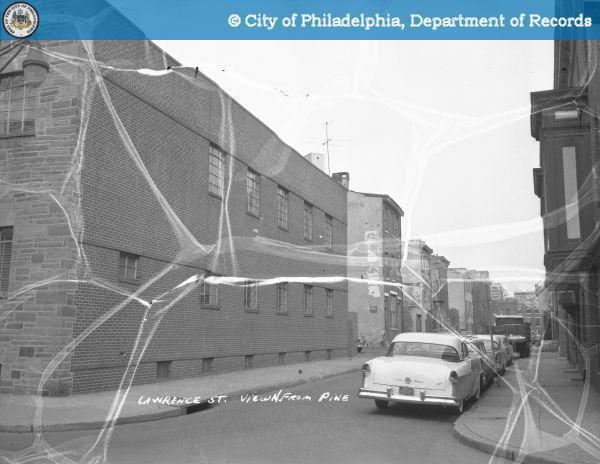
419 Pine Street (Neo-colonial new construction)
This neo-colonial red brick row house may initially look older than it really is. Built in 1970, it occupies the former site of a two-story brick building with a stone façade that served as a clubhouse or meeting space for La Sociedad Fraternal Hispanica de Filadelphia, a Hispanic fraternal and relief organization. A portion of that building --which dates to the 1920s--appears in the accompanying photo. The Philadelphia Redevelopment Authority acquired the property in 1962 for $50,500. Within a few years, they had demolished the structure and were offering the cleared lot for sale.
Joseph (J) and Suzy Pattison purchased the lot in 1969 for $8,500. They had been looking for several years to relocate their family from their home on Juniper Street. They debated between moving out of the city and staying in Philadelphia. The cleared lot at 419 Pine Street appealed to them as a chance to build a house that uniquely fit their taste, while also marrying some aspects of suburban privacy and urban living. J, an engineer, drafted plans for a house in neo-colonial style since he and Suzy admired the Federal period aesthetic and level of craftsmanship.
The interior of the house reflects the desire of the homeowners to incorporate authentic colonial details and a handcrafted aesthetic into their newly-constructed property. Even as some of their neighbors installed modern interiors into restored building shells, the Pattisons salvaged yellow pine ceiling joists for their kitchen from a Frankford Avenue church that had burned down. Most of the doors were salvaged from 338 South 4th Street—a house that was then being rehabilitated, but in which the developer wanted to replace the eighteenth-century doors with modern ones. Salvaged marble became part of a new fireplace. In addition, they contracted for hand-plastered walls—a process which took 12 years to complete while they were living in the house with their growing family. Throughout the building, they also incorporated antique hardware and period furniture. In this regard, the Pattisons were of a piece with fellow Society Hill residents whose preservation interests extended to include the interiors of their homes and the repurposing of salvage and antiques. Somewhat surprisingly in this case, however, their efforts were in service of outfitting a newly constructed building.
Image Source: PhillyHistory.org
-
Le hall d'entrée
-
L'escalier d'honneur
-
Le hall des bureaux des attachés militaires
-
Le hall de tapisseries
-
La salle de musique
-
La salle des estampes
-
La grande galerie centrale
-
La salle à manger
-
Le boudoir
-
Le petit salon
-
Le grand salon
-
Le bâtiment des anciennes écuries