401 Pine St (Restoration)
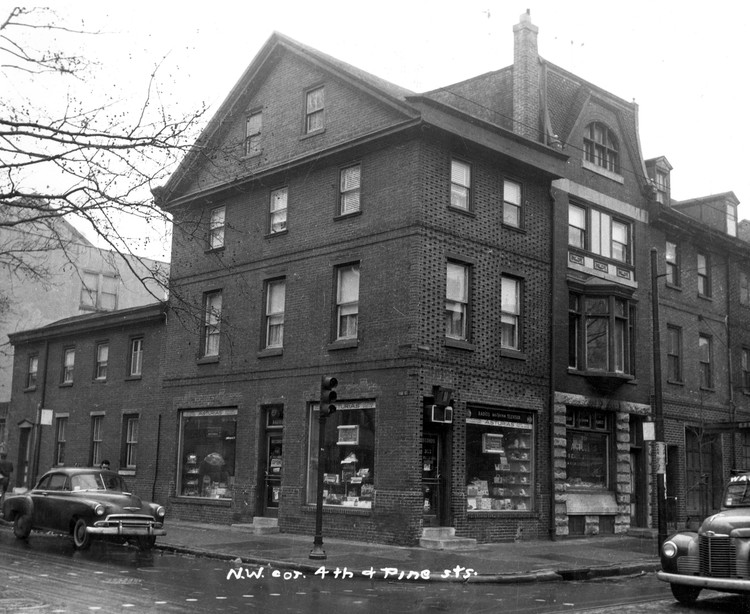
Stand at the SE corner of S 4th and Pine Sts to observe 401 Pine St (located at the NW corner of the intersection, and also known as 352 S 4th St). This Georgian brick row house was built in 1792 by lumber merchant Joseph Wetherill. The transformation of this property during urban renewal was typical of the impact of restoration across the neighborhood. In January 1957, an unknown photographer captured the photograph you see here.
Stop and compare this photograph with the building you see today. What aspects of the building seem to have changed during urban renewal?
The surviving 1957 image reveals the dense, mixed-use character of this area at mid-century. The corner property’s ground floor unit contains an electronics shop that extends into the adjacent building. Spanish language signage on the large glass windows advertises records, radios, and television equipment. A household resided above.
After renewal, however, all vestiges of modernist commercial and late 19th-century style were now gone, replaced by the clean uniformity of high Georgian residential architecture. In the corner property, ground-level plate-glass windows with one-over-one double hung windows above have yielded to nine-over-nine and six-over-six windows throughout—largely flanked by shutters. Where two primary entryways had once existed, there now appears just one. New marble steps elevate the main doorway. The chimney has changed from coal to wood. In front, gas lamps illuminate the brick sidewalks that have replaced cement paving, and street trees sprout from their midst. The building located just to its north – which had once been connected with this property – experienced an even more radical facelift.
In 1967, C. J. Moore purchased the property from the Redevelopment Authority for $10,500, instigating these physical changes. With architect Walter D. (Kip) Stowell, he restored the building to its mid-19th century appearance. But on the interior, they modernized the structure completely. Taking the house down to the studs, they updated mouldings and other trim details, inserted a contemporary kitchen and staircase, and installed recessed lighting and wall-to-wall carpeting. On the rear exterior, they tore down several additions and inserted contemporary semicircular windows and a balcony that a brick garden wall made invisible from the street. Thus, exterior restoration masked interior modernization. You can hear Moore discussing the work of transforming the interior in the attached audio clip.
Image Source: PhillyHistory.org
Audio Source: C. J. Moore Interview, Project Philadelphia 19106, Temple University Libraries and Preserving Society Hill.
-
Le hall d'entrée
-
L'escalier d'honneur
-
Le hall des bureaux des attachés militaires
-
Le hall de tapisseries
-
La salle de musique
-
La salle des estampes
-
La grande galerie centrale
-
La salle à manger
-
Le boudoir
-
Le petit salon
-
Le grand salon
-
Le bâtiment des anciennes écuries