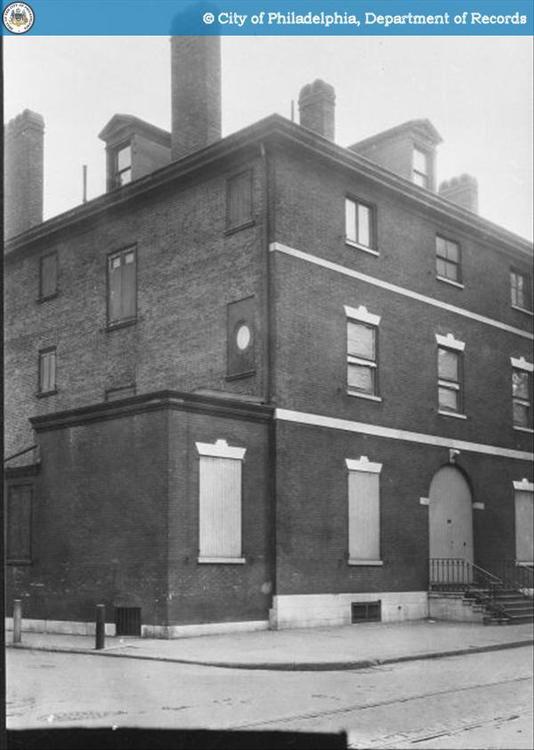
Hill-Physick House (Preservation) and Perkins House (Contemporary Infill Construction)
The Hill-Physick House was built in 1786 and was named for one of its early occupants, Dr. Philip Syng Physick, father of American surgery. Physick was affiliated with the country’s first hospital, Pennsylvania Hospital, located four blocks east, between S 8th and S 9th Streets. The Hill-Physick House is the only free-standing Federal style house still remaining in Society Hill. It’s free-standing stature, surrounded by green space, gives us a sense for William Penn’s original country house ideal for his new “green country towne.” By mid-century, as shown in this photograph from 1957, it was vacant and in disrepair. In 1965-66, architect George B. Roberts restored the building to its 1815 condition. This included removing several back buildings and one-story additions on its north side. Restoration work on the remaining building—both inside and out—was extensive. The Hill-Physick house is now owned by the Philadelphia Society for the Preservation of Landmarks, which operates it as one of two historic house museums in the neighborhood (plus others elsewhere in Philadelphia).
The modernist building located across the street, at the northwest corner of S 4th and Cypress Streets, was designed by architects Mitchell/Giurgola and completed in 1968. It was previously the site of a garage. The first resident of the property was G. Holmes Perkins, then dean of the Graduate School of Fine Arts, which today has become the University of Pennsylvania's Stuart Weitzman School of Design. Perkins also offered his expertise in urban renewal by serving on the Advisory Board of Design that approved all new construction proposals. Throughout the neighborhood, you will find examples of infill housing like this one that was constructed on individual sites. In general, there was a preference to build in contemporary architectural styles such that the neighborhood would marry old and new, rather than creating any faux-historical new construction. Still, you will find a mix of contemporary and neo-colonial designs throughout Society Hill.
Image Source: PhillyHistory.org
-
Le hall d'entrée
-
L'escalier d'honneur
-
Le hall des bureaux des attachés militaires
-
Le hall de tapisseries
-
La salle de musique
-
La salle des estampes
-
La grande galerie centrale
-
La salle à manger
-
Le boudoir
-
Le petit salon
-
Le grand salon
-
Le bâtiment des anciennes écuries