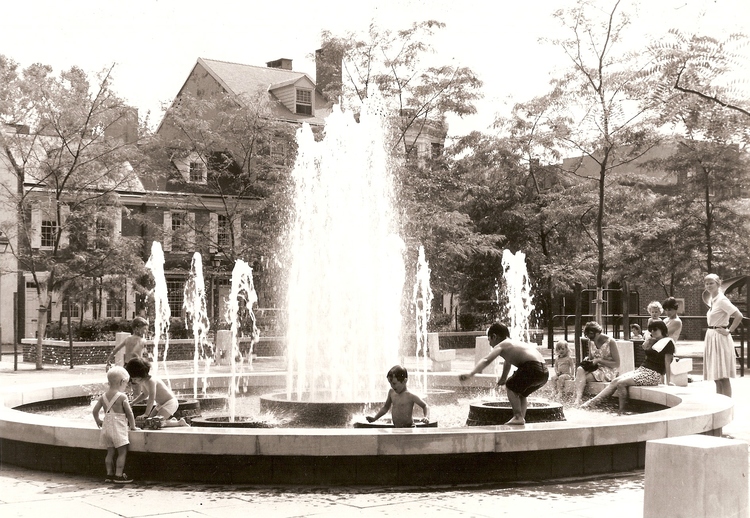
Delancey / Three Bears Park
In order to attract families to live in the renewed neighborhood, planners invested in schools and parks. For example, while our tour does not reach the McCall School--located between S 6th, S 7th, Cypress and Panama Sts--this public school building received a sizeable addition during this period. Three Bears Park, where you're standing now, was another public amenity. The Three Bears name derives from the sculpture in the SW corner of the park; officially, it's called Delancey Park. The park was designed by landscape architect John Collins, who also designed the neighborhood’s greenways. It sits on the former sites of a police station and fire house that were no longer in use. The city cleared these sites, as well as houses located on the south side of Delancey Street that were in the path between the park and St. Peter’s Church, in order to extend the greenways on an axis with the spire of the church. Centuries earlier, this block had been the site of Philadelphia’s first almshouse. In this audio clip, Libby Browne, who with her husband Stanhope Browne purchased a rowhouse to restore on S 2nd Street, discusses how spaces like the park contributed to the formation of community among the many young families in the renewal-era neighborhood.
Many of the public amenities of urban renewal projects nationwide have been criticized as sterile and underutilized. Depending upon the time of day when you visit, it may be difficult to assess this for Delancey Park. But, based upon what you see, how well does the park serve the neighborhood today?
From the park’s location, and as you continue to stroll east on Delancey Street to S 2nd St, you can also survey the variety of restoration and new construction on display there. Delancey Street is one of the signature streets of the neighborhood in terms of its scale, density, and mixture of building styles. You’ll find modernist infill next to restored properties, and even some neo-colonial construction. For example, 316 Delancey, the first building to the west of St. Peter’s Way on the south side of the street, was built in 1965, rather than several centuries prior. Other aspects of the public realm—including the Belgian block street pavers, brick sidewalks, and lampposts—were creatively funded during urban renewal in order to contribute to the overall historic feel of the neighborhood.
Image Source: PhillyHistory.org
Audio Source: Elizabeth Browne Interview, Project Philadelphia 19106, Temple University Libraries and Preserving Society Hill.
-
Le hall d'entrée
-
L'escalier d'honneur
-
Le hall des bureaux des attachés militaires
-
Le hall de tapisseries
-
La salle de musique
-
La salle des estampes
-
La grande galerie centrale
-
La salle à manger
-
Le boudoir
-
Le petit salon
-
Le grand salon
-
Le bâtiment des anciennes écuries