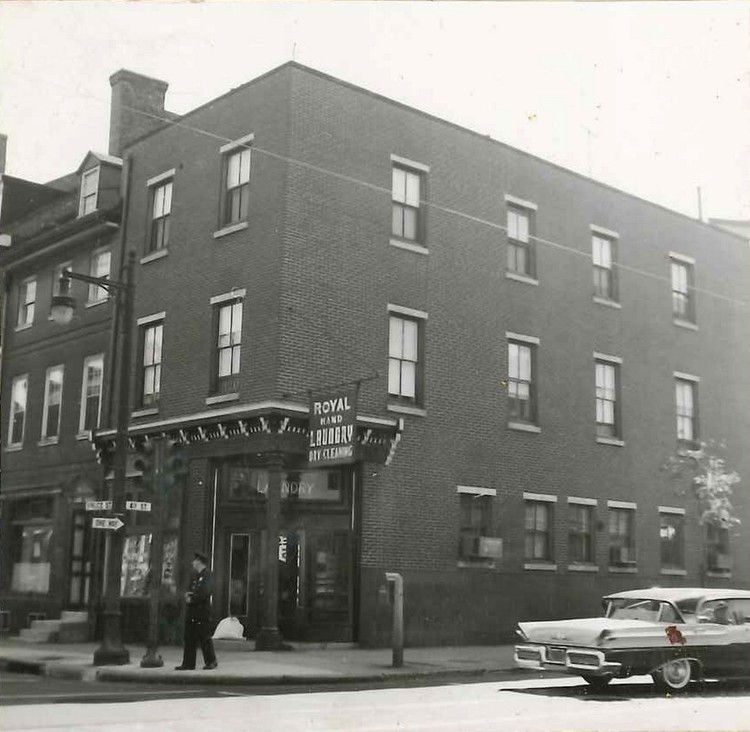
340 Spruce St (Commercial displacement)
Stand at the NE corner of Spruce and South 4th Streets and note that all four corners were transformed during urban renewal. Where you are standing, the current building had housed Ben's Sandwich Shop on the ground floor. The northwest corner had been a gas station, but neo-colonial row houses were built on that site c. 1960. On the southwest corner, a modern row house was built c. 1995. And, on the southeast corner had been located the Royal Hand Laundry. This was not an industrial site, but rather a place to drop off laundry which was then cleaned off-site. Owner Harry Altman lived in the apartment above and had operated his business there for more than a quarter century. Indeed, commercial uses of some sort had existed there for at least a century prior. There were about 60 commercial establishments located in Unit II of the neighborhood. Out of those 60, Altman was one of seven business-owners who asked to be allowed to stay in the redeveloped community. He even had an architect design plans for a neo-colonial façade replacement in order to make it fit in visually.
There was a public hearing in which Altman made his case, supported by an array of neighbors. Charles Peterson was among his supporters. Preservationists like Peterson thought that preservation should also include the preservation of people, and he was not wedded to eradicating all commercial uses from the area. Society Hill had never been like that anyway. Rather, the primarily residential version that urban renewal planners were creating responded more to contemporary preferences than to historical realities.
All along Spruce St, S 4th St, and several other streets in Society Hill, commercial uses occupied the ground floor while apartments were located above. Renewal removed this mixed-use character. Although businesses that were displaced typically received some moving expenses, many owners essentially lost their businesses entirely since they had to give up their local customer base when they lost their previous locations.
In this audio clip, Harry Altman and another local resident discuss why the laundry should have been allowed to stay. Ultimately, they were unsuccessful in their pleas as planners felt that allowing exceptions like this would mar the overall project. If you look carefully at 340 Spruce St, you can see the outlines of where the commercial storefront was replaced with new bricks for a more residential look.
QUESTION: Why might postwar planners have fixated so much on eradicating commercial and industrial uses from this neighborhood? How does this compare to planning practices today?
Image Source: Unidentified photographers, “Society Hill,” c.1950s, The Library Company of Philadelphia
Audio Source: Big City 1980 with Garry Moore (CBS Television Network, 1961), From the Vault of MIT, available via YouTube
-
Le hall d'entrée
-
L'escalier d'honneur
-
Le hall des bureaux des attachés militaires
-
Le hall de tapisseries
-
La salle de musique
-
La salle des estampes
-
La grande galerie centrale
-
La salle à manger
-
Le boudoir
-
Le petit salon
-
Le grand salon
-
Le bâtiment des anciennes écuries