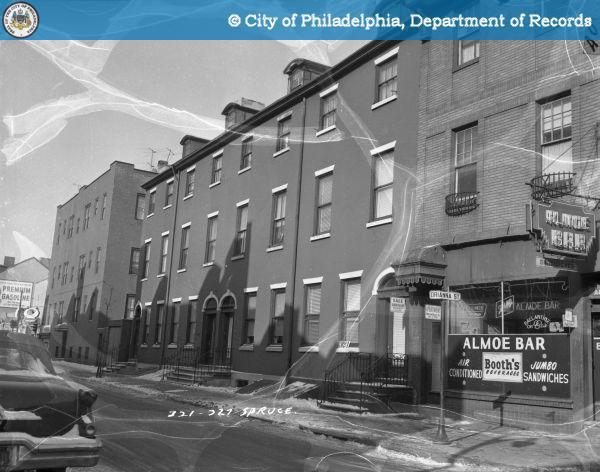
317-321 Spruce St (Greenways and Restoration)
The greenway system was one of Edmund Bacon’s signature design elements in the neighborhood. It helped knit together the area, connected it with Independence National Historical Park, and afforded pedestrians their own space separate from that of cars. In this last way, the greenways related somewhat to the design of places like Radburn, NJ. Urban renewal projects often had to balance the competing demands of the automobile and related parking, while also finding space for pedestrians. Society Hill was likely more successful at this balancing act than many peer projects. Planners created greenways by closing streets (as in the case of this one, St. Joseph's Way, which had previously been Orianna St -- it was renamed after the church located at its northern end) or by demolishing buildings to open up new space (as was the case in the Rose Garden and across Spruce St, where St. Peter’s Way continues to the south). A small factory had once existed on that St. Peter’s Way site.
At the intersection of Spruce and St. Joseph’s Way, you will also find an historical marker describing planner Edmund Bacon (on one side) and preservationist Charles Peterson (on the other). During urban renewal, Peterson lived in one of the marble-fronted rowhouses on the south side of Spruce Street. He founded the Historic American Buildings Survey (a New Deal organization dedicated to preservation through documentation, which continues today) and served as an architect in the development of Independence National Historical Park. He and Bacon sometimes disagreed on which buildings--or elements of buildings--were worth preserving, with Peterson being more conservative here. Supposedly, the two only agreed to appear together on a placard like this one if they never had to look at each other (hence the single side devoted to each). In reality, Society Hill was very much the product of the collaborative tension between this planner and preservationist.
Philip Price, Jr., a young lawyer, purchased and restored the house to the immediate west (321 Spruce St and the adjacent garden at 319 Spruce St). When the Redevelopment Authority originally acquired the properties, they were already vacant. The included photograph, taken in the 1950s, just prior to renewal, shows its earlier appearance, including the Almoe Bar that existed at 319 Spruce St, prior to its demolition to become a side garden. In this audio clip, Price describes the building's condition when he purchased it.
Image Source: PhillyHistory.org
Audio Source: Philip Price, Jr. Interview, Project Philadelphia 19106, Temple University Libraries and Preserving Society Hill.
-
Le hall d'entrée
-
L'escalier d'honneur
-
Le hall des bureaux des attachés militaires
-
Le hall de tapisseries
-
La salle de musique
-
La salle des estampes
-
La grande galerie centrale
-
La salle à manger
-
Le boudoir
-
Le petit salon
-
Le grand salon
-
Le bâtiment des anciennes écuries