The Dining Room
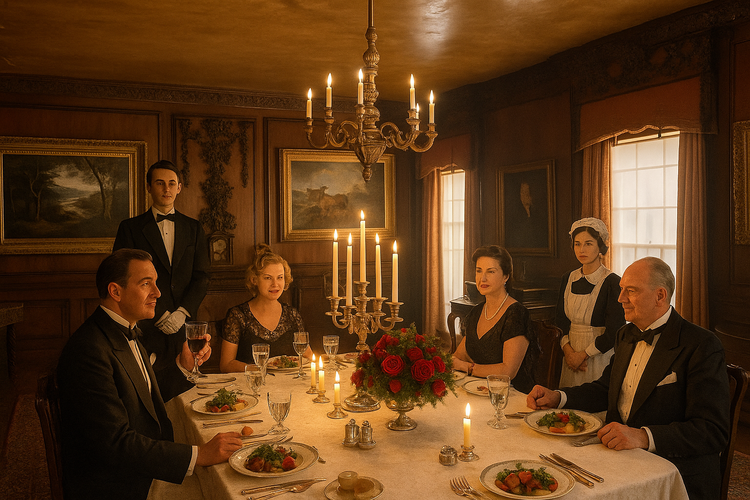
Welcome to the Dining Room, one of the finest and most atmospheric rooms in Samares Manor.
It was here that Sir James Knott, the wealthy shipowner and philanthropist who bought and restored the Manor in the 1920s, entertained his guests in the height of comfort and style.
The room immediately impresses with its French walnut panelling, a rich, honeyed wood that glows warmly in the light. Every panel was crafted and fitted with exquisite precision — creating a sense of quiet grandeur.
If you look carefully, you’ll notice something clever: hidden among the panels are disguised doors that lead directly to the kitchens. These allowed servants to move silently in and out during meals, unseen by guests — a mark of true Edwardian refinement.
The furnishings reflect Sir James’s taste for fine English craftsmanship. The Chippendale-style tables and chairs are elegant yet robust, echoing the Georgian ideals of proportion and beauty.
High above, the ceiling is covered with hand-finished leather parchment — a detail that’s both beautiful and practical. It was designed to stop the smells from cooking and smoke from drifting upstairs to the private rooms — a small but telling sign of the thought and comfort that shaped the Manor’s design.
If you glance toward the carved details, you’ll see delicate limewood decorations in the style of Grinling Gibbons, England’s most celebrated woodcarver. These intricate motifs — fruits, flowers, and flowing ribbons — bring a touch of baroque artistry to the room, softening the formal architecture with natural grace.
And there’s one more story whispered in these walls — that of Sir James Knott himself, who, at the age of seventy-six, married Elizabeth Christie Gauntlett, his bride of just twenty-six. Their marriage was the talk of Jersey society at the time.
Together, these features make the Dining Room not just a place for meals, but a stage — a reflection of Sir James’s wealth, his taste, and his desire to surround himself with craftsmanship, comfort, and a touch of theatrical elegance.