Rose Garden (Intro to Society Hill)
When you crossed south of Walnut Street, you entered Society Hill, which runs from Walnut to Lombard Streets on the north and south, and S Front to S 8th Streets on the east and west.
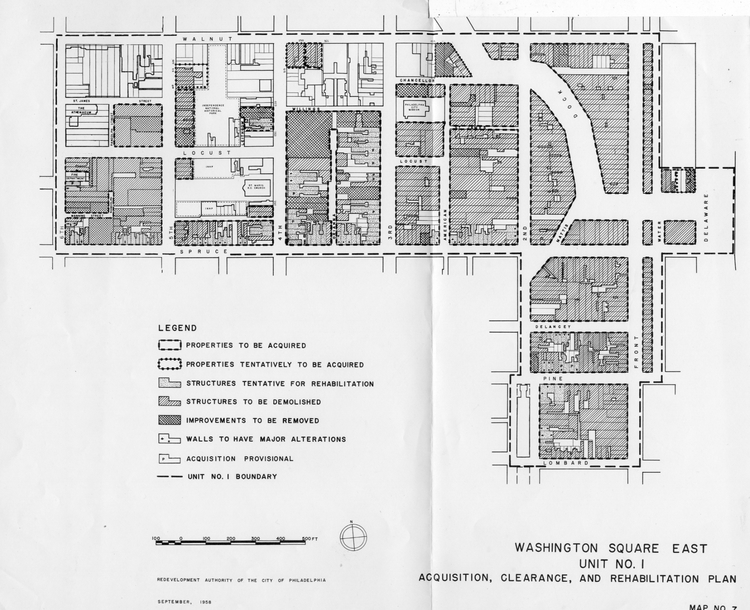
By contrast with the “culture of clearance” characteristic of much postwar planning, whereby cities tore down existing development to make way for new, modern construction, Philadelphia implemented a somewhat different approach, combining clearance with rehabilitation. (The accompanying plan for Unit 1--in which you are standing right now--makes this clear. In Unit 2, located south of Spruce St, rehabilitation is more prevalent.) In 1952, Architectural Forum termed the city’s methodology the “Philadelphia Cure”: that is, “clearing cities with penicillin, not surgery.” Many of the city’s redeveloped landscapes incorporated low-rise construction and pedestrian-oriented greenways. They also often included building conservation, albeit to varied degrees. In Society Hill, where the city pursued an affluent demographic, conservation took the form of restoration or preservation; whereas in lower-income neighborhoods, like the Morton section of Germantown, more modest rehabilitation dominated. From a policy perspective, such a conservationist approach was only possible because the Housing Act of 1954 had extended federal funding to apply to rehabilitation as well as clearance.
Society Hill takes its name from the Free Society of Traders, a joint-stock company of English Quakers who settled along the Delaware River upon William Penn’s 17th-century settlement of Philadelphia. As the area developed, Society Hill served as home to wealthy elites along major thoroughfares and to tradespeople and servants who lived on narrower back alleys and courts. Residences mixed with churches, libraries, and businesses ranging from taverns to insurance companies.
By 1950, the socioeconomic character of Society Hill had gone through several transformations since its colonial beginnings. While more than half the residents were native-born whites, nearly 20% were African American—concentrated primarily along the southwestern portion of the area. Eastern European Jews also made up a substantial contingent, including especially Russians, Poles, and Austrians.
In the late 1950s, planners designated the neighborhood for urban renewal, aspirationally reviving the historical “Society Hill” moniker. For official planning purposes, however, it was known as Washington Square East. About a quarter of all dwelling units lacked a private bath, and another quarter lacked central heating (although almost all units had heating of some sort).
As the statistics below show, by the end of renewal, the character of the community had changed dramatically, even as many buildings remained.
Key Society Hill Statistics
(Source: U.S. Bureau of the Census, 1950 and 1980, tract and block group data)
1950 1980
6,982 5,200 Population
19% ~25% Non-white %
4% 64% College-educated %
0.5 2.5 Family income vs. city avg
1,965 3,183 Housing units
18% 40% Owner occupancy
0.75 7.0 Housing Price vs. city avg
As these figures indicate, urban renewal effectively replaced one community with another. Unlike clearance projects, the removal was not wholesale. Some residents held on to their properties and stayed through the renewal project (and after). But the large number of renters (as well as many owners) were displaced. Displacement in a typical urban renewal project disproportionately affected non-white residents, earning the program the nickname “Negro removal” (nationwide, ~70% of the displacement burden was borne by non-white residents). In Society Hill, however, which consisted primarily of an ethnic white population, federal figures indicate that Black versus white displacement matched the pre-renewal population mix. The policy often preyed upon less powerful residents (including white ethnics) located in valuable central city locations, making Society Hill a typical target.
Several groups collaborated to bring the urban renewal plan to action. Edmund Bacon’s Planning Commission worked with the Philadelphia Redevelopment Agency to develop and execute the plans. The Redevelopment Authority approached property owners to encourage them to restore their houses to standards established by the city’s relatively newly formed Historical Commission. If they lacked the means to afford these upgrades, the Redevelopment Authority acquired their property at fair market value. In the accompanying audio clip, planner Edmund Bacon discusses the challenges of this approach. The Old Philadelphia Development Corporation was formed to market these acquired properties to buyers, as a real estate agency for urban renewal properties. The Historical Commission then assessed the completed work to ensure that rehabilitations met the necessary standards within the required timeframe (typically two years after purchase). Alternatively, when new construction was being pursued on a site, the Advisory Board of Design approved or rejected proposed designs. In this way, the city carefully managed the physical appearance of the renewed neighborhood.
We will now walk through the neighborhood to explore urban renewal’s various interventions, including demolition, new construction, and restoration; the insertion of parks and greenways; and the development of several mid- to upper-income high-rise housing projects.
Image Source: Acquisition, Clearance, and Rehabilitation Plan for Washington Square East, Unit 1, Housing Association of Delaware Valley Records, Temple University Libraries
Audio Source: Edmund Bacon Interview, Bacon-Cohen Collection, Architectural Archives, University of Pennsylvania
-
Le hall d'entrée
-
L'escalier d'honneur
-
Le hall des bureaux des attachés militaires
-
Le hall de tapisseries
-
La salle de musique
-
La salle des estampes
-
La grande galerie centrale
-
La salle à manger
-
Le boudoir
-
Le petit salon
-
Le grand salon
-
Le bâtiment des anciennes écuries