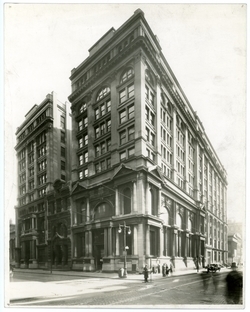
American Philosophical Society (Reconstruction)
As you walk from Independence Mall down South 5th Street, you passed a few examples of preservation in and around the park. Along the south side of Chestnut Street, between S 5th and 4th Streets, note the Second Bank of the United States.
Another example, one of the few reconstructed buildings, is the American Philosophical Society's Library Hall, located just south of Chestnut Street. It sits across from the original American Philosophical Society building (which still stands and is the APS museum). Note the cornerstone that indicates that this building is actually a reconstruction, albeit not an entirely accurate one. The Library Company of Philadelphia, a private lending institution founded by Benjamin Franklin and his friends, built their first building on this site in 1790. It remained there until 1884, when it was replaced by the 10-story office and bank building depicted in this photograph. In 1955, the National Park Service acquired the property and demolished that building. While architect Sydney E. Martin used surviving historical records to make the South Fifth Street façade of this new building as precise of a replica as possible of the Library Company building, he also incorporated aesthetically sensitive additions behind that façade that increased the building’s size by over 60 percent. But reconstruction, reminiscent of Colonial Williamsburg, is largely not what preservation was about in Philadelphia. Rather, preservation typically shaped the areas you will be traversing today in the form of restoration or historically-sensitive new construction.
Just before entering a gateway to the park to the east, look southwest and note the Egyptian Revival insurance company facade on the south side of Walnut St, between S 5th & 6th Sts (visible from Independence Square). Known as a “facadectomy,” the original building (the Pennsylvania Fire Insurance Company Building, designed by John Haviland and completed in 1838) was torn down, except for the retention of its former façade. The tower now behind it was designed by Mitchell/Giurgola Associates in 1975; they also designed individual homes in Society Hill. The facadectomy (which you may also encounter elsewhere in Philadelphia) is another, albeit limited, form of preservation.
As you enter the park (to the east), note the outlines of foundations of buildings that were demolished to create the openness of the park—a false impression of what the colonial city was actually like. This is yet another form of limited preservation. You will learn more about the relationships between preservation and urban renewal in Society Hill, arguably the pioneering and defining project of urban renewal through neighborhood (if not necessarily community) preservation.
QUESTION: How do the examples you have seen so far compare with your existing understanding of what historic preservation means?
Image Source:
Drexel Building, 432-434 Chestnut St, Philadelphia Architects and Buildings (www.philadelphiabuildings.org)
-
Le hall d'entrée
-
L'escalier d'honneur
-
Le hall des bureaux des attachés militaires
-
Le hall de tapisseries
-
La salle de musique
-
La salle des estampes
-
La grande galerie centrale
-
La salle à manger
-
Le boudoir
-
Le petit salon
-
Le grand salon
-
Le bâtiment des anciennes écuries