Society Hill Towers (Clearance and New Construction)
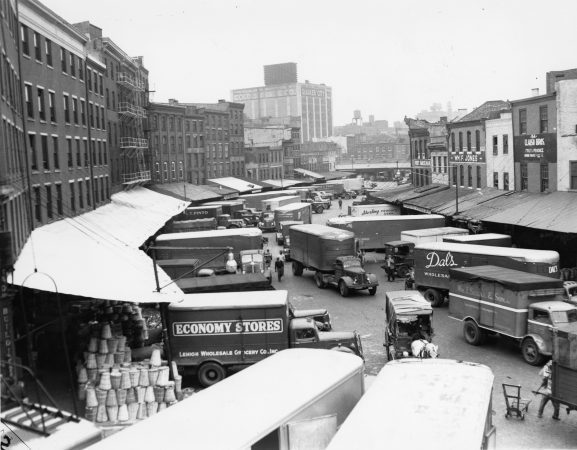
Our tour ends at one of the places where the urban renewal of Society Hill began. In 1957-59, the city bought up 31 acres around Dock Street, setting aside five of these acres for Society Hill Towers. This had been the site of a wholesale food market that the city wished to relocate to less central city land by constructing a new, more modern food distribution center closer to today's sports stadiums and port. You can see a 1951 view of the crowded market in the accompanying photograph. (For a modern-day comparison to this view, walk to the rear of the towers, on the north side of the property, overlooking the Marriott and Dock Street to the north.) This relocation strategy was part of a national trend of moving food distribution terminals out of city centers during urban renewal. With large trucks unable to fit in the cramped quarters that were once populated by horse-drawn carts, there was some practical argument to be made about modernization. But the relocation also targeted a primarily ethnically-run business center.
In the wholesale food market's place, architect I. M. Pei built three 32-story towers, plus nearby townhouses. In the attached audio clip, you can hear planner Edmund Bacon discussing the rationale behind constructing high-rise buildings in this location, as well as his feelings about adding any more towers near the waterfront in the future. As constructed, the towers were rental apartments, and the low-rise development included single-family row houses to be owned. In 1979, the towers became condominiums. The towers were envisioned as a relatively safe way to attract new middle- and upper-income residents to the transforming neighborhood. They appealed to many residents, ranging from young professionals to older couples. Several of these apartment dwellers looked down from their tower units to observe the restorations and new construction going on around them and eventually decided to purchase a row house of their own. The project earned the Progressive Architecture Award for Design in 1961.
Society Hill Towers is a classic urban renewal form. The tower-in-the-park design dates back to the ideals of Le Corbusier, who proposed creating superblocks where high-density residences could be achieved by building up, while still maintaining open space. It is also a hallmark of clearance-based urban renewal, which was certainly part of Society Hill’s story. Indeed, between Interstate 95 and the urban renewal project, more buildings were destroyed in the area than were saved. But number of buildings was notable. It broke with urban renewal norms. So did the project’s ability to attract families—likely due at least in part to the project's provision of single-family houses with yards, as opposed to high-rise apartments alone.
In 1971, the neighborhood was listed as a National Historic District. In 1999, it became a local historic district. The national designation is purely honorific, but the local designation ensures that no new development will affect the neighborhood without undergoing municipal review and approval. Thus, the changes that urban renewal brought to the community are likely to remain for a long time. The longevity of stasis, and its particularly historical feel, perhaps suggest that the neighborhood has always been this way. But now you know otherwise. If one looks carefully around the neighborhood, examining the building facades for traces of the past, talking to old residents who still remain, and asking how a certain site might have become available for a more modern use, a more complicated story may emerge. These remnants of Society Hill’s past reveal the neighborhood’s more dramatic history of change over time instead.
Image Source: George D. McDowell Philadelphia Evening Bulletin Collection, Temple University Libraries.
Audio Source: Edmund Bacon Interview, Bacon-Cohen Collection, Architectural Archives, University of Pennsylvania.
-
Le hall d'entrée
-
L'escalier d'honneur
-
Le hall des bureaux des attachés militaires
-
Le hall de tapisseries
-
La salle de musique
-
La salle des estampes
-
La grande galerie centrale
-
La salle à manger
-
Le boudoir
-
Le petit salon
-
Le grand salon
-
Le bâtiment des anciennes écuries