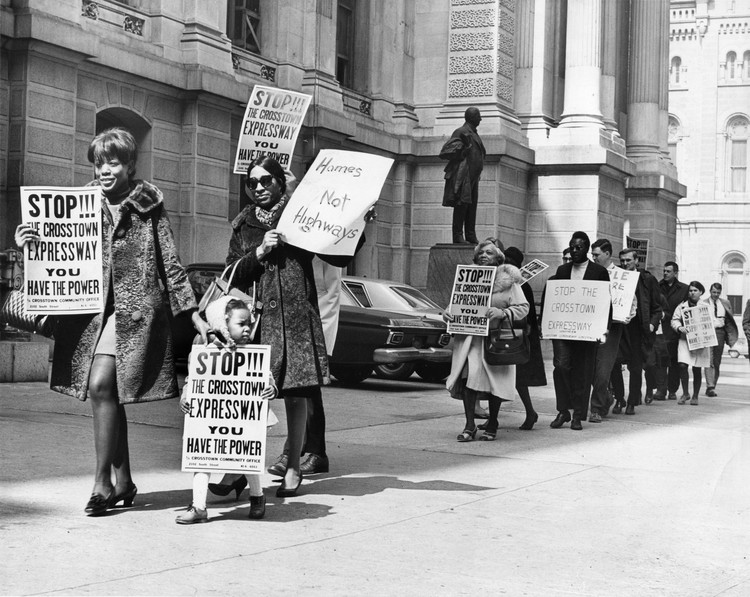
Lombard and S 2nd Sts (Crosstown Expressway)
This overall area likely would not look as it currently does if a multi-lane highway, the Crosstown Expressway, had been built as planned. Starting in the 1930s, the City Planning Commission envisioned a Center City ring road--which would include the Vine Street Expressway (now I-676) to the north, the Schuylkill Expressway (now I-76) to the west, the Delaware Expressway (now I-95) to the east, and the Crosstown Expressway to close the loop on the south. Specific plans for the Crosstown were first introduced in 1947 by Robert Mitchell, then head of the Planning Commission and later chair of Penn’s Department of City & Regional Planning. In 1957, the Crosstown Expressway was added to Interstate Highway system plans.
The proposed routes for the road would have demolished a wide swath of land, running across the entirety of Center City, between South and Bainbridge Streets or South and Lombard Streets (basically the southern edge of Society Hill). South Street was a major Jewish (in the east) and African American (west of S 6th St) commercial corridor. With the Crosstown, as with other highways in Philadelphia and elsewhere, planners aimed to separate the downtown from poorer neighborhoods to the south.
In response, a mixed-race, mixed-class anti-highway movement developed. One of the leaders of the grassroots oppositional movement was Alice Lipscomb, an African American resident of the nearby Hawthorne neighborhood. Lipscomb helped establish the Citizens’ Committee to Preserve and Develop the Crosstown Community, which joined white residents of Society Hill with black residents along most of the route and newly-arrived artists who began occupying the emptying South Street storefronts. The Committee argued that the choice of route amounted to racial discrimination, that the need for the road was unproven, and that the city lacked an adequate plan for relocation of several thousand residents in the path of the highway. They were also supported by several design professionals, including architect Robert Venturi--whose parents’ property (where his father had been a produce vendor) was in the path of the expressway--and architect Denise Scott Brown, Venturi's wife, who photographed the full length of South Street and developed alternative proposals for rehabilitating the community, rather than wiping it out. This photograph depicts activists protesting the expressway outside City Hall in 1968.
Under pressure from many quarters, including Robert Mitchell, who originated the initial proposal for the Crosstown Expressway but by the late 1960s opposed the project, Mayor Tate pulled his support for the expressway during his re-election bid in 1967, going against planner Edmund Bacon. In 1969, a study by Alan Vorhees and Associates, a leading transportation planning consultant, determined that the expressway’s costs would outweigh its benefits and that it would not be the optimal transportation investment. Finally, by the early 1970s, the advent of environmental impact laws likely dealt the project its final blow. In 1974, the expressway was officially cancelled, thanks in part to one of the more effective freeway revolts in U.S. cities. In this audio clip, Joanne Denworth, who had been president of the Society Hill Civic Association at the time, and lead activist Alice Lipscomb both reflect on the lessons of their communities’ collaborative victory.
Nevertheless, the construction of I-95, to the east, did destroy huge swaths of historic fabric and displace many residents. It continues to separate Philadelphia’s neighborhoods from the riverfront today. But Society Hill is the one place that residents succeeded in arguing for pushing the highway underground as it passed by, and decking it over on top, so that some waterfront access could still be had. While the city did not build a deck on the scale that activists proposed back then, it recently announced plans to expand the existing highway cover—in a manner similar to what is happening in cities around the country that now regret the divide they imposed by slashing highways through their centers and alongside their waterfronts.
How do you think the construction of the Crosstown Expressway would have affected the urban renewal and continued development of Society Hill and its surrounds? Even with the defeat of that plan, however, what impact might its very proposal have had on the area?
Image Source: George D. McDowell Philadelphia Evening Bulletin Collection, Temple University Libraries.
Audio Source: Crosstown (documentary). Dir. Miriam Camitta. 2001. https://www.youtube.com/watch?v=sQwdH6I0roI.
-
Le hall d'entrée
-
L'escalier d'honneur
-
Le hall des bureaux des attachés militaires
-
Le hall de tapisseries
-
La salle de musique
-
La salle des estampes
-
La grande galerie centrale
-
La salle à manger
-
Le boudoir
-
Le petit salon
-
Le grand salon
-
Le bâtiment des anciennes écuries