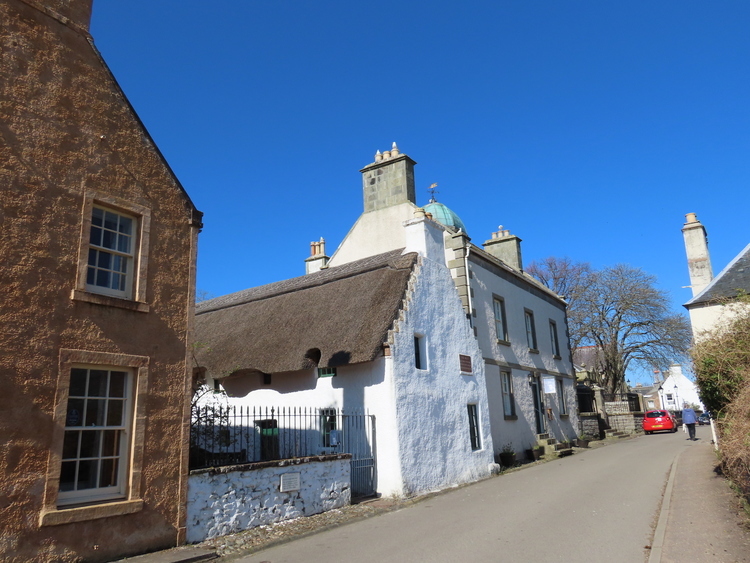
Stop 12 Hugh Miller’s Cottage.
This small cottage was occupied by Hugh Miller, his mother, brothers and sisters after his father, a ship’s captain, died at sea. The more substantial house next door was their original home but it was let out to lodgers to help the family pay their way.
We have mentioned Hugh Miller a few times on this tour. When we were at Rosemarkie we talked about him learning about geology as he examined the stones on the beach, we have seen his words carved on the migration stone on the foreshore and we have also seen some of the gravestones he carved while working as a stonemason. He is without doubt Cromarty’s most famous son and someone all Scots should know something about.
As a popular writer of science he was regarded as one of the best ever at introducing generations of curious people to the wonders of the natural world. He was also a very staunch Christian and became the editor of “The Witness” a popular protestant newspaper. As well as being the editor, commissioning some of the finest writers to write articles, he was also its biggest contributor averaging 10,000 words a week to the publication. That is an astounding output when you consider that a reasonable length article in a paper of today may only have 600 words in it. It would be like writing a short novel every month. And, of course he was, at the same time, also writing scientific books, lectures and other papers. He published over 15 major works in his lifetime.
He was one of the leading lights of “The Disruption” which saw a large section of the Church of Scotland split and form the Free Church in protest at what was seen as the state, or more often rich landowners, having the power to appoint ministers to parishes against the will of the congregation.
The amount of pressure his writing, his work for the church and his scientific endeavours placed on him was immense and his mental health suffered. Sadly, at the height of his powers in 1856, Miller took his own life while living just outside Edinburgh. One of the leading academics of the day, Sir David Brewster, who was at one time the principal of both St. Andrews and Edinburgh Universities rather snobbishly said of him, “Mr Miller is one of the few individuals in the history of Scottish science who have raised themselves above the labours of humble profession, by force of their genius and the excellence of their character, to a comparatively high place in the social scale”.
Above the town you will see a tall column with a statue of Miller on top.
Continue along Church street where you will see some fine Georgian buildings. The traditional merchants’ houses with accommodation for the family above are still easily recognisable. While it was not common for Scots of the period to show off their wealth in any ostentatious way, if you look at the roof line you may see some carvings that indicate how people may have made their money. I particularly like the carved ship’s capstan that you can see halfway along on the right.
When you come to the junction with the High Street turn left and walk up High Street where there are some lovely shop fronts. Also look out for Forsyth House which is set back off the road with a tree growing in its front courtyard. Forsyth was a contemporary of George Ross and the two gentlemen collaborated on several commercial enterprises.
Take the next right onto Bank Street and wander back down towards the harbour and your car. If you look at the names of the buildings you will see there are three bank houses. Can you imagine such a small town ever having one let alone three banks nowadays? It is an indication of the wealth found in Cromarty at one time.
Keep going down Bank Street and return to your car and press Stop 13.