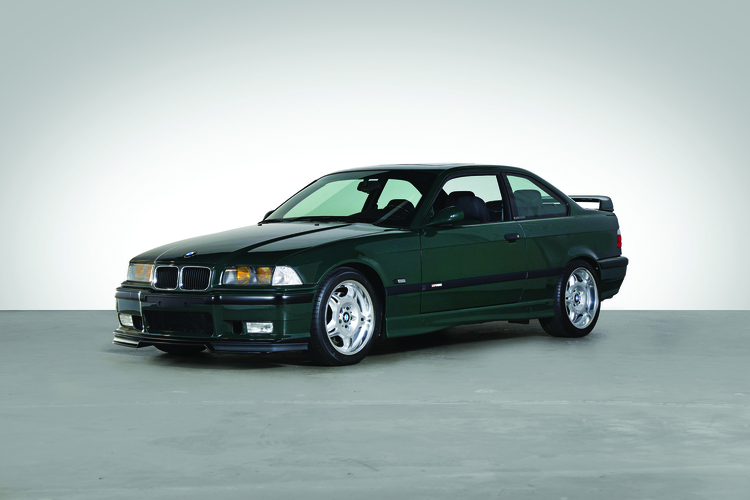
1995 BMW E36 M3 GT
VIN#: EA40319
ENGINE 3.0-liter S50B30 inline six-cylinder
OUTPUT 295 hp @ 6000 rpm, 238 lb-ft @ 3900 rpm
TRANSMISSION 5-speed ZF manual
CURB WEIGHT 2976 lbs
TOP SPEED 137 mph
BUILD DATE May 1995
COLOR British Racing Green
OWNER EVO MotorWerke
OWNED SINCE N/A
LOCATION Cincinnati, OHIO
How do you follow a legend? With the E36 M3, BMW aimed its freshly minted enthusiast nameplate at a broader mass market, turning a niche homologation special into a people-pleasing volume-seller.
And yet: Munich knew that racing was key to the M3 mythos. To keep selling, the M3 had to keep winning. Enter the E36 M3 GT.
Just 356 GTs were built, and each existed to homologate the E36 M3 for FIA and IMSA GT-class competition. All were coupes. The model was built exclusively for the German market, though many trickled out of the country into Europe, Japan, and America. Like many limited-run M3s, the GT was sprayed in just one color: an elegant, menacing shade of British Racing Green.
Power came from an uprated version of the European M3’s S50B30 3.0-liter straight-six. Thanks to more aggressive camshafts, an increased compression ratio, and a host of other tweaks, the engine offered 295 hp. That output represented nearly 100 hp per liter of displacement, a figure that left the GT lurking outside the figurative living-room window of contemporary Ferraris, ready to go full ‘90s slasher flick. Perhaps more important, the output gave the model a level of potent charisma unlike any M3 before it. (According to BMW, the GT’s 24-valve six made more power at idle than the E30 M3’s 16-valve four had at redline.)
Still, it wasn’t all an M Power Play. In building the GT, BMW’s engineers carved some 66 pounds from the ordinary M3, packing in aluminum doors and a host of other weight-saving measures. The coupe’s exterior mirrored its interior, with seats clad exclusively in Mexico Green Nappa leather, a shade unavailable on the standard car. A smattering of unmistakable but under-the-radar visual flair further separated the model—“Lightweight” alloy wheels, a jutting front splitter, and a high-rise rear wing.
It’s hard to imagine someone doubting that BMW could follow up one legendary homologation special with another. Still, the GT was built to quiet the doubters. And so it did.
-
1987 BMW E30 M3
-
1989 BMW E30 M3
-
1990 BMW E30 M3
-
1990 BMW E30 M3
-
1991 BMW E30 M3
-
1992 BMW E30 M3
-
1995 BMW E36 M3 GT
-
1995 BMW E36 M3
-
1995 BMW E36 M3
-
1997 BMW E36 M3
-
1999 BMW E36 M3
-
2001 BMW E46 M3 GTR
-
2003 BMW E46 M3
-
2003 BMW E46 M3
-
2009 BMW E92 M3 GT
-
2011 BMW E92 M3 GTS
-
2012 BMW E92 M3
-
2013 BMW E92 M3
-
2014 BMW F82 M4
-
2015 BMW F82 M4
-
2016 BMW F82 M4
-
2020 BMW F82 M4
-
2023 BMW G82 M4
-
2023 BMW M3 G80
-
2024 BMW G80 M3