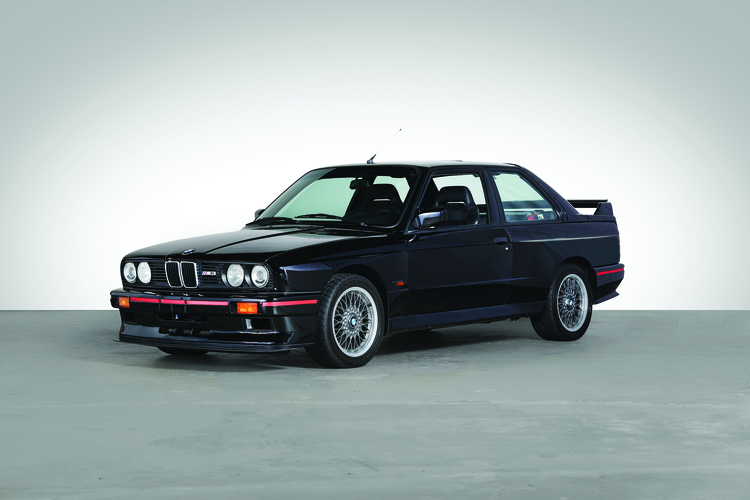
1990 BMW E30 M3
Sport Evolution
CHASSIS#: AC79306
ENGINE 2.5-liter S14B25 four-cylinder
OUTPUT 238 hp @ 7000 rpm, 177 lb-ft @ 4750
TRANSMISSION 5-speed Getrag manual
CURB WEIGHT 2646 lbs.
TOP SPEED 155 mph
BUILD DATE February 1990
COLOR Black
OWNER Scott Hughes
OWNED SINCE 2017
LOCATION Sunset, South Carolina
At first glance, this 1990 M3 looks like any other E30. Then the details pop. There’s a red stripe on the bumpers. The wheels are slightly larger. It sits a little lower. The fog lights have been replaced by ducts. And the rear wing is adjustable.
This isn’t just an M3: It’s a Sport Evolution, one of just 600 built in 1990, the model’s only year. The Sport Evo was the last of the E30’s Evolution variants, and while a series of more developed M3s were a gift to the driving public, they were also necessary for motorsport regulations.
To get the E30 M3 approved for FIA Group A touring-car competition, BMW had to build a minimum of 5,000 examples over the course of 12 months. However, in order to evolve the cars that went racing—if M engineers wanted to improve things like aerodynamics or the powertrain—the FIA required that BMW build at least 500 regular-production examples with the desired changes. The Sport Evolution was the third and most comprehensive overhaul, featuring more displacement and the greatest jump in power.
The ordinary M3’s 2.3-liter S14 four was bored out to 2.5 liters, helping output rise to 238 hp at 7,000 rpm—around 40 hp more than the standard M3. (Torque dropped slightly, to 177 lb-ft at 4,750 rpm.) The reworked suspension features upgraded shocks, stiffer springs, and 16-inch wheels. Even the glass is lighter.
Other additions include adjustable aerodynamics front and rear, with a multi-position splitter and a three-position adjustable rear wing. BMW dubbed the Sport Evo’s low-downforce configuration “Monza,” the middle choice “Normal,” and the most aggressive one “Nurburgring.”
Scott Hughes purchased this Sport Evo in 2017, and he’s been enjoying it ever since.
“From the turn of the key, this is a different E30 M3,” Hughes says. “The 2.5-liter sounds different, feels different, responds better; it’s exactly what the final interpretation of this legendary BMW should be.”
“It’s fun to point out the many differences between the original and the SE. Though, interestingly, explaining those things doesn’t [tell you] how different the car feels and drives. It has to be driven.”
-
1987 BMW E30 M3
-
1989 BMW E30 M3
-
1990 BMW E30 M3
-
1990 BMW E30 M3
-
1991 BMW E30 M3
-
1992 BMW E30 M3
-
1995 BMW E36 M3 GT
-
1995 BMW E36 M3
-
1995 BMW E36 M3
-
1997 BMW E36 M3
-
1999 BMW E36 M3
-
2001 BMW E46 M3 GTR
-
2003 BMW E46 M3
-
2003 BMW E46 M3
-
2009 BMW E92 M3 GT
-
2011 BMW E92 M3 GTS
-
2012 BMW E92 M3
-
2013 BMW E92 M3
-
2014 BMW F82 M4
-
2015 BMW F82 M4
-
2016 BMW F82 M4
-
2020 BMW F82 M4
-
2023 BMW G82 M4
-
2023 BMW M3 G80
-
2024 BMW G80 M3