Green Line Cafe
Before the second half of the tour, here is some brief history to contextualize the “planned” revitalization led by Penn. Founded in Old City in 1749, the University of Pennsylvania relocated the campus to its current location in West Philadelphia in 1871. Penn expanded quickly to the north and the west as a neighborhood-unfriendly, fortress-like, perimeter-enclosed campus in the Urban Renewal era. Meanwhile, the area’s buildings experienced increasing dilapidation, and the population was declining.
In the 1980s, the disconnection between the university and the neighborhoods was apparent. According to Judith Rodin, the university’s former President, “Penn had not made the upgrading of the surrounding neighborhoods a significant institutional priority in the 1980s. . . Many of the university’s investment and development decisions over the decades had created new barriers between Penn and the adjacent communities.” (Rodin, 2005)
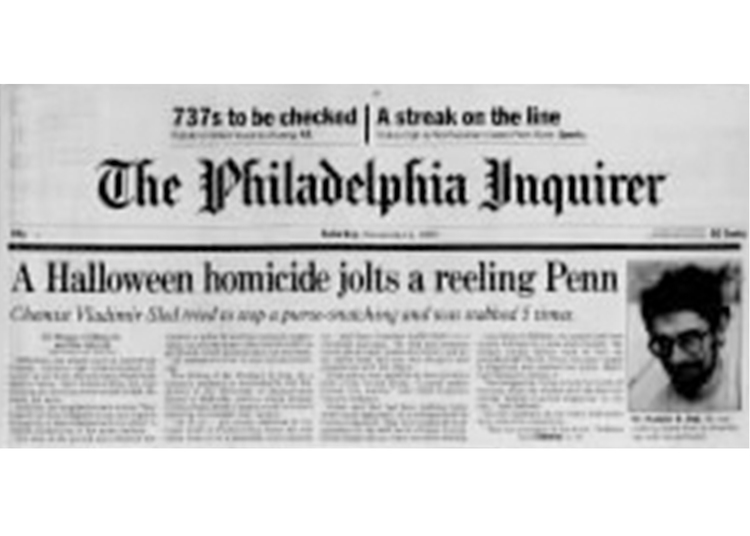
However, as crimes around the campus reached to a peak in the 1990s, Penn recognized the importance of improving the neighborhood and came up with the West Philadelphia Initiatives (WPI) under the premise that “for Penn to flourish academically, our neighborhood had to flourish as well.” (Rodin, 2005) WPI was a five-pronged strategy:
1. “Making the neighborhood clean, safe, and attractive, with a variety of new interventions.
2. Stimulating the housing market.
3. Encouraging retail development by attracting new shops, restaurants, and cultural venues that were neighborhood friendly.
4. Spurring economic development by directing university contracts and purchases to local businesses.
5. Improving the public schools.”(Rodin, 2005)
Figure 7. A research associate at Penn was stabbed to death on Larchwood Street and 43rd. © The Philadelphia Inquirer, Nov. 2nd, 1996. https://www.newspapers.com/newspage/178362696/
Source:
Rodin, J. (2005). The 21st century urban university: New roles for practice and research. Journal of the American Planning Association, 71(3), 237-249.
-
Natural Mangrove Lagoon Stop #1
-
Stingray Cove Stop #2
-
Caribbean Spiny Lobster Stop #3
-
Nursery Exhibit Stop #4
-
Big Shark Bay Stop #5
-
Tide Pool Touch Tank top #6
-
Everglades Area Stop #7
-
Alligator Exhibit Stop #8
-
Freshwater Fish Exhibit Stop #9
-
Freshwater Turtle Exhibit Stop #10
-
Lionfish Exhibit Stop #11
-
Predator Reef Tank Stop #12
-
Coral Reef Tank Stop #13
-
Deep Water Isopod Exhibit Stop #14