Cornerstone
HOUSING:
Penn’s effort on the housing market is threefolds. First, the university offered mortgage reduction assistance to encourage homeownership in the area by Penn employees. As both housing developer and source of housing subsidy, Penn spent much effort to promote homeownership in the neighborhood. The purpose was to establish a stable base of homeowners for the neighborhood’s long-term viability. Penn is providing forgivable loans and closing cost reductions to those who will live in the University City area. Today, the subsidy footprint has expanded beyond West Philadelphia to include parts of Overbrook and Wynnfield.
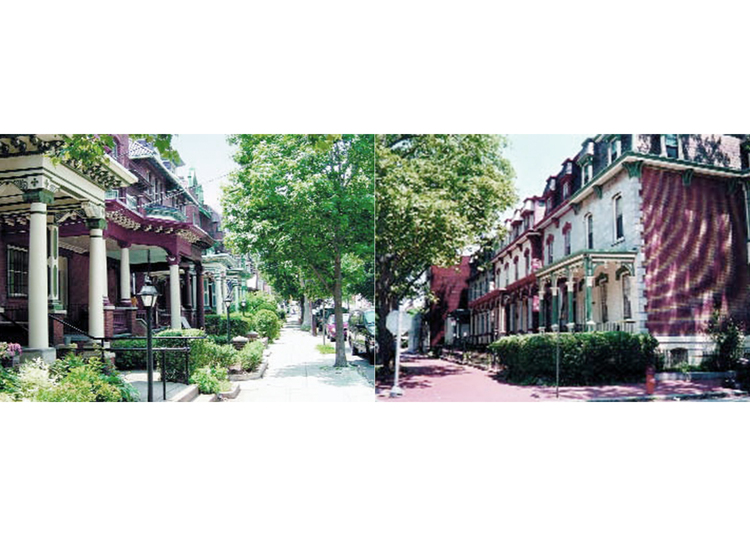
Second, the university improved the buildings in poor conditions. Through the Vacant House Rehabilitation program, Penn acquired, renovated, and sold 20 vacant houses in strategic spots. Instead of pursuing profit, these projects were intended to stimulate and restore the real estate market’s confidence. According to John Kromer and Lucy Kerman, “this experience demonstrates how the transformation of a blighted property into a valued new asset may have a substantial “ripple” effect in stimulating the improvement of adjacent or nearby properties.” (Kromer & Kerman, 2005) Meanwhile, Penn also acquired and renovated five apartment buildings for rental, including the Cornerstone at Pine Street and 48th Street.
Third, Penn attracted private developers to invest in the neighborhoods. Exemplary projects include the Hub at Chestnut Street and 40th Street, the Radian at Walnut Street and 40th Street, and luxury apartments such as Domus and Left Bank. Later on in this tour, you will see some of the Walnut Street properties.
Kromer and Kermand also note that “by the end of the decade, the market had grown strong enough to attract developers to acquire, rehabilitate, and sell vacant houses on their own, without special program intervention.”
Figure 8. Houses renovated by Penn. © John Kromer and Lucy Kerman
Source:
Kromer, J., & Kerman, L. (2005). West Philadelphia initiatives: A case study in urban revitalization: University of Pennsylvania, Fels Institute of Government.
-
Natural Mangrove Lagoon Stop #1
-
Stingray Cove Stop #2
-
Caribbean Spiny Lobster Stop #3
-
Nursery Exhibit Stop #4
-
Big Shark Bay Stop #5
-
Tide Pool Touch Tank top #6
-
Everglades Area Stop #7
-
Alligator Exhibit Stop #8
-
Freshwater Fish Exhibit Stop #9
-
Freshwater Turtle Exhibit Stop #10
-
Lionfish Exhibit Stop #11
-
Predator Reef Tank Stop #12
-
Coral Reef Tank Stop #13
-
Deep Water Isopod Exhibit Stop #14