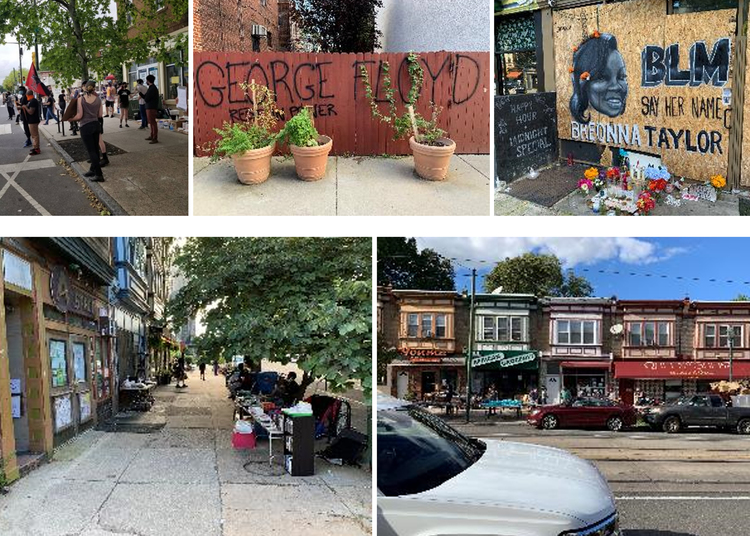
Pandemic and protest
As walking up 43rd Street from the beginning, you will see the change of the streetscape, caused by the pandemic and protest. For example, Milk & Honey Market at 4435 Baltimore Avenue was closed this summer because the owner and the employees disagreed on salary and the working environment during the pandemic. While many owners claimed their support to BLM, some stores along Baltimore Avenue experienced physical destruction during the protest. Such support and damages could be observed along the first half of the tour. After the pandemic, some residents also set up informal markets along Baltimore Avenue, such as the sidewalk between the church and the A-Space, and between South Melville Street and 45th Street.
Summary of Part 1
Key Questions to Consider for:
1. Who is running the shops and institutions?
2. Who is patronizing the establishments along Baltimore Avenue? To meet what needs?
3. What or whom has been lost/displaced to make way for these current uses?
4. What forms of revitalization have we seen so far?
5. Is Baltimore Avenue healthy gentrification or not? For whom?
Through the first half of the tour, it is hard to see evidence of displacement at just one point in time, but we can see a clear African & Southeast Asian commercial revitalization pattern. Africans and Asians lived here in the 1980s, moved a bit further out in the 1990s as rents rose. Coffee shops, local food specialty stores, and high-end uses west of 48th Street are evidence of recent gentrification since the 2000s.
Baltimore Avenue is a good example of the diversity of drivers and forms of revitalization and gentrification. It is generally representative of national patterns in inner cities since at least the 1990s. The resident-owned shops reflect individual households’ choices to stay or move into the city. Some people’s preference for suburban residence declined, and preference for city residence grew. There are not so many empty nesters, while some certainly exist. Since the 1990s, immigration increased and became national, beyond New York, Chicago, and the Southwest. Together with the artists, they were the “pioneers” moving into neighborhoods.
Along with the unplanned revitalization, we also notice the mild interventions by the business improvement districts such as UCD. The façade and streetscape improvements and safety/patrolling programs are crucial parts of the “invisible” planned revitalization. We will explore more obvious projects, primarily led by Penn, in the second half of the tour.
Figure 6. Top left: Milk & Honey employees protesting. © milkandhoneyworkersunited. https://www.instagram.com/milkandhoneyworkersunited/?hl=en;
Top right: BLM graffiti. ©Boqian Xu; Bottom: Informal street market. ©Boqian Xu
Source:
https://www.inquirer.com/food/milk-honey-market-west-philadelphia-closed-workers-health-coronavirus-20200601.html
https://milkandhoneytogo.square.site/
-
Natural Mangrove Lagoon Stop #1
-
Stingray Cove Stop #2
-
Caribbean Spiny Lobster Stop #3
-
Nursery Exhibit Stop #4
-
Big Shark Bay Stop #5
-
Tide Pool Touch Tank top #6
-
Everglades Area Stop #7
-
Alligator Exhibit Stop #8
-
Freshwater Fish Exhibit Stop #9
-
Freshwater Turtle Exhibit Stop #10
-
Lionfish Exhibit Stop #11
-
Predator Reef Tank Stop #12
-
Coral Reef Tank Stop #13
-
Deep Water Isopod Exhibit Stop #14